


 The following is a guest post we’re pleased to share by Ilana Cohen, Tim Foster, Aaron Krolikowski and Rob Hope from the Water Science, Policy and Management programme at Oxford University.
Mobile money in Africa offers a promising tool for one of the most enduring and widespread challenges on the continent: the provision of safe water.
The scale of the challenge (and the opportunity) can be seen in the fact that the number of mobile phone subscriptions will exceed the number of people with access to safe drinking water by 2013. At the same time, emerging mobile money options to pay for water services have the potential to increase revenue collection, which is needed for service providers to improve and expand access to water services. On the commercial side, this represents a market in which mobile network operators (MNOs) can potentially build or retain customers to boost transaction volumes, based on regular water consumption patterns.
A research group from Oxford University has evaluated such benefits from mobile water payments in a study of 20 different water service providers across Kenya, Tanzania, Uganda and Zambia. You can read the full report here, and key findings are summarised in two blog posts:
This first post explains the potential value of mobile money to the water sector, and highlights findings of benefits for customers and water service provider (WSPs), with challenges in customer adoption. The second post relates this to commercial interests of MNOs offering mobile water payments.
What mobile money could mean to the water sector’s revenue challenge.
For the water sector in many African countries, mobile money speaks to the key challenge of revenue collection that leaves USD 500 million uncollected a year (equivalent to 0.07% of the continent’s GDP).[i] Poor revenue collection is partly responsible for the fact that 67 million more Africans are without access to safe water in 2008, than in 1990. Infrastructure has simply not kept pace with rapidly growing populations and urbanisation. Unpaid customer bills – averaging up to 40% even among wealthier customers[ii] – cut into operations and maintenance budgets catalysing a vicious cycle of declining services. Such non-payment is unsurprisingly common considering the onerous time and money costs water users usually face when travelling and waiting to make cash payments at limited pay points in underdeveloped regions.
Mobile water payments can potentially bypass these obstacles of cash payments. If the ease of remote payments can enable more timely payments, increased revenue collection should help provide the re-investment needed to improve and expand water services.
Mobile water payments may also be an important tool for those with low or variable incomes, or the unbanked. Mobile money provides a more accessible savings mechanism, and greater flexibility and convenience for making smaller, more frequent payments. For WSPs, mobile payments may reduce administrative costs, or improve accounting of smaller utilities lacking digitised billing systems.
Strong potential benefits and understanding customer adoption
The findings indicate mobile water payments can bring significant customer benefits from time and money savings, and financial benefits to utilities, though customer adoption of mobile payments has been limited in most instances investigated, due to contextual challenges.
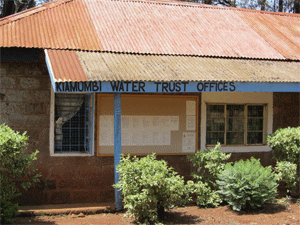
The majority of water service providers investigated have one to ten percent of their customers paying via mobile payments (See Figure 1). Uganda’s National Water and Sewerage Corporation leads this pack with 20,000 (10%) of its customers paying USD300,000 per month in mobile payments. The exception to this group is a small-scale and private service provider in Kiamumbi, Kenya (15 km outside Nairobi) with a 76% adoption rate.
 Figure 1: Key mobile water payment options across the four countries, and their low adoption rates, with the exception of Kiamumbi.
A household survey was conducted in Kiamumbi to assess customer benefits of mobile payments and understand the motivations, and potential barriers to adopting them. Though Kiamumbi and its piped water network are small (nearly 700 connections and 1,000 households), prior to the mobile payment option, customers could only pay by bank deposit. Yet trips to the nearest bank, 4 km away, can require significant time (66 minutes on average for travel and queuing), and money (USD 0.40 for those who take the bus). In comparison, mobile payments provide an 82% time-savings, requiring only 12 minutes on average (where time is sometimes spent topping up at the agent). And the USD 0.20 fee for the mobile payment is half of the cost for the bus trip[iii].
Unsurprisingly, time-savings was the primary reason respondents chose the mobile option, followed by cost-savings (see Figure 2). In contrast, those not switching to mobile payments cited having to make bank trips anyway or not knowing about the option or how to use it. Some households simply didn’t trust the mobile payments, and the absence of paper receipts was another barrier identified by five percent of respondents.
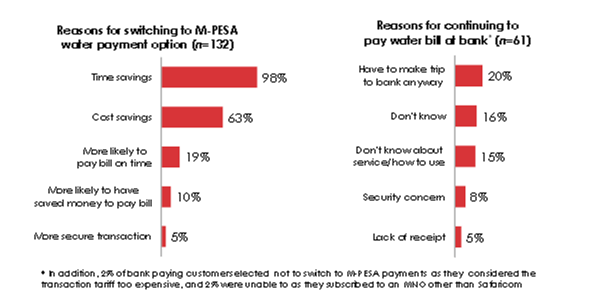 Figure 2: Time and cost associated with bank trip are key drivers of mobile water payment adoption in Kiamumbi.
The other WSPs investigated hypothesized similar reasons why few of their customers had made the switch to mobile. Currently, limited advertising campaigns have failed to increase customer awareness of the option in several instances. Across all scenarios, demand for paper proof of payment has been a likely barrier to adoption.
Two other key adoption barriers are delayed account reconciliation, and the customer fee for mobile payments. In Kenya, some mobile payments options are not integrated in real-time with utility billing systems, causing accidental water disconnections when payments are made at the deadline. Though utilities have mostly addressed this by delaying the generation of disconnection lists, this initial problem may have impacted customer trust in the mobile option.
The fact that Kiamumbi’s adoption rate was still far higher suggests the barriers in these larger service contexts are greater and more complex. (See the full report for other reasons Kiamumbi’s adoption may be higher.) For example, in large urban areas, frequent pay points may make the time-savings of mobile payments less valuable. This could be the case in Dar es Salaam, where a third-party company offers GPRS-enabled points-of-sale at many city-wide locations.
The cost of the mobile transaction may be another barrier to adoption when it exceeds the costs of traditional payment methods or is very high relative to the total billed amount. This could be a particular disincentive for low-income households who might otherwise use mobile payments to pay in more frequent smaller instalments. The variation in this fee across the study, and how it relates to MNO benefits, is considered further in the following post.
Potential benefits to water service providers and the outlook for mobile water payments
Given low water payment adoption rates, there have been limited benefits for WSP collection rates. However, some have identified cost savings related to bill handling and timelier collection of bills: Uganda’s national provider anticipated savings of USD 420,000 per year from reduced insurance and handling costs, after closing payment offices (though payments can still be made at banks) and enabling mobile payments.
WSPs anticipate further savings if mobile payments can reduce accounting errors, and some say they are seeing fewer disconnections attributed to non-payment. In Kiamumbi, billing records show mobile water payments are 10% more likely to be paid on time compared to bank payments. Though proving a definite causal connection is difficult, customers in Kiamumbi do feel mobile payments are improving their ability to pay: half feel less likely to be disconnected since using them, and one in four feel better able to save for water bills.
On the whole, these findings reveal there is strong potential for mobile water payments to benefit customers, providers, and eventually increase water access as providers reinvest greater revenue. However, the evidence shows the current scale of benefits is limited, where operational and behavioural constraints are barriers to adoption. Mobile money can be an important tool in addressing water sector challenges, but ultimately the scale of its impact depends on understanding and addressing these constraints, and the surrounding institutional and regulatory contexts.
Interestingly, MNOs appear to be one driving force behind mobile payments as they compete for more customers in emerging markets, and have in some cases instigated negotiations with water service providers for a mobile payment option. The next post will consider how this dynamic around MNO benefits is playing out in mobile water payments.
If you are attending MWC in Barcelona next week, make sure to join us for a panel on the subject on Monday 27th February from 14.00-15.00 (Hall 5, Room 2)
Smart Metering for Better Access to Energy and Water in the Developing
In this session we hope to investigate how mobile operators can get involved in this smart metering opportunity. Even though the market is still nascent, mobile operators stand to benefit directly from increased ARPU and customer retention. The increased mobile phone penetration and the decreased cost of cellular components are spurring innovation from vendors to develop solutions for a better access to energy and water services in developing countries. Several projects in Africa and Asia have been launched in recent months using smart meters (based on GSM technology) to allow consumers to ‘pay as you go’ for energy and/or water the same way they would top up for mobile airtime. We hope that such innovations will also catalyse further socio-economic development for these communities.
[i] Banerjee and Morella. (2011) Africa’s Water and Sanitation Infrastructure: Access, Affordability and Alternatives. The international Bank for Reconstruction and Development/The World Bank: Washington DC.
[ii] Banerjee et al. (2008) Access, Affordability and Alternatives: Modern Infrastructure Services in Africa. Africa Infrastructure Country Diagnostic. The international Bank for Reconstruction and Development/The World Bank: Washington DC.
[iii] Note that these are raw costs, where the averages presented in the full report consider the complexities of multiple transport modes.