


In an article published last month, we discussed what people use mobile money for and which products were most popular. Today, I will try to answer the following question: what are the key factors currently driving success in mobile insurance?
In this year’s State of the Industry report, for the first time, MMU looked at the state of mobile insurance [i]. The MMU Deployment Tracker reveals 84 live mobile insurance services, 16 of which launched in 2013. In addition, 8 Global Adoption Survey respondents reported they were planning to launch mobile insurance in the next twelve months. The regions where mobile insurance has been most popular (in terms of number of policies initiated) are Sub-Saharan Africa and South Asia.
Opportunities for mobile insurance
Anyone in the insurance industry would tell you that the distribution and administration of insurance is an expensive proposition. When it comes to low-income households, traditional ways to deliver insurance is prohibitive as the costs involved in the sales, underwriting, collection and administration of insurance claims doesn’t decrease proportionately with the policy. Thus, there is a large gap between those who are covered and those who are not, based on income levels, and as a result a huge opportunity for players to use mobile technology to capitalise on the need for effective, low cost and simple insurance.
Despite the potential, the low-income segment is a difficult market to capture. A well-known saying in the insurance industry is “insurance is sold, not bought.” This is especially true in low-income segments where customer product awareness is low and this is why providers must invest heavily in customer education to explain how an insurance policy could benefit a customer.
False starts
A number of players have tried to enter this mobile insurance space, and their failures have highlighted the importance of getting the commercial and partnership model right. Services can achieve scale rapidly but can also fail just as quickly as 7 mobile insurance services that were launched have since either closed or merged. Despite these false starts, there is still strong interest in exploring the mobile insurance opportunity and this has resulted in the emergence of third-party implementing partners with specific expertise in scaling micro-insurance.
Which mobile insurance products are most popular?
Life cover seems to be the most popular product, with over three quarters (76%) of mobile insurance services in our sample offering life cover, demand is high. However, for life insurance policies to be successful, terms and conditions need to be easy to understand to ensure increased customer confidence in the product. The other 24% provide health insurance, accident coverage, or agricultural insurance.
With a view to simplify non-life products, some mobile insurance providers are innovating in the use of data collection to automatically pay out claims via mobile money. For example, Killimo Salama, a micro-insurance program for farmers in Kenya, has developed a system whereby they pay out based on weather conditions. The local weather conditions are monitored by specially set-up weather centres which collect data about the weather using automated, low-cost technology. These types of automated, low-cost, technology services give customers confidence in the claim process and are likely to have quick market uptake.
What are the business models for mobile insurance?
Mobile insurance can be offered either where customers pay a premium for the service or as a loyalty reward for mobile customers. Our survey found 48% charge a premium, whereas 52% of providers offer mobile insurance free in return for meeting certain airtime usage levels. In addition customers who receive free cover, can choose to increase their cover by paying a premium and this is known as a freemium model.
How do customers sign up and pay for mobile insurance premiums?
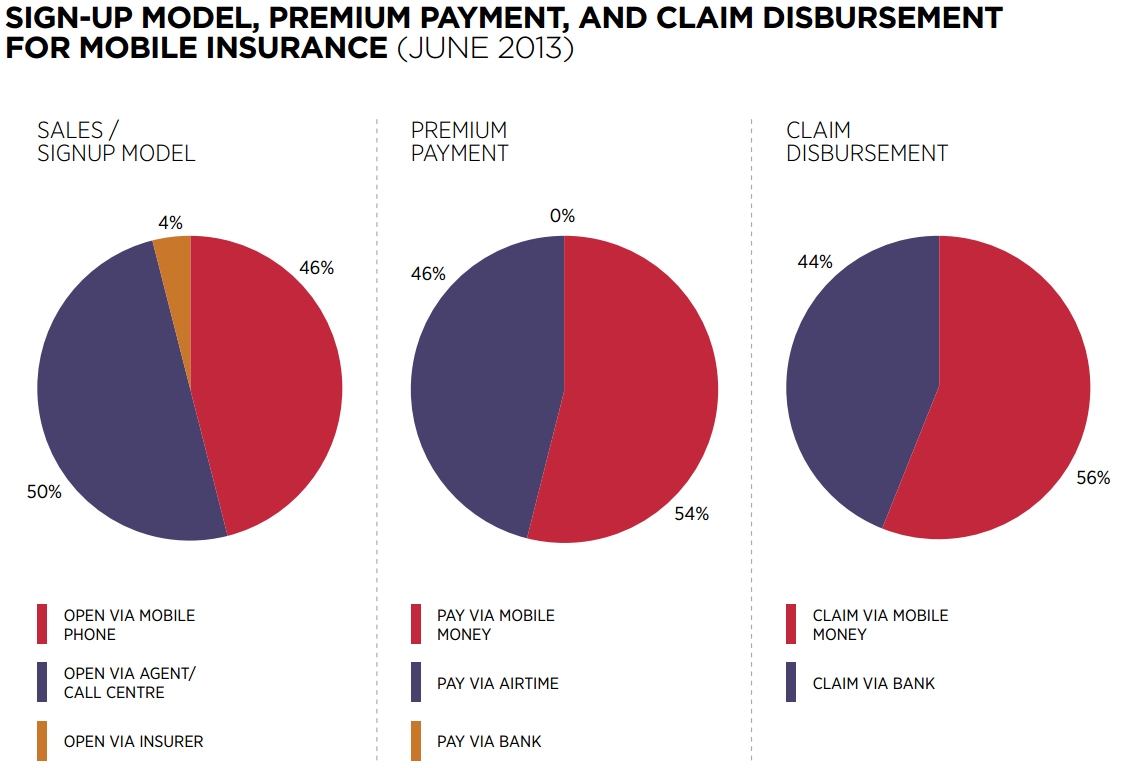
Based on the data from our 2013 Global Adoption Survey, we found that 46% of mobile insurance services allow subscribers to sign up for their policy using their mobile. A further 50% of services allow customers to sign up over the phone with a call centre operator, and just 4% of services allow customers to sign up via dedicated agents.
For those customers that made premium payments to upgrade their insurance policies, 54% of services allow them to use their mobile wallets, and the other 46% of services use airtime wallets, to receive insurance policy payments.
In terms of claims disbursement, the survey found that 56% of mobile insurance providers are paying-out claims via mobile money wallets, and the other 44% are using airtime wallets to disburse payments.
Conclusion
It is early days for mobile insurance, but looking at the first successful services reveals three key factors that are currently driving success:
- The ability to automatically debit, at set intervals, an account that is likely to have an active balance (an airtime wallet rather than a mobile money wallet);
- Offering mobile insurance in partnership with insurers and third-party implementing partners with specific expertise in micro-insurance; and
- Employing a “freemium” model whereby customers are given free insurance in exchange for loyalty to the MNO and given the option of upgrading to a more robust paid policy with additional features or coverage.
Download the 2013 State of the Industry Report & presentation slides
Download the recent ‘Promising Starts in Mobile MicroInsurance: Tigo Senegal and Telenor Pakistan’ case study
[i] Insurance is defined as an arrangement by which a company or the state undertakes to provide a guarantee of compensation for specified loss, damage, illness, or death in return for payment of a specified premium. Mobile insurance provides insurance via a mobile phone.