



Quantum Technologies
Quantum technologies enable smarter design, stronger security and the next generation of network services. Discover the current landscape, future timelines, and the transformative potential across telecoms and the digital ecosystem.
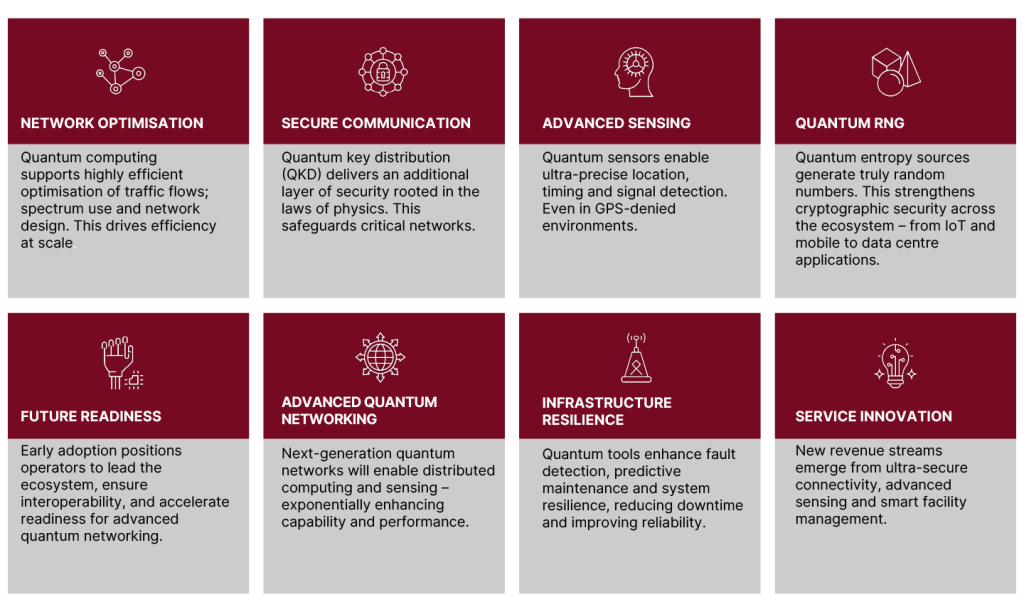
Quantum technologies are set to redefine how networks are built, secured and scaled. Quantum innovation is now moving from theory to reality, with far-reaching implications for networks and the broader digital ecosystem. They work at the atomic and sub-atomic level – where physical systems can exist in multiple states at once or become linked across distance – they enable smarter design, ultra-efficient optimisation, next generation encryption, and entirely new services and revenue streams.
Our initiative explores the state of quantum computing, communication and sensing and its value to the wider telecoms community. We provide insight into maturity curves, likely implementation timelines, and what they could mean for the resilience and industry competitiveness. Here, the crucial question is not if, but when, and how quickly the industry can seize the advantage.
The role of quantum technologies in telecoms
Key quantum technologies

Quantum computing
Solving complex optimisation challenges to build the networks of the future
Quantum communication
Today’s ultra-secure information exchange, tomorrow’s quantum internet

Quantum
sensing
Unprecedented precision throughout the network
Quantum Technologies resources and events

GSMA intelligence Report

Quantum Technologies: Telecom Use Cases

Get in touch
Want to explore how GSMA Quantum Technology initiatives can help you prepare for the next wave of secure, efficient, and future-ready networks?
FAQs
How do quantum technologies work?
They work by harnessing the unusual behaviours of particles at the atomic and sub-atomic level.
Unlike classical systems that process information in binary (0s and 1s), quantum systems use qubits, which can exist in multiple states at once (superposition) and become linked across distances (entanglement). These properties allow quantum computers to efficiently search for optimal solutions, quantum communication to secure data with the laws of physics, and quantum sensors to measure with unmatched accuracy.
In essence, quantum turns the ‘strangeness’ of physics at the smallest scale into powerful tools for computing, communication and sensing, with the potential to transform how networks are designed, secured and managed.
What are the main drivers of quantum technology for telco?
The main drivers of quantum technology in telecoms are efficiency, security, and innovation.
Network optimisation: Quantum computers can solve complex optimisation problems, improving routing, outage impact analysis, and calibration of key network infrastructure - reducing costs, boosting performance, and offering improved reliability.
Next-generation security: Quantum communication enables powerful new tools for securing data, strengthening encryption, and authenticating users and devices at the highest level of trust.
New services and revenue streams: Across the three pillars of computing, communication, and sensing, quantum technologies offer opportunities for advanced enterprise solutions, from timing services and smart facility management to infrastructure monitoring and quantum computing as a service.
Future readiness: Early exploration helps operators influence standards, shape ecosystems and avoid being left behind as governments and enterprises adopt quantum technologies.
In short, quantum offers operators a way to future-proof networks while unlocking competitive advantage.
Could post-quantum cryptography be considered a quantum technology?
While post-Quantum Cryptography (PQC) is part of the wider quantum conversation, there is an important distinction. Unlike quantum computing, communication or sensing, PQC does not use quantum physics directly. Instead, it develops new cryptographic algorithms that can withstand the power of future quantum computers. These algorithms are designed to replace today’s public-key cryptography systems, which could be broken once sufficiently large quantum computers become available.
Therefore, PQC and quantum technologies play different roles. While quantum key distribution (QKD) leverages the laws of physics to provide information-theoretic security, PQC ensures classical networks and systems remain secure in a quantum-enabled world. For the telco ecosystem, both approaches are relevant: PQC offers practical protection that can be deployed at low cost on existing infrastructure, while QKD and other quantum-native methods offer an additional physical security layer and contribute to the development of tomorrow’s quantum communication networks.
In a nutshell, what do quantum technologies mean for mobile network operators?
Quantum technologies give operators new tools to build smarter, more secure, and more resilient networks.
Crucially, they can optimise performance and improve reliability. They enable ultra-secure communication and support precise sensing for infrastructure and services. Together, these capabilities create new efficiencies, unlock enterprise services, and strengthen the operator’s role in the digital ecosystem.