


Women in Pakistan remain significantly under‑represented in formal finance and the digital economy. Only 12% of the women are banked as opposed to 42% men in the country. Deep gender gaps in account ownership, digital access and economic participation mean that the coming wave of AI-driven financial services risks amplifying existing inequalities unless we act now. For a deep dive into numbers, please refer to GSMA’s mobile gender gap report 2025, Karandaaz Financial Inclusion Survey (K-FIS) and World Bank’s Pakistan Development Update Report April 2025.
According to State Bank of Pakistan (SBP) targets and national diagnostics, Pakistan launched the Banking on Equality agenda in 2021 precisely because women are disproportionately under‑served by the financial system and require targeted policy measures to close the gap. The global and regional evidence is clear1: without sex-disaggregated data, fairness testing and deliberate design, AI models reproduce historical bias instead of expanding opportunity.
When I opened the doors of WIN2 Incubator – Pakistan’s Micro Finance Industry’s First Women Incubator – at Mobilink Bank a year ago, I didn’t expect a single neat narrative to emerge. I expected messy, brave entrepreneurship: mothers building home‑based supply chains, young women quietly scaling cosmetic micro‑brands via social media platforms. What arrived in the First Cohort surprised me: ambition, humility and grit! This was further amplified in Cohort Two where I saw a wave of founders embedding AI into their business models. Currently, ten of our startups are embedding AI into their business models.
That pivot, from analog resilience to digital ambition, is the hinge on which financial inclusion and gender justice can swing. To make that hinge real, the WIN Incubator functions as a practical lab where women founders pilot ideas, generate women-specific data signals, and graduate with stronger business plans, market connections, clearer pathways to finance, and the operational confidence to scale. Over the course of the year, we have graduated more than 30 startups. More than a training programme with access to network and finance; WIN is a living dataset and a talent pipeline: graduates feed the bank’s product and R&D teams so those teams reflect the
customers they serve. This practical laboratory is what makes WIN not just an incubation success, but a strategic lever for Mobilink Bank’s women-first AI ambition.
Examples of promising WIN start-ups embedding AI into their business models are:
- Neuroticure is a mental health startup leveraging data science and digital tools to provide accessible, personalized care for anxiety and depression to bridge gaps in mental healthcare through innovative, tech-driven solutions.
- Ecolight AI is a green-tech startup building smart, solar‑integrated lighting that uses AI and IoT to make urban spaces safer and energy‑efficient, enabling small local installers to predict demand and manage inventory.
- Ecogen is an AI-powered smart recycling solution turning organic food waste into valuable resources while tracking carbon reduction. It empowers communities to fight climate change through sustainable waste management and climate rewards.
These startups may still be in the early days of AI, but what sets them apart is that they’re being led by women founders. Women founders, by design, are more likely to embed gender-disaggregated data into their models, reducing bias at the very foundation of their technologies. This not only makes their solutions more inclusive but also creates a powerful multiplier effect for the communities they serve.
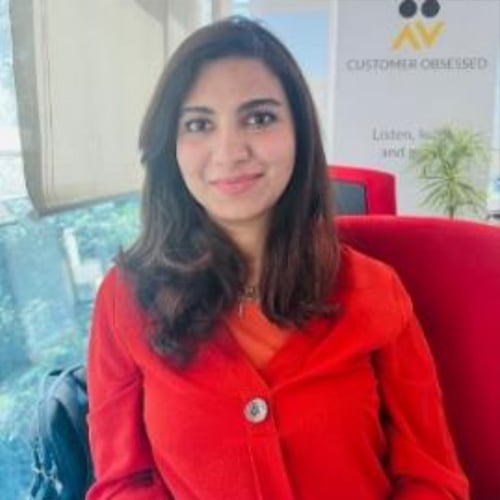
This is my story as the Head of Strategy & Sustainability at Mobilink Bank: of building the Micro-Finance Industry’s first incubator for women micro‑entrepreneurs, of leaning into the Central Bank’s gender agenda, of translating the lessons learnt into inclusive AI by advocating for credit scoring models that recognize women’s realities, datasets that capture gendered nuances, and digital tools that don’t just enable women entrepreneurs but embed them in the digital footprint, amplify their reach and ripple impact across communities rather than gatekeeping inequality.
The policy moment in Pakistan is unambiguous. The Central Bank’s ‘Banking on Equality’ framework sets clear operational targets – from workforce gender ratios to active women digital accounts – and positions sex‑disaggregated monitoring as a governance requirement. Mobilink Bank leaned into this policy direction early on. For the last two years, Mobilink Bank has consistently topped Banking on Equality metrics. Earlier this year, the Bank also become a signatory for the Women Entrepreneurs Finance Code (WE Finance Code), committing to
expand credit and products for women entrepreneurs and to adopt gender‑disaggregated data practices. These steps are not symbolic. They rewire incentives, embed measurement and create the preconditions for responsible, inclusive AI.
Across the Asia Pacific, regulators and industry leaders are learning a hard lesson: innovation without governance often amplifies existing inequalities. Banks are the natural stewards of fairness because they hold three crucial assets – trust, distribution and data. But those assets carry responsibility. If banks apply AI to underwriting using male‑skewed histories or incomplete samples, they risk automating exclusion. A practical solution to this problem is simple to its core: measure sex‑disaggregated baselines, collect representative data, adopt fairness‑aware algorithms and deploy human oversight and remediation.
Globally, there are already early signs of how gender-disaggregated data can be embedded into AI models in banking. Lendingkart in India3, for instance, applies machine learning to alternative datasets such as GST filings, bank statements, and e-commerce sales to underwrite small businesses. In partnership with Women’s World Banking, its models were stress-tested for gender bias, leading to adjustments that ensured women-owned enterprises were not systematically disadvantaged. Similarly, TymeBank in South Africa4 has deployed AI-enabled credit scoring and Buy Now Pay Later (BNPL) models that draw on transaction flows, mobile usage, and behavioural data. Working with CGAP, the bank conducted gender-disaggregated audits of these models, re-
weighting risk predictions to improve access for women while maintaining portfolio quality. BBVA5 in Spain and Mexico has gone further by embedding gender fairness testing into its AI-driven credit risk engines. In collaboration with Women’s World Banking, BBVA reviewed how approval thresholds and repayment predictions differed for men and women and adjusted its models to expand lending to women entrepreneurs without raising default risk.
When I write of Mobilink Bank, I include JazzCash’s 50 million‑strong customer base: a distribution advantage that can make inclusive AI not just possible, but scalable. Here are the five priority actions that Mobilink Bank can take going forward based on the global use cases shared earlier.
- Mobilink should embed gender tagging across every dataset, dashboard, and AI model lifecycle. This ensures systemic visibility of women customers and prevents their exclusion right at the source.
- Mobilink should collect more women-specific data through pilots with women micro-entrepreneurs and JazzCash merchants. If gaps remain, synthetic data can be used carefully, only to make sure women’s realities are reflected, not distorted.
- Lendingkart showed how proxies like invoice payments and cash-flow patterns improve AI underwriting. Mobilink can localize this by testing proxies like airtime top-ups, bill payments, and JazzCash usage. Fairness checks should validate that predictive performance is consistent across men and women, reducing the risk of proxy bias.
- AI should not make the final call on its own since Pakistan is still in an early stage of AI adoption. There should always be a human-in-the-loop. Mobilink can set up a process where loan applications flagged by AI for rejection are reviewed by staff. Instead of a hard “no,” women could be offered alternative pathways such as smaller starter loans, financial coaching, or another pathway to build trust.
- Mobilink can convene a cross-functional committee on a quarterly basis with a majority of women representation across product, risk, customer experience and sustainability to continuously review AI models through a women-first lens.
Bringing women into the AI and digital finance economy is an economic multiplier: it creates jobs, raises household welfare and strengthens resilience. Mobilink Bank has the regulatory alignment, the distribution reach, and a testbed in the WIN Incubator to begin exploring this journey. The next step is careful experimentation – piloting, validating, and learning – before moving to scale. Done right, this disciplined approach will make ‘Creating a Women-First AI Moment’ possible: turning gender data gaps into verifiable digital value for women and the wider economy.
The author is Senior Vice President, Strategy & Sustainability at Mobilink Microfinance Bank. The views expressed in this article are the author’s own and do not necessarily represent those of Mobilink Microfinance Bank.