



The Jobs That Disappear First Will Be Ours
Women, the AI economy, and the choice between disruption that erases and disruption that empowers
ABSTRACT
The AI economy will create 170 million new jobs by 2030, according to the World Economic Forum Future of Jobs Report. It will also destroy 92 million. The mathematics look reassuring – a net gain of 78 million. But mathematics conceals a distributional injustice: the jobs most likely to disappear first are the ones disproportionately held by women. This research piece draws on frontline experience as a sustainability consultant at Tata Consultancy Services – including work on AI powered project – alongside global data from the IMF, WEF, GSMA, and Brookings to examine what the AI economy is doing to women’s work, what it could do differently, and why the window for change is closing faster than most institutional forecasts acknowledge.
There is a statistic I return to often. Brookings Institution research finds that 79% of employed women in the United States work in jobs at high risk of automation – compared to 58% of men. Among those in the highest risk categories with the least capacity to adapt, 86% are women.¹ Read that again. Not ‘more women than men are affected’. Not ‘women face elevated risk’. Eighty-six per cent.
This is not an American story. It is a global pattern with particular urgency in Asia-Pacific, where women’s participation in formal digital employment is already structurally constrained. The GSMA’s Mobile Gender Gap Report 2025 finds that 945 million women in low- and middle-income countries (LMICs) still lack smartphones – 230 million fewer than men – and that literacy and digital skills remain the top barrier to mobile internet adoption for women who are aware of it but not yet online.² The workers who will be most harmed by AI-driven automation are, in large part, women who are not yet sufficiently inside the digital economy to benefit from it. And the AI is coming for them anyway.
I write this as a sustainability consultant at TCS, currently working on one of the most technically intensive
energy transition regulatory sandbox projects,⁹ wherein we have an AI powered platform serving as the
intelligence layer for it. I am also a former educator who built and led programmes at Singapore Management University – a career spent enabling transformation in people, not just in organisations. That dual vantage point, across systems and humans, is what I bring to this question. And from that vantage point, I want to be direct: we are running out of time to choose which kind of disruption this will be.

01 The Layoff Math That Doesn’t Add Up
The headline from the World Economic Forum’s Future of Jobs Report 2025 sounds almost optimistic: 170
million new jobs created, 92 million displaced, a net gain of 78 million by 2030.³ The IMF’s analysis adds
texture: roughly 40% of global employment is exposed to AI, rising to 60% in advanced economies.⁴ Goldman Sachs models suggest that approximately 300 million full-time equivalents worldwide will be affected by generative AI – with displacement for some, augmentation for others.⁵
But every ‘net positive’ narrative in AI employment research contains a hidden assumption: that the people who lose jobs and the people who gain them are in the same demographic. They are not. They are frequently not in the same country. They are almost never the same gender.
The jobs being automated most aggressively – data entry, administrative coordination, clerical processing,
customer service, back-office operations – are the jobs that women worldwide entered in large numbers
precisely because they were accessible: no capital requirement, relatively flexible hours, available in cities
and towns, with paths to stability that did not require elite credentials. AI is not just taking those jobs. It is
taking the on-ramp.
McKinsey research published in early 2026 found that women’s representation in European tech roles fell
from 22% in 2023 to 19% in 2026, with many AI-era layoffs concentrated in roles disproportionately held by women.⁶ In India, only 18% of young women aged 20–29 are in paid work, compared with 79% of young men – despite near-parity in higher education.⁶ As AI reshapes entry-level employment structures, the ladder that women were just beginning to climb is being removed while they are on it.
“The net job creation numbers are real. The distributional injustice underneath them is also real.
We cannot resolve a gender gap by counting gains and losses in aggregate when the gains go to
some people and the losses go to others.”
02 The Two Economies: Risk and Opportunity, Mapped by Gender
It is useful to be concrete about which jobs are shrinking and which are growing, because the picture is not uniformly bleak – but neither is it uniformly hopeful. The table below maps the AI economy’s two faces:
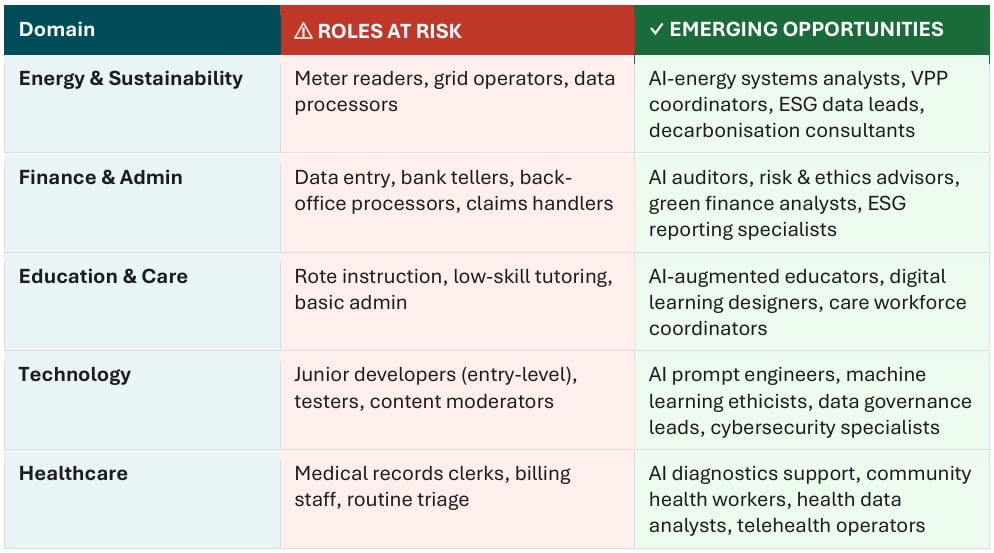
author’s analysis.
The opportunity column is real – and it is substantial. The green and AI economy will generate millions of
roles that simply do not exist today: AI governance specialists who understand both the technology and its societal impacts; sustainability data analysts who can translate ESG metrics into business strategy;
community energy coordinators who translate complex VPP dispatch decisions into language households
can understand and contest. These roles reward exactly the skills that women bring in disproportionate
measure: systems thinking, stakeholder communication, ethical reasoning, and the capacity to hold
complexity without losing sight of the human at the centre of it.
But opportunity without access is not opportunity. It is a closing door with a map taped to the outside.
“Every role I can see being created in the AI-energy economy I am working in – the ESG analyst,
the AI ethics lead, the sustainability data translator – requires a woman who was first trusted
with a meaningful seat, then trained to use it. Right now, we are struggling to provide either.”
03 What I Have Seen from the Inside
My career has straddled two worlds that rarely speak to each other: the world of institutional transformation – where I led flagship academic programmes at Singapore Management University, shaped curriculum to embed ESG thinking into the next generation of business leaders, and drove systems-level change inside educational institutions – and the world of corporate sustainability, where I now help leading companies across sectors and geographies navigate their net-zero transitions.
In both worlds, I have seen the same pattern play out with depressing reliability: the decisions that shape
economic opportunity for women are made in rooms where women are under-represented, using data that does not capture women’s experiences, by institutions that have not yet built the accountability structures to notice what they are missing.
In the energy transition project – where we use an AI enabled platform for energy transition orchestration – I have watched an AI system of genuine sophistication be built with the best technical intentions. And I have asked questions that were not on the original brief: Are the demand response protocols modelled against households headed by women? Are the communities most affected by automated dispatch decisions – those in public housing, those in informal employment, those with least capacity to contest an algorithmic outcome -represented in the governance structure? Are the ESG metrics that define ‘project success’ measuring what this technology actually does to people?
Those questions were not anticipated. They were not unwelcome – but they required someone to ask them. That someone needed to be in the room. This is not unique to energy AI. It is the defining structural problem of the AI economy as it is currently unfolding: the people who will bear the heaviest costs of its disruptions are the people least likely to be present when its parameters are set.
Lean Six Sigma teaches you to find the waste in a system – the rework, the inefficiency, the defect that
compounds. The AI economy’s greatest waste, right now, is the systematic exclusion of women from the
design, governance, and benefit of the systems that are most rapidly reshaping their working lives. This is
not just a moral failure. It is an economic one. McKinsey Global Institute has estimated that achieving gender equality could expand the global economy by USD 12–28 trillion.⁷ The AI economy, designed without women at the table, is leaving that value on the floor.
“The Future of Work was the title of an event at which I participated in 2018. Seven years later,
the future has arrived – and it is not treating all workers equally. The urgency is not rhetorical. It
is actuarial.”
04 The Three Interventions That Matter Most
I am not interested in writing a list of problems without a credible theory of change. Drawing on research,
policy analysis, and field experience, I propose three interventions at the system level:
- Redesign reskilling as infrastructure, not charity. The WEF estimates that 59 out of every 100 workers will need retraining by 2030.³ Governments in APAC – particularly Singapore, India, Indonesia, and the Philippines – are making meaningful investments in national reskilling programmes. But most of these programmes are designed around the assumption that workers can self-navigate a transition: they must identify the right course, find childcare, absorb the opportunity cost, and successfully apply skills that the labour market may not yet value. Women in informal employment, in caregiving roles, or in geographically constrained labour markets cannot make that journey alone. Reskilling must be accompanied by paid transition support, community-based delivery, and employer commitments to hire from the trained pool. Singapore’s SkillsFuture programme is an important model; it needs gender-responsive implementation metrics.
- Make women architects of AI systems, not just users of them. The IMF’s 2024 analysis notes that women face both greater risks and greater opportunities from AI – because their exposure is distributed across both high-complementarity and low-complementarity job categories.⁴ The difference between the two outcomes depends, in significant part, on whether women are designing the AI systems that affect them. Only 22% of the global AI workforce is female.⁶ That gap does not self-correct. It requires targeted investment – in STEM education, in sponsorship and mentorship inside technology companies, in procurement criteria that reward vendors with gender-diverse AI teams. TCS’s flagship CSR initiative, the goIT programme, in which I have participated, is one model for building the pipeline at school level. It must be matched by systematic action at the industry level.
- Build accountability into AI deployment from day one. The GSMA has already committed to halving the digital gender gap by 2030, with G20 South Africa reaffirming the target.⁸ The next step is translating that commitment from connectivity to AI governance: requiring gender impact assessments for AI systems deployed in public-facing services; mandating gender-disaggregated reporting of AI-driven workforce changes; and creating accessible grievance mechanisms for workers displaced by algorithmic decisions. The mobile industry is uniquely positioned to lead here – mobile networks are the infrastructure through which AI services will reach women in emerging markets. GSMA’s Diversity4Tech programme can be the convening forum that moves from aspiration to binding standard.
Conclusion: Whose Future is This?
The World Economic Forum tells us the gender gap will close – in 123 years, at the current pace of progress.⁶ The AI economy will not wait 123 years. It will make consequential decisions about women’s economic participation in the next five.
I have spent my career at the intersection of people and systems – first in education, where the work was to open minds and expand what people believed was possible for them; now in sustainability consulting, where the work is to embed a long-term view of value into organisations that are designed to optimise for the short term. Both careers have taught me that systems do not change on their own. They change when people with the knowledge, the credibility, and the access to the room where decisions are made choose to use that position to ask different questions.
The AI economy needs women who ask different questions. It needs women who understand both the
technology and its human consequences. It needs women who can read a dispatch optimisation algorithm and also read the faces of the community members that algorithm affects. It needs, in short, the kind of woman who has always been essential to every institutional transformation I have seen succeed – and who has always been the last to be invited to lead it.
The jobs that disappear first will be ours. But the future that gets built on what remains – that can be ours
too, if we choose to build it. The window is open. It will not stay open long.
REFERENCES & RESEARCH CITATIONS
¹ Brookings Institution. (2026). AI Job Displacement Data 2026: Evidence, Projections, and Adaptive
Capacity.
https://smarthumain.com/workforce-ai/ai-job-displacement-data-2026/
² GSMA. (2025). The Mobile Gender Gap Report 2025. Connected Women Programme. London: GSMA.
https://www.gsma.com/gender-gap
³ World Economic Forum. (2025). The Future of Jobs Report 2025. Geneva: WEF. January 2025.
https://www.weforum.org/publications/the-future-of-jobs-report-2025
⁴ IMF. (2024). Gen-AI: Artificial Intelligence and the Future of Work. IMF Staff Discussion Note
SDN/2024/001. Mauro, P., et al. Washington DC: International Monetary Fund. January 2024.
https://www.imf.org/en/blogs/articles/2024/01/14/ai-will-transform-the-global-economy
⁵ Goldman Sachs Research. (2026). AI and Employment: Labour Market Projections.
https://www.goldmansachs.com/insights/articles/how-will-ai-affect-the-us-labor-market
https://www.goldmansachs.com/insights/articles/how-will-ai-affect-the-global-workforce
https://www.cnbc.com/2025/08/05/ai-labor-market-young-tech-workers-goldman-economist.html
⁶ World Economic Forum. (2026). AI, gender parity and the future of work: jobs news this month. WEF
Stories, March 2026. Data: McKinsey & Company; WEF Global Gender Gap Report 2025.
https://www.weforum.org/stories/2026/03/ai-gender-parity-womens-history-month-jobs
⁷ AI Technology Intensity, Gendered Labor Structure and Gender-Inclusive Sustainable Development. MDPI
Sustainability, 18(2), 1105.
⁸ GSMA / Mobile for Development. (2025). Advancing Digital Gender Equity. G20 South Africa Leaders
Declaration reaffirming commitment to halve the gender digital divide by 2030.
https://www.gsma.com/solutions-and-impact/connectivity-for-good/mobile-for-development/impact
report/gender
⁹ EMA Singapore. (2025). New Initiatives to Future-Proof Singapore’s Power Grid. Energy Market Authority
Media Release.
https://www.ema.gov.sg/news-events/news/media-releases/2025/new-initiatives-to-future-proof-sg
power-grid