


This article is part of the Spectrum Policy Trends 2026 report. Download the report for a handy compilation of the top five spectrum policy trends for 2026.
Nearly eight years on from the first commercial launches, 5G deployment is starting to mature. As a result, the pace of 5G launches is starting to slow with 375 networks already launched globally by the end of 2025. Adoption varies regionally and the busiest areas for the next wave of 5G deployments are likely to be in Africa as well as island nations. 5G’s maturity in early-adopters has seen MNOs developing their networks as data consumption increases in line with network quality. Operators continue to require access to sufficient low-, mid-, and high-band spectrum to deliver affordable, high-quality 5G for smart cities, high-capacity enhanced mobile broadband, and enterprise digitalisation.
Why does it matter?
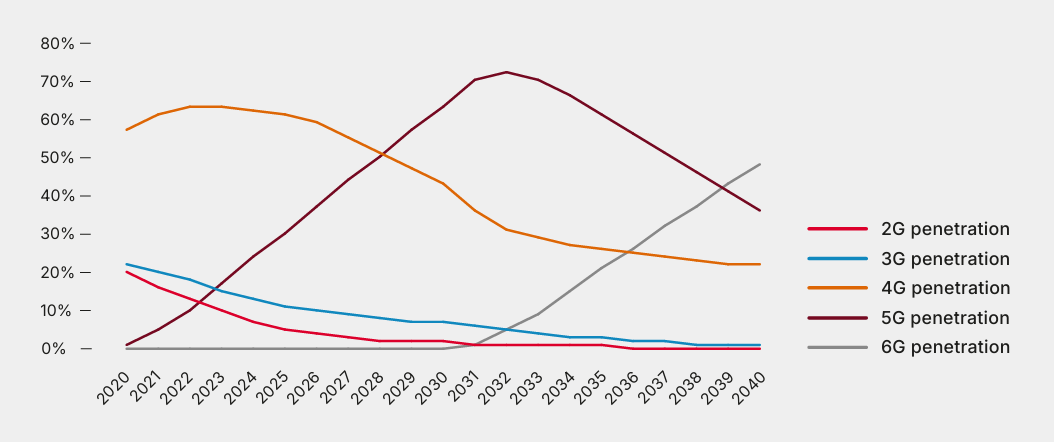
5G is expected to continue developing into the 2030s, while growth in the second half of this decade will see 5G connections surpass 4G by 2028. Higher 5G adoption will help deliver capacity for increasing consumer demand as mobile traffic is expected to grow by 15-20% in the period up to 2030. However, the migration of operators and consumers to 5G and higher-speed networks will also drive traffic growth in itself as users become accustomed to consistent speeds and higher network quality.
Ensuring 5G capacity delivers connectivity in all areas will enable secure public networks and provide economic growth. New functionality will continue to develop through 5G-Advanced and 5G will remain a platform for innovation that will drive mobile into the 2030s. However, the speed, reach and quality of 5G services continues to depend on governments and regulators supporting sufficient, affordable spectrum access.
Figure 1: Market penetration by technology, 2020–2040
What are the policy considerations?
Full-power, licensed spectrum has been important to 5G’s success. It enables wider coverage areas, helps provide high-quality service, and drives network investment. To deliver the full range of 5G use cases, operators need access to spectrum across low, mid-, and high bands.
Low-band spectrum (below 1 GHz) ensures digital equality by providing rural and deep indoor coverage, while mid-bands (1-8.4 GHz) deliver city-wide capacity and support applications like smart cities and advanced manufacturing. High bands (above 24 GHz) offer ultra-fast speeds and low latency for high-capacity hotspots, complementing the broader coverage of lower bands.
Regulators can support growing demand through clearing and harmonising prime bands, aiming for at least 100 MHz of contiguous mid-band spectrum per operator at launch, while expanding low-band capacity.
Long-term, technology-neutral licences and flexible-use frameworks encourage sustained investment. Voluntary spectrum sharing can improve efficiency, although it does not reduce overall spectrum needs. Excessive spectrum pricing slows deployment and reduces coverage: linking licence conditions to achievable roll-out targets instead can help enhance connectivity.
What to expect in the year ahead
As 5G adoption becomes more widespread, and operators and consumers migrate to 5G and higher-speed networks, data traffic increases. Markets with higher 5G penetration show greater data usage – up to 2.5x more where 5G accounts for at least 30% of connections, and nearly 4x more in markets with download speeds above 250 Mbps. However, demand in many countries remains constrained by network capacity issues.
Spectrum assignments for 5G launches will continue in the remaining countries, while many are already looking to expand spectrum capacity to avoid future constraints. North and Sub-Saharan Africa have shown significant progress in deploying 5G networks, and more assignments in 3.5 GHz are expected in 2026. Fiji started assigning spectrum for 5G in 2025 and other island nations, including in the Caribbean, are expected to follow this trend.
Southeast Asian countries have ambitious plans to amplify assignments in the 700 MHz, 2.6 GHz and 3.5 GHz bands, following success in Vietnam. Spectrum refarming from legacy 2G and 3G networks to 5G is also expected to continue.
The upper 6 GHz band will continue to support 5G deployment in some countries, while it will be used later for 6G in others. More countries are expected to release 6 GHz plans in 2026, while the band will be gradually brought into use this year, ahead of full commercial deployments in 2027. Following assignments in the UAE and Hong Kong, India and Brazil have announced ambitious auction plans.
2026 could also see more spectrum roadmaps emerging, combining long-term planning with clearer pathways to release bands that have already been identified but not yet assigned. This creates the potential for additional capacity across bands such as 600 MHz, 700 MHz, 1500 MHz, 2.3 GHz and 2.6 GHz, as well as further expansion in 3.5 GHz and 6 GHz.
| Policy in practice: The US unlocks 800 MHz of mid-band spectrum In July 2025, the US took a major step to boost its supply of mid-band mobile spectrum, passing legislation to identify an additional 800 MHz by 2034, with much of it required to become available sooner. This is a significant initiative to commercialise mid-band spectrum and allow the US to keep pace with global leaders. Spectrum licensing in the US has been grounded on the principle of fair auctions to deliver pricing signals for the value of spectrum. Market-driven secondary trading also supports spectrum efficiency. Perpetual spectrum licences give regulatory certainty for operators to invest, and the country was a first-mover on 600 MHz spectrum, which has contributed to high levels of 5G coverage and use. 5G FWA is also a robust and growing market segment. The new legislation provides clear guidance on the future availability of mid-band spectrum by clearing up at least 800 MHz new spectrum, with the majority (500 MHz) to be found from current federal users. At least 100 MHz will come from 3.98-4.2 GHz and the rest from elsewhere in the 1.3-10.5 GHz range. Towards the end of 2025, the US set out its vision for 6G. This included studying the reallocation of incumbent services in the 7.125-7.4 GHz frequency range for full-power commercial licensed use. Studies will also consider portions of the 2.69-2.9 GHz and 4.4-4.94 GHz frequency ranges. |