


Spectrum choices can keep the world’s largest economy in the mobile fast lane. Can others keep up?
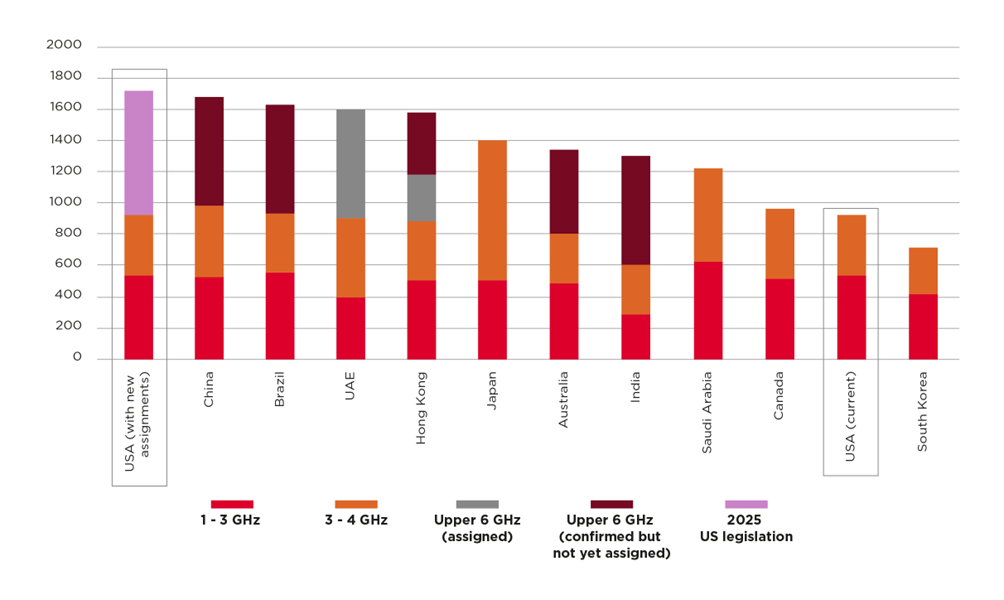
In July, the US took a major step to boost its supply of mid-band mobile spectrum, passing legislation to identify an additional 800 MHz by 2034 — with much of it required to become available sooner. This is a significant initiative to commercialise mid-band spectrum and allow the US to keep pace with global leaders. It is an important development for US mobile operators that will be welcomed by business and consumer mobile users. Above all, it is a necessary move for the world’s largest economy to retain its place among the global connectivity elite.
There are few countries in the world that create as much value from licensed spectrum as the US but, with the existing pipeline used up, a new roadmap was required. Spectrum shortages lead to congested networks that negatively impact quality of service. Until the new legislation, the pathway to necessary spectrum has been unclear and its new clarity is crucial to continue the country’s leadership on 5G implementation and 6G development.
The US MNOs need resources to ensure the market remains competitive and the spectrum legislation will help deliver the certainty and investment required to keep pace. Countries in Scandinavia, the Gulf Cooperation Council (GCC), and East Asia have higher 5G speeds than the US today, supported by a strong current and future spectrum pipeline. GCC countries have very high data usage while China, with its lower disposable income levels and lower average revenue per user (ARPU) than the US, has comparable download speeds.
The new legislation acknowledges the importance and need for new mid-band spectrum (between 1.3 and 10.5 GHz) to meet the growing traffic demand from US mobile and FWA consumers. It also looks to give balance. Significant amounts of mid-band spectrum had already been made available for Wi-Fi. The US will need mobile as well to deliver the next generation of applications being developed by some of its technology base across wide areas: there is limited potential in AR glasses that only work in your home. In 2024, US citizens used 132 trillion megabytes of data, an increase of 32 trillion over the previous year with data demand increasing around 35% again. Traffic is expected to continue increasing as consumers and businesses realise the potential of one of the world’s leading 5G markets. US mobile operators may now be able to access the capacity required to support this as the country will move up along the global leaders of mid-band spectrum supply.
Figure 1: US spectrum comparison to non-European 5G benchmarks
Mid-bands under discussion
The US market has several strengths. Its spectrum licensing has been grounded on the principle of fair auctions to deliver pricing signals for the value of spectrum. Market-driven secondary trading also supports spectrum efficiency. Perpetual spectrum licences give regulatory certainty for operators to invest, and the country was a first-mover on 600 MHz spectrum which has contributed to high levels of 5G coverage and use. 5G FWA is a robust and growing market segment. Now, we may see the US catching up on mid-band spectrum as well.
The challenges in US mid-band spectrum have been well-documented. CBRS may have been necessary at the time, but it was a sub-optimal experiment. A strong global preference has been the certainty of spectrum use derived from cleared spectrum, and this has driven the 5G networks of all leading markets. Additionally, the decision to use all of 6 GHz for unlicensed users in the US, without a pricing signal, left the value of that spectrum unclear and has not encouraged its efficient use. It also helped create spectrum scarcity for US mobile operators.
The new legislation will improve that by clearing up at least 800 MHz new spectrum in total with the majority (500 MHz) to be found from current federal users. At least 100 MHz will come from 3.98-4.2 GHz and the rest from elsewhere in the 1.3-10.5 GHz range. The only exclusions are 3.1-3.45 GHz and 7.4-8.4 GHz, which will not be considered, and the other bands in the range are in play. The legislation does not exclude 6 GHz and there is a chance that the CBRS situation could also be re-examined. The legislation is just part of a robust spectrum debate in the US and there is little second-guessing as to which bands are most likely to be cleared beyond 3.98-4.2 GHz. For now, the world’s biggest economy just made a big move to keep pace with the top tier of mobile connectivity countries.
Will Europe make its own move?
The US move will no doubt cause ripples elsewhere. Europe’s Radio Spectrum Policy Group is nearing the end of its process of discussion, study and consultation on the upper 6 GHz band. This is likely to be the last piece of full-power mobile spectrum available in the region for the foreseeable future, with the exception of a possible extra 125 MHz tranche of 7 GHz spectrum at WRC-27.
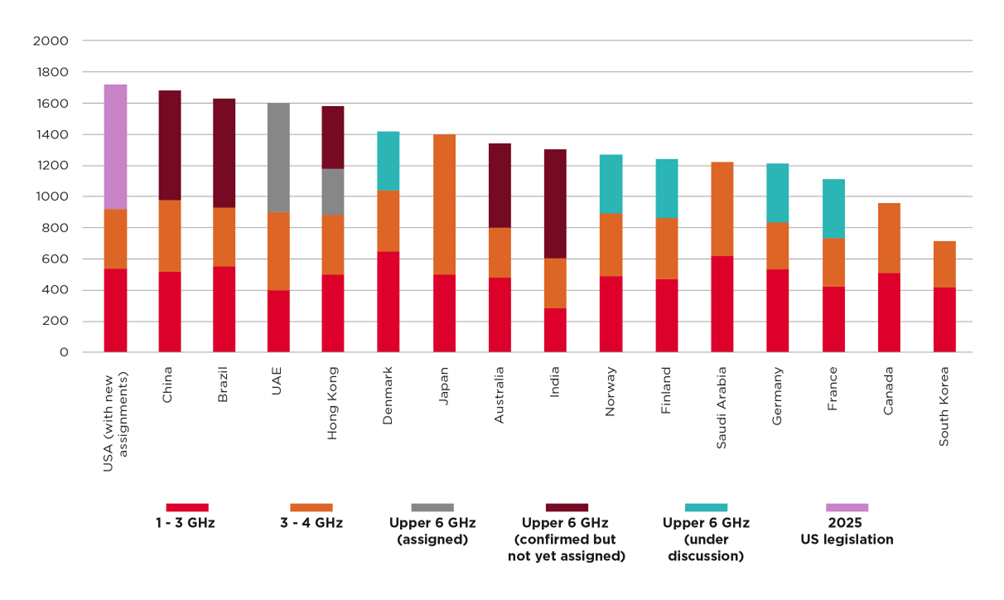
Europe is considering whether to leave the mobile/Wi-Fi band split at 6.425 GHz (as per the World Radiocommunication Conference decision in 2023) or to allow Wi-Fi beyond its new home in the lower 6 GHz band (5.945-6.425 in Europe). Current options are highly varied. These range from using all 700 MHz for full-power mobile use, to restricting the mobile band to 380 MHz and other segmentations in between. The band is being discussed for use in the 6G era, i.e. after 2030, and while the need for 200-400 MHz channels for 6G has been recognised, some of the options (even with a slice of 7 GHz capacity at WRC-27) will not allow for this.
The worst-case scenario is that spectrum will be constrained, and costs will rise. Outside of Scandinavia, Europe is lagging behind 5G leading nations and the future capacity decisions will be vital to ensuring the future competitiveness of the birthplace of GSM.
Figure 2: European 5G leaders with maximum possible 6 GHz assignment (700 MHz) against RoW benchmarks
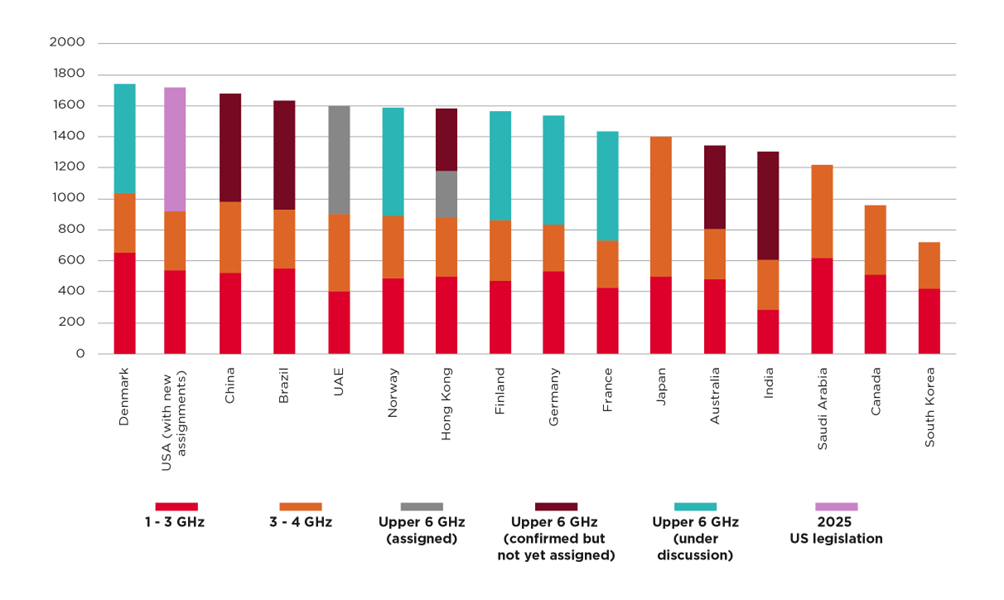
Figure 3: European 5G leaders with minimum possible 6 GHz assignment (380 MHz) against RoW benchmarks
6 GHz and 7 GHz remain critical
Decisions around mid-band spectrum are crucial to the future evolution of mobile. The US has taken a broad approach to considering its options while European consensus leaves 6 GHz as the main option.
Mobile operators on both continents are making a case for bringing the most value out of spectrum and this discussion is paramount. The pricing signal faced by mobile operators, as they are required to pay for their spectrum, makes this value clear.
There is an opportunity cost to reassignment of all spectrum bands, and while Europe is on the cusp of concluding its own decision-making process, the robust US legislation will now be backed up by its own period of analysis to define which bands will be used for mobile.
The US has joined the top group of countries which set the benchmark with their spectrum pipeline. Other countries, soon to include Europe, must now decide what action of their own is required.