


This article is part of the Spectrum Policy Trends 2026 report. Download the report for a handy compilation of the top five spectrum policy trends for 2026.
Low-band spectrum is a driver of digital equality, helping reduce the digital divide between urban and rural areas by delivering capacity across wide spaces. Regulators aiming to bridge this divide are starting to focus again on improving access to sub-1 GHz spectrum.
In low- and middle-income countries (LMICs), adults in rural areas are 28% less likely to use mobile internet than urban users. Among mobile internet users, rural populations record a lower intensity of use and are 30% less likely to regularly engage in key activities such as instant messaging, online calls and accessing services such as banking or education. Despite coverage improvements, these gaps limit access to economic growth and other societal benefits.
Why does it matter?
As mobile is rolled out using mid-bands such as 3.5 GHz across urban areas, covering wide rural areas with the same quality of service remains a challenge. Sufficient low-band spectrum will help give rural communities access to the latest digital technologies.
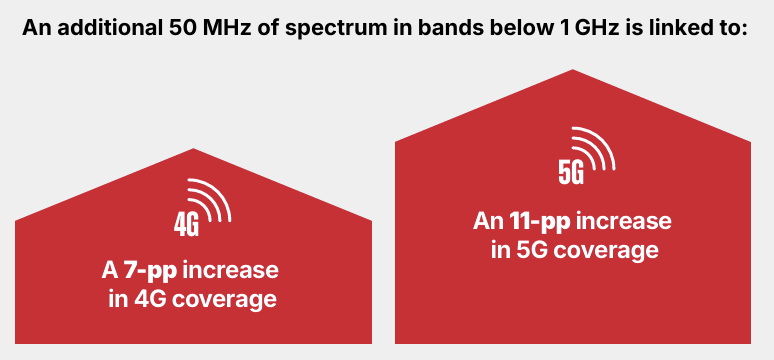
Low-band spectrum is essential for mobile because it enables wide rural coverage and deep indoor penetration in urban areas, ensuring connectivity for both remote communities and hard-to-reach city environments. The volume of low-band spectrum is important as download speeds are directly linked to the volume of spectrum available. Communities that rely on low bands will get access to faster connectivity if new low bands like 600 MHz or below (such as 500 MHz) are developed for mobile use.
Mobile connectivity delivers significant social and environmental benefits, helping to reduce poverty, improve education and health, enhance well-being, and expand access to jobs and financial services. Ensuring adequate low-band spectrum extends these benefits to rural and underserved areas – where typically economic prospects are already lower.
What are the policy considerations?
Replanning spectrum below 700 MHz is a lengthy process. Policymakers are considering additional low-band frequencies as part of their long-term planning to address the digital divide. To promote digital equality, regulators can harmonise and release additional low-band spectrum alongside mid- and high-band allocations, making it available under affordable conditions that support network rollout in underserved regions.
International negotiations have taken place at recent WRCs to expand low-band access for rural communities and ensure they have better access to digital services. This has included the wide harmonisation of 700 MHz the development of 600 MHz and consideration of the future of low-band spectrum beyond this, such as 500 MHz.
WRC-23 considered further UHF low-band spectrum and began to develop the international agreements to support widespread use with both primary and secondary allocations. WRC-27 represents an opportunity for more countries to sign into existing footnotes throughout the UHF band and also consider the full scope of a new item on the agenda for WRC-31 to finalise the issue in EMEA. In APAC, existing allocations support increased low-band use, and this has seen the development of the n104 bandplan (allowing for an expanded 2 x 40 MHz assignment in 600 MHz) by some Asian markets. Expansion of existing footnotes can support development in the Americas.
World Radiocommunication Conferences can deliver interference-free coexistence in low bands and lay the foundations for harmonised future spectrum use. Lasting impact will depend on political commitment to improving connectivity in rural and underserved communities. By pursuing policies that genuinely level up all parts of their countries, governments can ensure that those most in need are not left behind.
What to expect in the year ahead?
Digital inclusion will continue to be a priority in countries across the world in 2026. The Baku Declaration, adopted at the ITU WTDC in 2025, underscored the importance of new and emerging technologies for societal development and how investment in connectivity can tackle the usage gap.
While 700 MHz has dominated low-band 5G rollouts so far, the 600 MHz band is starting to pick up momentum and is expected to expand in 2026. The US and Canada have already licensed the band and use it heavily for 5G, while Saudi Arabia and the UAE have also developed 600 MHz as the first countries in EMEA to do so.
Changes to broadcast networks are at different stages across the world. Some countries are looking to the final sunset of digital terrestrial TV, while at the other end, some markets are looking to realise their first digital dividend through analogue switch off. However, all these actions will have the net result of freeing up low-band spectrum and those at later stages of development can benefit from lessons learnt over the past 30 years of digital TV and ensure the maximum dividend is made for mobile at the onset.
| Policy in practice: Saudi Arabia reallocating the 600 and 700 MHz bands from incumbent users as a driver of technology evolution At WRC-23, the whole of EMEA (ITU Region 1) discussed the development of low-band spectrum. Varied levels of use and development led to a fragmented approach in the EMEA region as a whole, with countries from the GCC gaining a primary allocation and IMT identification but others gaining a secondary or no allocation. However, the creation of a regional bloc within GCC countries was critical in allowing rapid local moves. In 2024, Saudi Arabian regulator CST reallocated spectrum to mobile from incumbent users, such as terrestrial TV and amateur radio, and made 1300 MHz of licensed low- and mid-band spectrum available to the national mobile operators, including the 600 and 700 MHz bands. This pipeline has successfully contributed to early 5G network deployments, high levels of adoption and some of the highest download speeds globally. As a result, Saudi Arabia became the first country in the EMEA region to award the 600 MHz band for mobile. The UAE has also assigned the 600 MHz band subsequently (having already made 700 MHz available). Low-band signals propagate further, meaning that international coordination is an important part of enabling nationwide use of the spectrum. The strength of the GCC regional bloc allowed Saudi Arabia and UAE to move quickly after the WRC, following bilateral negotiations with other neighbours. This regional bloc approach may be adopted in other areas, where groups of neighbouring countries decide to change use along similar timescales to minimise interference issues. Such blocs can then grow and merge as more countries change the use to level up all communities with better mobile connectivity. |