


Six years after the first European launches, the efficiency gained by 5G technologies is being overtaken by capacity demand. Speeds are already decreasing, and data usage is still expected to grow threefold in Europe within this decade.
New Opensignal data from Denmark, Germany, Norway, Sweden, and the UK, published in collaboration with the GSMA, shows that speeds are decreasing by between 6% and 23% between 2024 and 2025. The vision for consistent 5G user experiences powering Europe’s digital economies in the 2020s is under threat unless declines like this are reversed.

The reasons behind the stark reality of reducing download speeds are simple. Over the past five years, 5G subscriber numbers have increased by over 30x in the above countries, and average data use by mobile connection has tripled. More people are using data – a fact that all European regulators are aware of – but at the same time some of the options for capacity expansion are reducing. Network grids became highly densified through 5G roll-outs in 3.5 GHz and further densification is not desirable in some cases, not feasible in others. Inter-site distances cannot be endlessly reduced without causing interference, while adding base stations creates a carbon footprint and raises costs.
Opensignal’s data highlights how much European mobile operators rely on wide mid-band channels for 5G, but also how much of this comes from the lower part of the 3.5 GHz. Up to 72% of user 5G scans used this frequency and, as capacity is reached, some mature markets have diversified its spectrum usage to add 2.1 GHz and 700 MHz, leading to a decline of the proportion of 5G readings in 3.5 GHz.
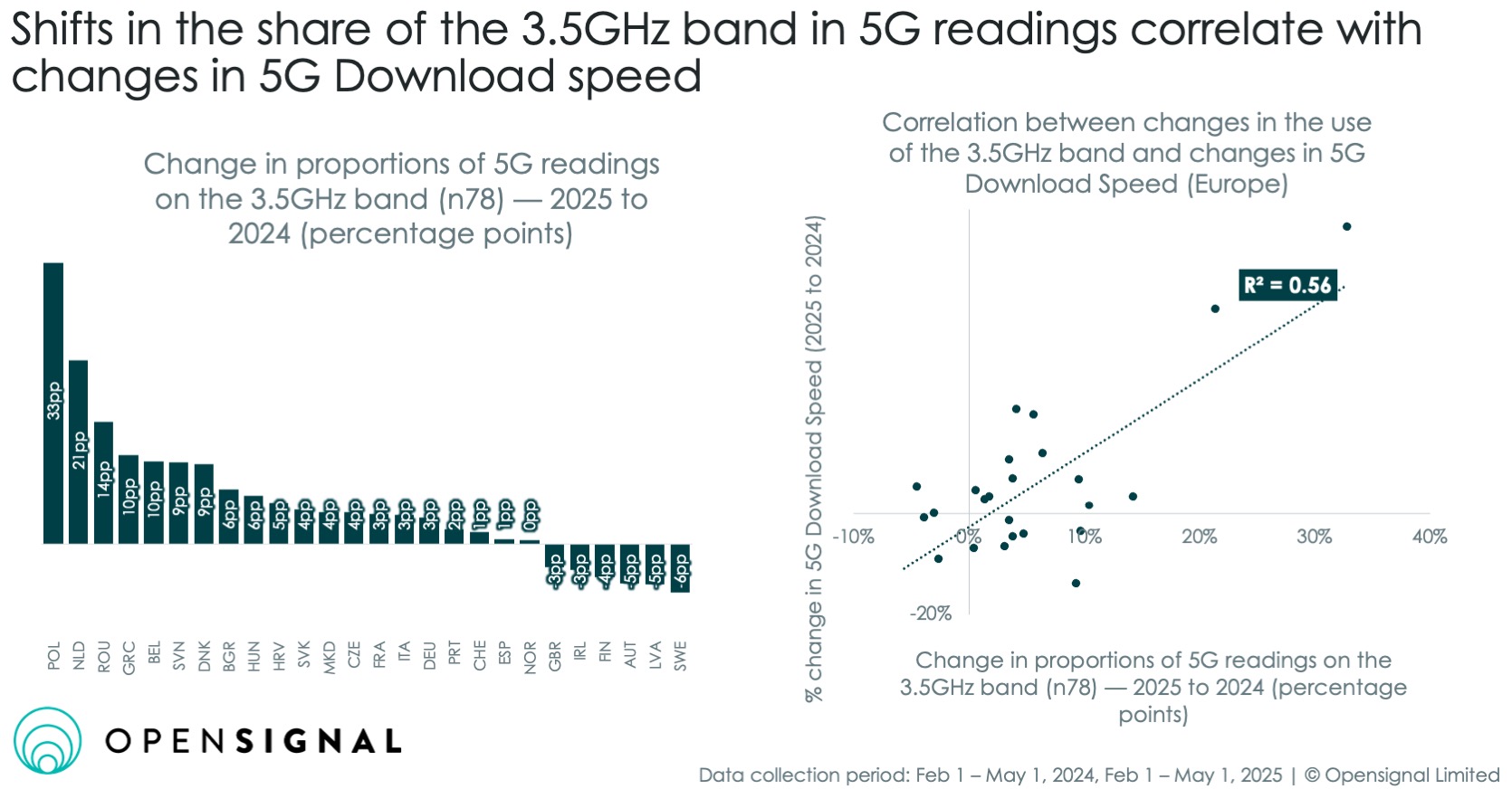
Future mid-band spectrum access is unclear in Europe at present. There are limitations on expanding the 3.5 GHz band through 3.8-4.2 GHz, the option that has been used in the US and Japan. On top of this there is ongoing uncertainty on the future of the upper 6 GHz band.
Europe’s Radio Spectrum Policy Group (RSPG) recently published its opinion on the upper 6 GHz band for comments, proposing between 380 MHz and 700 MHz for mobile. Some countries are active in supporting the 700 MHz option to ensure mobile growth, while others still support constraining access to this spectrum for mobile. The UK, for example, has been one of the most active supporters of minimising upper 6 GHz mobile spectrum within Europe’s CEPT technical groups.
This contrasts to other markets globally. The US recently announced plans to find 800 MHz of new full-power mobile spectrum in mid-bands. It joins other global 5G leaders in addressing its future spectrum roadmap. The upper 6 GHz band, for example, is already assigned in some 5G-leading countries such as UAE and Hong Kong while others have laid out clear plans for use. Spectrum is needed to position Europe as a digital leader.
Spectrum for evolution
The timely availability of 6 GHz capacity at reasonable conditions and prices will drive cost-efficient network deployment, help lower the broadband usage gap, and support digital inclusion. It can also cater for the 200-400 MHz channels that 6G is initially being designed to operate in. 5G-leadership markets are looking at significant new tranches of mid-band spectrum for mobile development. Europe’s digital plans are vital to the region’s future competitiveness and a strong mobile sector is an important part of this.
The UAE and Hong Kong assigned the upper 6 GHz band at the end of 2024, while Australia, Brazil, China – and soon India – have reserved the majority of the upper 6 GHz for IMT in their Tables of Allocations. 6 GHz has also been added to roadmaps in several APAC countries. These advancements represent a near-global harmonisation leading to economies of scale.
The mobile sector is committed to working closely with governments and regulators to support the future evolution of mobile, including developing 6 GHz ecosystem, and deliver world-leading connectivity that supports mobile users, economic objectives, productivity and jobs. As European mobile operators continue to innovate, keep up with data growth and set the stage for 6G, spectrum is a vital ingredient to ensure Europe can deliver digital and economic leadership going into the 2030s.