



Thursday 8 October, 2026
The GSMA’s Vision 2040 study on spectrum needs during the peak 6G era of 2035–2040 provides the most comprehensive assessment of mid-band spectrum needs for mobile networks to date. It is designed to support policymakers in developing the long-term spectrum roadmap needed to ensure seamless evolution into the networks of the 2030s.
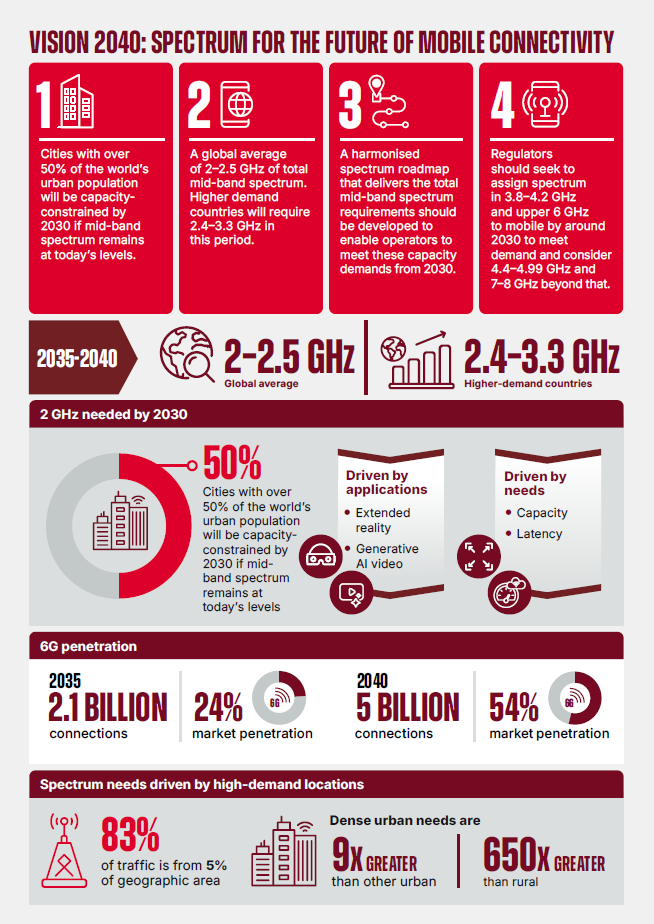
Considering this evolution of demand and network capacity in dense urban areas, and reflecting the uncertainty involved in making long-term forecasts, we estimate an average of 2-2.5 GHz of mid-band spectrum (frequency bands between 1 GHz and 10 GHz) will be required in the 2035–2040 period to meet demand in high-population density locations around the world.
In higher-demand countries (representing the top 50% of countries globally) spectrum needs will be 2.4-3.3 GHz in that period. Considering existing IMT allocations, where in most countries around 1 GHz of mid-band spectrum is identified for mobile, this means that an additional mid-band requirement of 1–2 GHz is needed.
Building on existing spectrum, including recent spectrum identifications at WRC-23, and also looking ahead to WRC-27 discussion items, the primary mid-bands currently under consideration for additional mobile spectrum are from within the:
- 3.8–4.2 GHz range, which could provide an additional 200–400 MHz of mid-band spectrum
- 4.4–4.99 GHz range, which could provide an additional 400–600 MHz
- upper 6 GHz range (6.425–7.125 GHz), which could provide an additional 700 MHz
- the 7.125–8.4 GHz range, which could provide an additional 600–1275 MHz.
