


The MENA region continues to show 5G leadership but needs to start planning for the future by finding more spectrum, and sunsetting 2G and 3G networks, according to a new Opensignal study in partnership with the GSMA spectrum team.
The 5G era kicked off with near-simultaneous launches in three Gulf countries in 2018. Six years later that pioneering spirit has been rewarded with great 5G networks.
Today, the mobile industry underpins rapid digital transformation in MENA, with advanced mobile connectivity enabling innovative use case cases for consumers and enterprises helped by 5G expansion.
Saudi Arabia, Qatar, Kuwait, UAE, and Bahrain all have among the fastest 5G networks in the EMEA region and the world. The analysis also shows the benefits of rolling out 5G. For example, Kuwaiti subscribers are experiencing an 8.2 times increase, followed by Qatar (7.5 times faster), Saudi Arabia (7.3 times faster).
This should serve as inspiration for countries in the region that are still in the planning or beginning phases of rolling out 5G. For them, implementing effective spectrum policies is vital. Spectrum roadmaps that include additional low and mid-bands are needed.
They are essential to ensure there is enough spectrum to meet surging demand for mobile services in both the short and long terms. They help governments forecast future trends and manage their work. For mobile operators, they mean increased certainty to invest based on the government’s future assignments, renewal plans and spectrum management.
As part of the roadmap, spectrum should be fully assigned to mobile operators at affordable prices on a technology neutral basis.
In addition to new spectrum, sunsetting 2G and 3G networks and refarming the spectrum will also help future proof the region. The rationale for legacy network sunsets, while upgrading to 4G or 5G, comes with benefits to mobile users and the broader economy. This includes faster speeds, lower latency, higher capacity, and, in some cases, improved spectrum bandwidth. Switching to newer technologies on market-driven timescales also promotes energy efficiency and lowers carbon emissions.
It is also important to note that sunset processes should be driven by market conditions, rather than mandated.
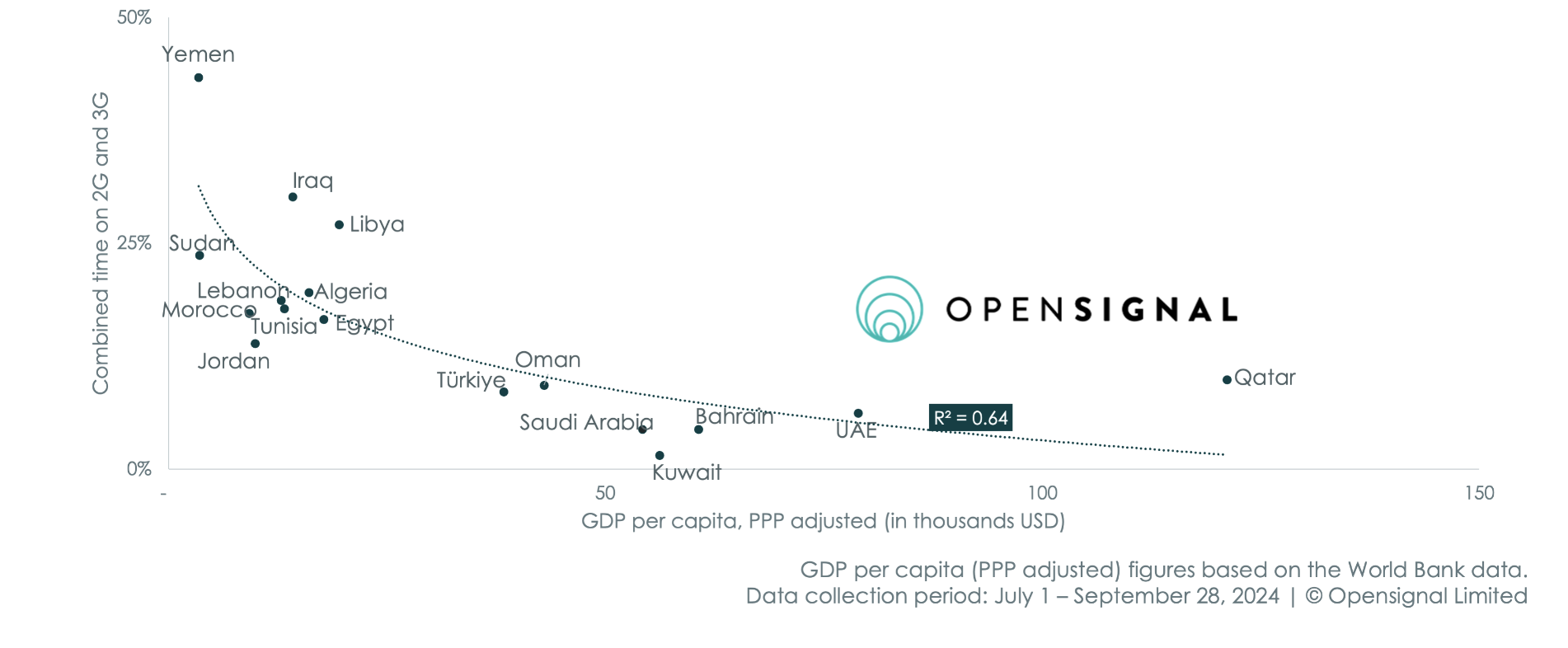
There are still countries in MENA, including Sudan, Libya, Iraq, and Yemen where a larger portion of users depend on 2G and 3G. Addressing this requires close collaboration between regulators, mobile operators and other ecosystem players, to identify and implement the enablers of a smooth phasing out of legacy networks in the region.
Users in higher income MENA markets spend less time on legacy technologies (2G & 3G)
While there are countries in MENA that have some catching up to do, regional leaders cannot afford to rest on their laurels if they want to remain among the best in the world. Beyond existing and future expanded use of the 3.5 GHz band, data growth must also be supported by consideration of additional new spectrum.
Mobile networks will need, on average, 2 GHz of mid-band spectrum per country by 2030. Whether or not countries can make that much available depends in large part on the future the 6 GHz band.
Last year, WRC-23 identified 6 GHz (6.425-7.125 GHz) for mobile use by countries in every region – EMEA, Eurasia, the Americas, and Asia Pacific – and global, harmonised conditions for its use have been agreed in the ITU’s Radio Regulations. This brings together a population of billions of people into a harmonised 6 GHz mobile footprint. It also serves as a critical step for manufacturers of the 6 GHz equipment ecosystem. Making 6.425-7.125 GHz available for licensed, macro-cell mobile at the right time, is therefore critical.