


This article is part of the Spectrum Policy Trends 2026 report. Download the report for a handy compilation of the top five spectrum policy trends for 2026.
Connectivity is a cornerstone of every nation’s digital ambitions, and this is prompting governments and regulators to adopt innovative spectrum pricing and licensing approaches that encourage investment in connectivity and coverage. Nationwide connectivity objectives, such as better network quality and wider coverage, will help shape spectrum pricing and licensing decisions.
In 2026, spectrum licensing will be shaped by three major trends: widespread licence expiries, evolving renewal practices, and shifting pricing models.
Why does it matter?
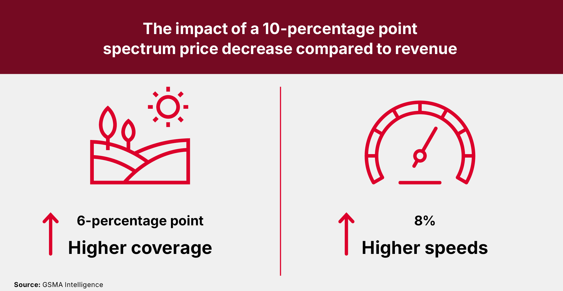
Over the last decade, mobile service costs have reduced as more people are brought into the digital community. Access to affordable, well-managed spectrum can expand digital inclusion and unlock mobile’s full potential, but spectrum costs have not reduced in line with pricing. Low spectrum costs directly improve network rollout and service quality: a 10‑percentage-point (pp) decrease in spectrum cost‑to‑revenue ratios results in up to 6-pp more coverage and 8% faster download speeds.
Transparent, technology-neutral licence renewals help maintain investment certainty, since spectrum access drives long-term infrastructure planning. Spectrum is a finite national asset and aligning pricing and licensing with broader connectivity goals, such as coverage obligations and affordable access, ensures networks expand into underserved areas and deliver socioeconomic benefits at scale.
What are the policy considerations?
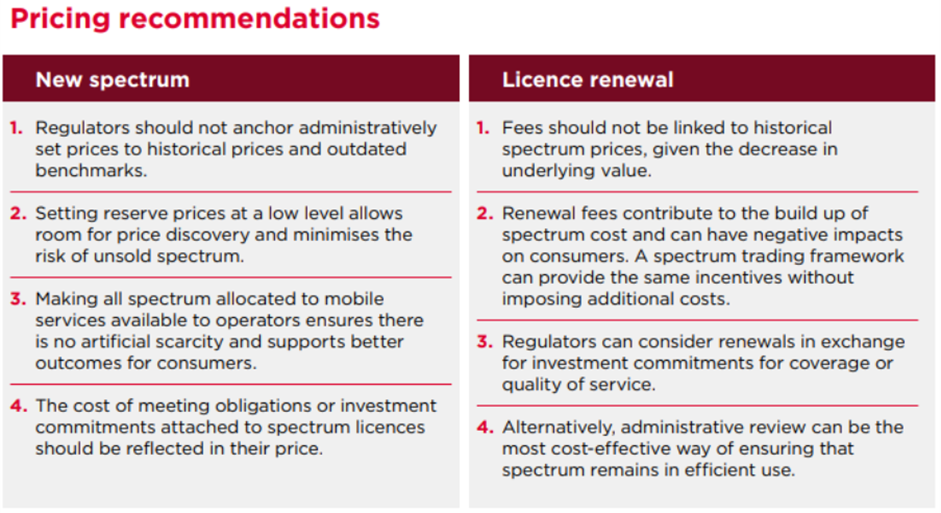
Regulators are increasingly adopting transparent processes and innovative renewal mechanisms, such as zero-cost extensions tied to coverage obligations, to align with national connectivity goals.
Pricing strategies are also evolving, with governments moving away from high upfront fees toward models that incentivise investment in underserved areas. This shift reflects the need to balance affordability with long-term network expansion as operators plan for 5G growth.
Regulators can support the delivery of better service quality by ensuring renewal decisions are made five years ahead of the renewal date. Continued network development is required to support growing consumer and business needs, but operators may not invest in their networks if there is uncertainty over future spectrum rights. Uncertainty can be further minimised by creating a presumption of renewal unless a breach of licence condition has occurred, a fundamental reallocation of spectrum or a new service is required, or an overriding policy need arises.
What to expect in the year ahead
Licences in 43 markets will expire in 2026, mainly in Europe, followed by APAC, Latin America, and MENA. Most expiries are in the 900 MHz, 1800 MHz and 2100 MHz bands, which are important for coverage and capacity and commonly refarmed during 2G/3G sunsets.
The Digital Networks Act (DNA) in Europe, which will take shape throughout 2026, is an opportunity to reset how Europe manages spectrum for the years to come. In particular, longer licence durations and predictable renewals are part of the proposal.
Best practice of prioritising overall policy goals regarding connectivity growth will continue to grow as governments seek to digitalise their economies. Zero-cost renewals and coverage-based obligations will become more common as long-term connectivity development is backed by governments to deliver GDP growth.
Operators will assess the impact of new pricing frameworks and coverage obligations on long-term strategies. Where commitments are not realistic, the spectrum may remain unsold or underused. Regulators will continue to align spectrum prices for future development, avoiding outdated benchmarks. Between 2025 and 2030, nearly 1,000 licences will expire globally, creating further opportunities to rationalise pricing and support efficient spectrum use.
| Policy in practice: Spain enables long-term investment The Spanish government, seeking to align domestic regulation with the European Electronic Communications Code (EECC), commissioned a review of licence renewals. Based on the findings, all existing licences were extended by 10 years, up to a maximum of 40 years since the date of the first award. No additional costs, obligations or charges were involved, beyond the continued payment of existing annual fees. The review found no alternative spectrum uses that could deliver greater or similar socioeconomic benefits. Extension ensured the most efficient use of spectrum while minimising administrative costs. The government expected that cost-free renewal will mean “savings of hundreds of millions of euros for operators, which can be invested directly in deployment and innovation”. Beyond cost savings, licence extensions provide certainty of access, enabling long‑term investment planning. This is particularly important for bands expiring before 2030 that are likely to be refarmed for 5G, which reached 91% population coverage in Spain in 2024. |