


This article is part of the Spectrum Policy Trends 2025 report. Download the full report for a handy compilation of the top five spectrum policy trends for 2025.
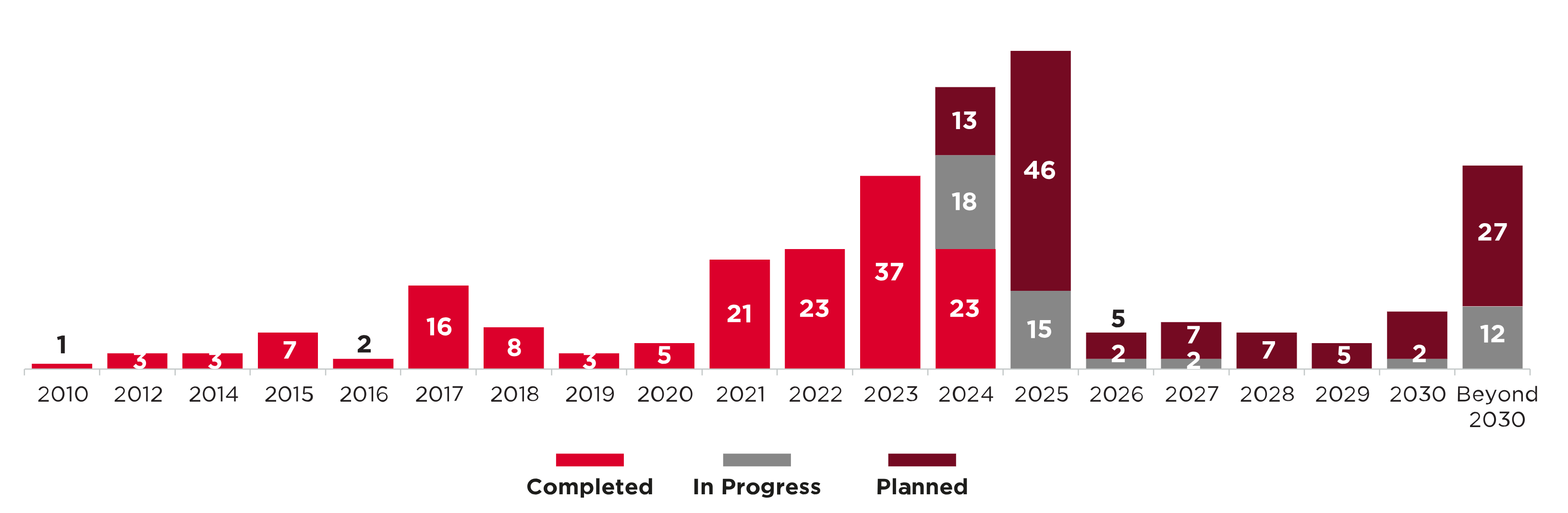
5G adoption has spurred momentum behind network sunsets. This global effort aims to address declining traffic on legacy network generations (2G/3G), the financial burden of maintaining legacy infrastructure, and the need to use spectrum resources efficiently by migrating to newer (4G/5G) technologies. According to GSMA Intelligence, 131 networks are planned to be shut down by 2030, with 61 scheduled for 2025.
Why does it matter?
The continuous evolution of technology increases the demand for additional spectrum resources by different communications service providers. This makes it critical for operators to optimise and efficiently use their existing spectrum assets. The need for additional spectrum to serve 4G and 5G capacity, alongside the declining traffic on legacy networks, as well as higher maintenance costs, make network sunsets an attractive decision for operators.
What are the policy considerations?
Mobile operators face significant roadblocks in their network sunset journeys in many countries. Common challenges include the lack of technology-neutral policies, reliance on legacy 2G/3G networks for critical services (such as e-call or SOS), public utilities (such as meters and elevators) still being configured to these networks, and affordability of 4G/5G devices.
Regulators should provide a guiding framework and implement policy measures to assist operators. Network sunsets can benefit their country’s population and enhance user experience. Regulators can implement supporting measures to complement the adoption of 4G/5G networks, facilitating smoother network sunsets.
Technology-neutral licensing is essential for legacy network sunsets. It allows mobile operators to refarm spectrum used for legacy networks for 4G and 5G services at a pace driven by market demand. Regulators must assign bands on a technology-neutral and affordable basis to maximise the efficient use of spectrum and allow the migration of these spectrum resources for future connectivity requirements.
What to expect in the year ahead
The benefit of network sunsets is being increasingly understood, and 2025 will be a big year. According to GSMA Intelligence, 131 networks are planned to be shut down by 2030, 61 of them within 2025. Globally, the 900, 1800, and 2100 MHz bands are often used for 2G and 3G networks, offering a good portfolio of spectrum that can be refarmed. They are ideal bands to migrate in part or fully via network sunsets to enhance telecom operators’ 4G and 5G connectivity alongside new spectrum such as 3.5 GHz. While refarmed spectrum will help add capacity, it is important to remember that new spectrum bands are also needed to meet future needs.
Figure 1: Network sunsets by completion year
Source: GSMA Intelligence
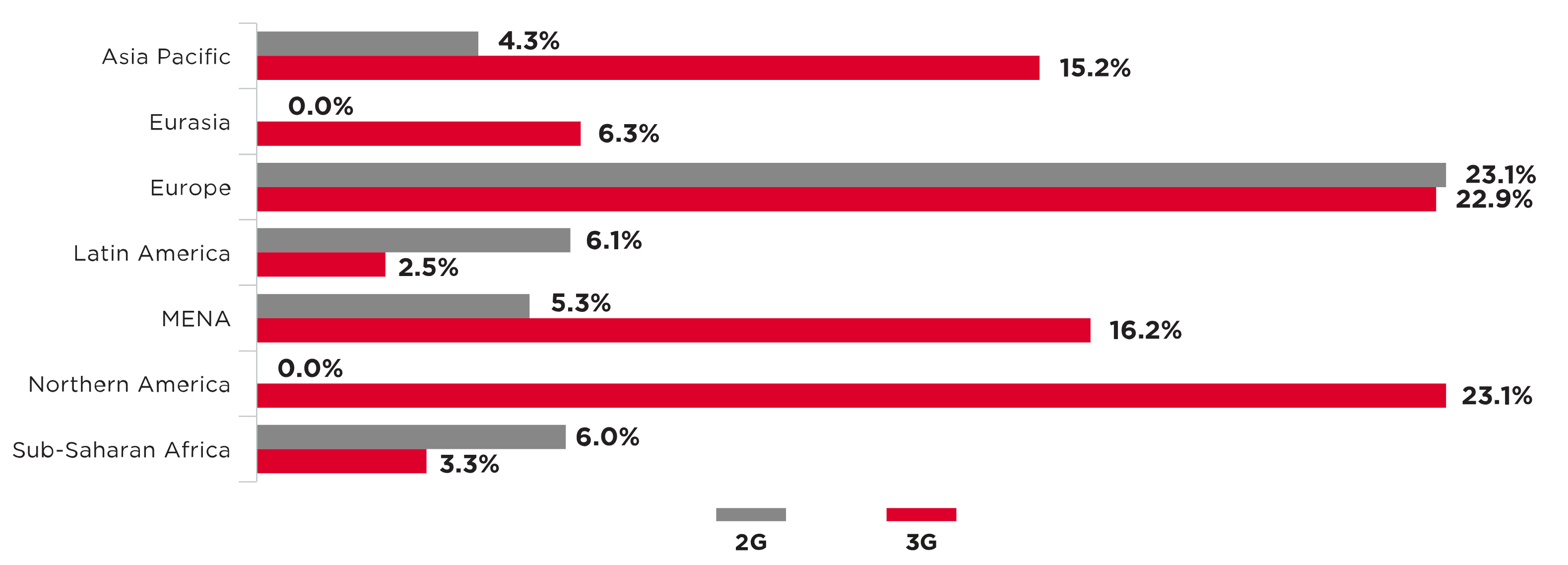
So far, Asia Pacific and Europe have been at the forefront of network sunsets, accounting for around 70% of shutdowns. By 2030, Europe will lead in network sunsets, with 62% of European countries participating, compared to 34% of Asia Pacific countries. 3G will outnumber 2G shutdowns, accounting for 55% of the total sunsets by 2030.
Figure 2: Planned network sunsets in the region as a percentage of active networks in the region
Source: GSMA Intelligence
| Policy in practice: Kuwait and Qatar aim to sunset 3G in 2025 Kuwait and Qatar’s telecommunication regulatory bodies have mandated telecom operators to shut down 3G networks by June 2025 and December 2025, respectively. To support the shutdown and customer transition, Qatar also banned the import of mobile phones that only support 2G and 3G technologies. |