


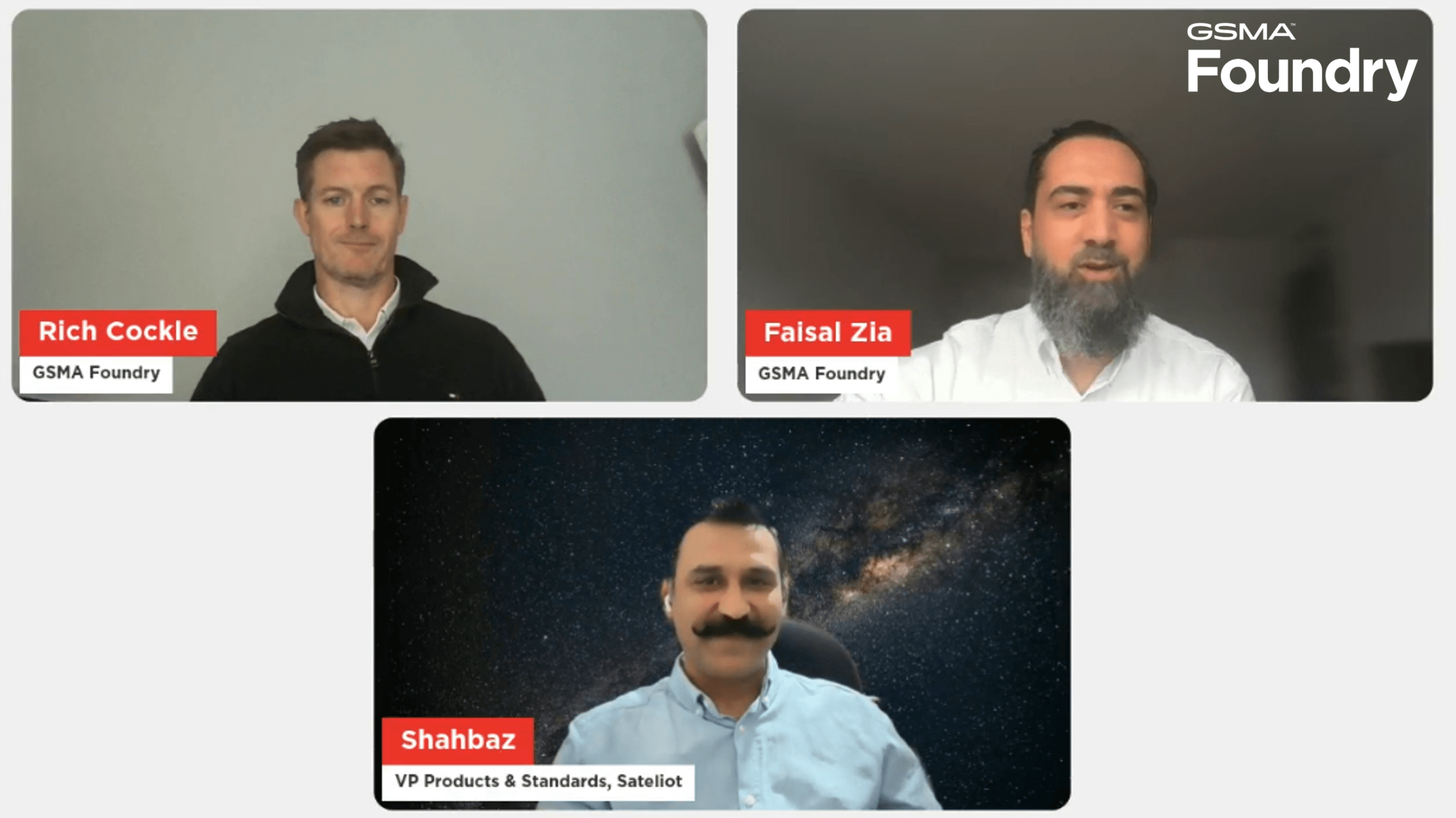

Innovation Spotlight #11 took us far beyond traditional telecoms, straight into the future of seamless global connectivity. With a space-themed nod to Apollo 11, hosts Rich Cockle and Faisal welcomed Satelliot, one of GSMA Foundry’s 2025 Excellence Award winners, for a deep dive into the convergence of terrestrial and non-terrestrial networks (NTN).
What followed was an insightful and candid conversation with Shahbaz, VP of Products and Standards at Sateliot, covering everything from the limits of today’s networks to the transformative potential of affordable, standardised satellite connectivity.
Watch the full interview here.
A Journey Rooted in Solving Real-World Problems
Shahbaz opened by sharing a personal story that’s familiar to many innovators: a career spanning major telecom equipment providers and operators, driven by a desire to tackle real-world challenges.
The turning point? Seeing Satelliot pioneering a paradigm shift—bringing IoT connectivity directly from space using standard 3GPP technology.
The promise of solving coverage gaps at a global scale made the move irresistible.
Why Seamless Connectivity Matters Now More Than Ever
Despite claims of 99.9% terrestrial coverage, the reality for IoT is far more complex. Devices moving across borders, logistics routes, oceans, or remote land areas frequently fall into coverage gaps.
Shahbaz highlighted a striking fact: “Only 20% of Earth’s landmass actually has terrestrial coverage.“
The other 80%, oceans, forests, mountains, rural expanses, remains disconnected.
For mission-critical verticals like agriculture, mining, logistics, public safety, and environmental monitoring, this is a costly limitation.
This is where Non-Terrestrial Networks (NTNs) step in.
Democratising Satellite Connectivity Through Standards
One of Sateliot’s core missions is democratisation, taking satellite connectivity from premium, proprietary, and expensive to affordable, interoperable, and massively scalable.
How?
By leveraging 3GPP Release 17 standards. This allows:
- The same modules and chipsets used for terrestrial NB-IoT to connect to satellites
- Mass adoption driven by low-cost, standardised hardware
- Direct-to-device connectivity without expensive proprietary terminals
- Operators to extend coverage without additional infrastructure
In Shahbaz’s words: “This is not a proprietary solution. We are implementers of the standard.”
That distinction is critical; it enables global scale.
Working With the Ecosystem, Not Against It
A recurring theme throughout the discussion was collaboration. Shahbaz was clear: Sateliot is not competing with Mobile Network Operators (MNOs).
Instead, they extend the operator’s coverage footprint through standard roaming, no infrastructure upgrades required.
This means:
- Customers keep their existing operator as the service owner
- Devices switch seamlessly from terrestrial to satellite
- Operators unlock new revenue without new towers
This cooperation-first model has been instrumental in driving industry buy-in and reducing early-stage scepticism.
Regional Demand: Why Australia Is a Hotspot
Australia, with its vast unconnected landmass and critical industries like agriculture and mining, has emerged as a priority market.
Demand there is high across both IoT and emerging Direct-to-Device (D2D) use cases, especially for public safety and emergency communications.
Sateliot is already licensed and actively integrating with operators across the region as part of broader global expansion.
MWC Barcelona 2025: A Milestone for Live NTN Validation
At MWC Barcelona 2025, Sateliot showcased:
- A real reference device using 3GPP Rel-17 NTN
- Live switching between terrestrial and satellite networks
- End-to-end data flow from device → satellite → MNO → cloud
- A clear roadmap toward wider constellation coverage
Industry response? Strong interest from agriculture, logistics, mining, and environmental solution providers who saw their own use cases reflected in the demo.
Looking Ahead: AI, Spectrum Strategy, and a More Connected Planet
For the next two to three years, Sateliot’s vision is anchored in three pillars:
- Connect the unconnected: Expanding global coverage through an affordable NTN layer.
- Advance and influence standards: Active participation in 3GPP releases 18, 19, and 20 to align terrestrial and space-based connectivity.
- Integrate AI for optimisation: Potential applications include:
- Predictive network planning
- Intelligent bandwidth allocation
- Dynamic spectrum sharing
AI-driven NTN could dramatically improve efficiency and latency in the future.
Winning the GSMA Foundry Excellence Award
Sateliot’s work culminated in a major recognition: “The GSMA Foundry Excellence NTN Award 2025.“
For Shahbaz and the team, it wasn’t just an award; it was validation.
“It created believability in the ecosystem that this is real, this is viable, and this is happening now.”
Final Thoughts: Building a Connected, Sustainable Future
As the conversation wrapped, Shahbaz posed a powerful question for the next Innovation Spotlight guest:
“What is the single most important thing we need to ensure technology creates a more equitable and sustainable future for all?”
It’s the perfect reflection of Sateliot’s mission: Use technology not just to innovate, but to elevate—connecting people, places, and industries that have been left behind.
With standardised NTN, that future feels closer than ever.
Watch the full interview here. You can delve into past Innovation Spotlights here.
Stay tuned for further developments from the GSMA Foundry. If you have any questions or want to join this exciting journey, feel free to reach out.
You can delve into past Innovation Spotlights here.