



“Sports are losing grip on their fans in general.” Speaking at MWC26 Barcelona’s Sports and Entertainment Summit, Vladimir Liulka, CEO of Blocksport did not deliver this verdict softly. He stated it as fact, and the data backs him up. Research from Infobip found that 66% of fans feel disconnected from their clubs. Critically, 81% of those disengaged fans are under 35. For an industry that has long assumed loyalty was unconditional, AI sports fan engagement has moved from a strategic option to an urgent priority.
Yet sport has never enjoyed wider global reach. Formula One now claims 1.57 billion followers worldwide. MotoGP, meanwhile, delivers content to 632 million viewers across 19 countries. Platforms multiply and content volumes swell, but something essential is still missing. The fan at the centre increasingly feels like a passive spectator. The summit addressed one central question: how can AI sports fan engagement close this gap before the next generation disengages entirely?
The sport’s loyalty myth is unravelling
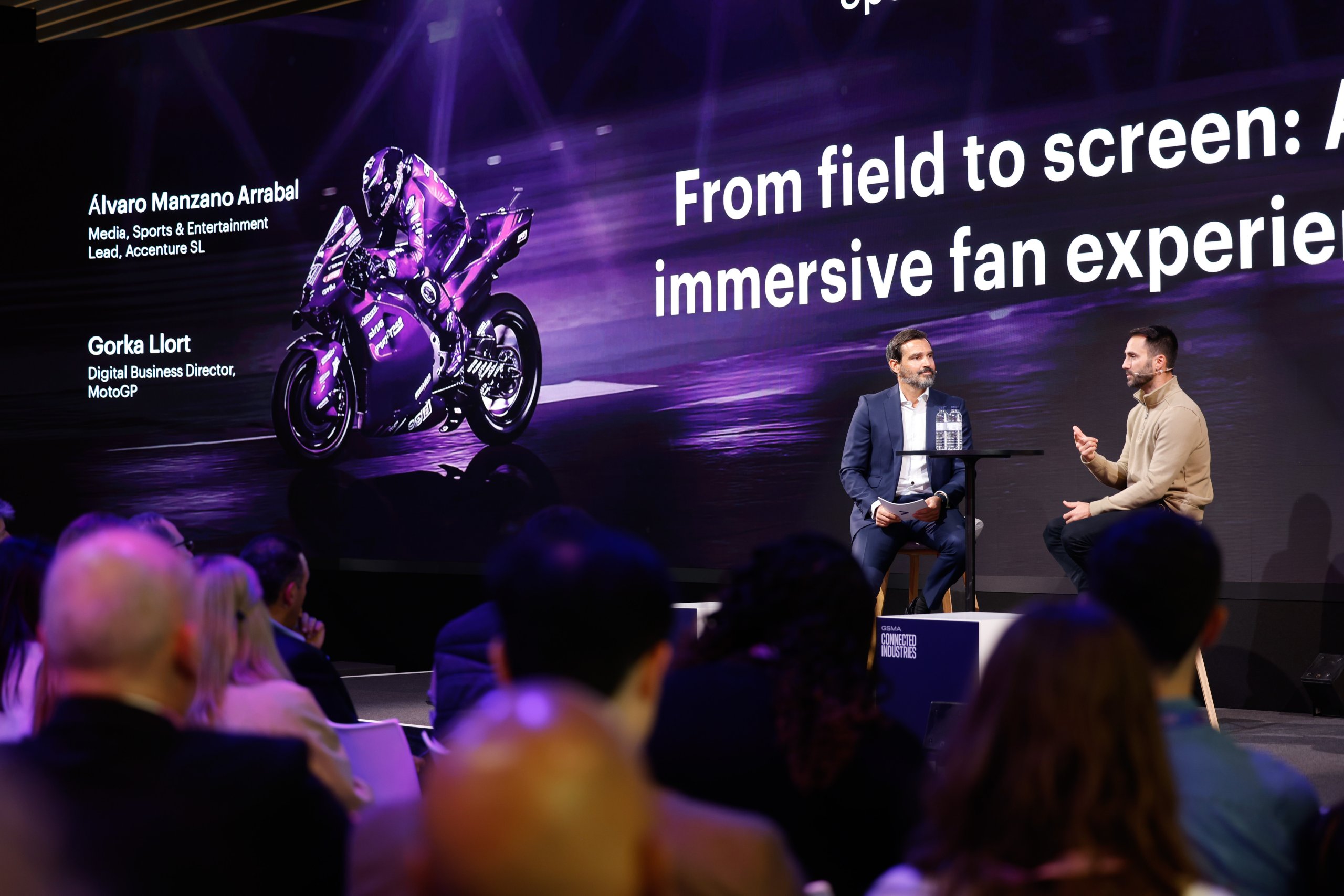
For decades, sport operated on one widely-held assumption: content is king. Produce more, broadcast wider, and fans will follow. MotoGP’s Digital Business Director, Gorka Llort, explained why that model has broken down. The fan base has fragmented dramatically. Every person consuming sport today does so differently. They use different devices, engage on different platforms, and arrive at different moments in the fan journey. Treating them as a single demographic, Llort argued, no longer reflects reality. “You cannot talk about fans as a group of people of this age and this demographic anymore. We have as many types of fans as people consuming our content out there — millions and millions. And in order to do that, we need to personalise the experience better”, he said.
This change demands a fundamentally different approach. Personalisation is no longer a differentiating feature. Indeed, it has become the baseline expectation. Moreover, delivering it at scale requires a wholly different relationship with data. Llort was direct on this point: capturing user data is ultimately revenue. It may not convert immediately, but it compounds over time. Richer audience insight enables more targeted partnerships, more relevant content, and stronger commercial conversion as a result.
Know your fan: the data behind sports fan engagement
If personalisation is the destination, data is the only route there. Michael Heath leads Fan Engagement and CRM at TGR Haas F1 Team explained about how far sport still has to travel. For more than two decades, clubs and rights holders rested on unconditional fan loyalty. They expected audiences to come to them, to open emails and visit websites. Formula One has 700 million fans. Yet only 5% of them will ever attend a race. The remaining 95% have largely been left to find their own way in.
“Being able to be where the fan is, rather than expecting the fan to be where you are, is going to be how you win in this space” explained Michael Heath. Working with Infobip, Haas began putting this principle into practice through pilots including a live Monza chatbot campaign, using channels such as WhatsApp and RCS around race weekends. The results were stark: a 79% click-through and completion rate, against a typical 2% on email. Furthermore, the cost per acquisition fell by 80%. The data collected through these interactions also built a richer picture of each fan individually. Vladimir Liulka reinforced this from the platform side. He argued for a unified fan data layer bringing together interactions across ticketing, merchandise and other channels. Without that foundation, he argued, hyper-personalisation remains aspiration rather than practice.
AI and XR are redefining sports fan engagement
Data and personalisation address the fan relationship. However, a parallel set of technologies is tackling something more ambitious. The question is not simply how to know the fan better. It is what the fan experience itself can become. Adam Berger, Head of Product Marketing for Wearables at Meta, set the context with one striking statistic: “It took 23 years to reach 90% adoption of the internet. It has taken three years to reach 90% adoption of AI. And we’re just at the beginning.”
That adoption curve sets the pace of expectation. Meta’s AI-enabled smart glasses include a sports-focused partnership with Oakley. Together, they are beginning to dissolve the boundary between watching and experiencing sport. Point-of-view footage from athletes is already in market. So is real-time performance data via Garmin integration. AI-powered coaching queries during a run or a race are no longer conceptual. As I put it during the discussion, AI gives entertainment intelligence, and XR gives it presence. Combined, they point to a more immersive layer around live sport, extending what broadcast alone can offer.
Building the infrastructure: Circuit X and the 5G imperative
These experiences demand infrastructure that can actually support them. Notably, that infrastructure is already being tested. The GSMA Foundry’s Circuit X initiative is a three-year connectivity testbed at Circuit de Barcelona-Catalunya. It was established in partnership with Mobile World Capital. Ten technology partners joined, including Ericsson, Telefónica, and antenna specialist MatSing. The weekend prior to MWC26 Barcelona, they ran their first live demonstration. Over 200 people attended. The centrepiece was a connected module attached to a Formula E car, transmitting live data at 170 miles per hour. “We’ve heard a lot of theory. This is practice” said Richard Cockle, Head of GSMA Foundry and Connected Industries at the GSMA.
Circuit X demonstrated what standalone 5G makes possible at scale. Luis Ramirez, founder and CEO of 3D streaming company Mawari, illustrated why the urgency extends beyond the circuit. For AR experiences to feel genuinely immersive, the network must respond in under a second. That requires compute power distributed close to the end user. Consequently, Mawari is running 5G millimetre-wave trials in Tokyo, benchmarking delivery from 20 to 1,000 concurrent users at a virtual AR concert.
Tim Hatt, Head of Research & Consulting for GSMA Intelligence, argued that standalone 5G is now reaching the scale needed to support richer AR, real-time personalisation and broadcast use cases. This is the architecture needed to support enhanced AR, real-time personalisation and higher-quality live experiences at scale.
The monetisation window is closing and the telco opportunity
For MNOs, the rise of AI sports fan engagement represents both a major opportunity and a pressing strategic risk. Giles Tongue, VP of Marketing at Bango, framed the situation directly. His research found that sports fans carry 40% more subscriptions than average consumers and spend 55% more. They are, therefore, a highly valuable audience for operators. They are also the most acutely affected by subscription fatigue.
The opportunity to bundle sports content with connectivity (and resolve that fatigue in one move) is consequently one of the most powerful tools an operator has. Tongue cited Telenet in Belgium, for example, which recorded a 26% reduction in churn among customers who took a sports bundle. The business case is already proven. As he laconically explained: “Bundle or be bundled. There are only two roles available in that future. You’re the one who controls the customer relationship, or somebody else does and you’re a component within their bundle.”
That binary is sharpening rapidly. Non-endemic platforms are entering the space. Banks and content creators are launching their own MVNOs and lifestyle bundles. Additionally, AI is becoming a discovery layer that can bypass apps and websites entirely. As a result, telcos that fail to build direct relationships with sports audiences risk becoming invisible infrastructure. Those who invest now in data platforms, conversational AI, and sports content bundling will own the customer relationship. Those who wait will instead find themselves a component in someone else’s offering.
The future of AI sports fan engagement
The picture from the industry summit is therefore one of urgent convergence. The technical infrastructure is not waiting for a future deployment; we can see that Circuit X has demonstrated that. The AI layer, meanwhile, is maturing at extraordinary speed. Consumer expectations are already ahead of what the industry currently delivers. What remains is the harder work: aligning rights holders, technology providers, MNOs, and clubs around a shared model. One where the fan sits at the centre rather than at the end of a broadcast chain. AI sports fan engagement is the mechanism through which that relationship gets rebuilt. The organisations that understand this first will consequently define the next era of the industry.
Get the latest news on CircuitX and how to get involved in next year’s partnerships.