


Monday 19 October, 2026
Held every five years, the World’s Fair—also known as the World Exposition—is a major international event hosted in different cities. Osaka, Japan, was selected as the host city for World Expo 2025. The event, officially known as Expo 2025 Osaka, Kansai, Japan, is scheduled to run from April 13 to October 13, 2025, and is located on the man-made Yumeshima Island in Osaka Bay. The organizers anticipate around 28.2 million attendees during the event’s six-month duration.
The success of the Expo’s experiences hinges critically on robust and advanced mobile performance and connectivity. This analysis evaluates 5G coverage and performance, using data collected between the opening day of the Japan Expo 2025, which was April 13, up till June 6, 2025.
Key Takeaways
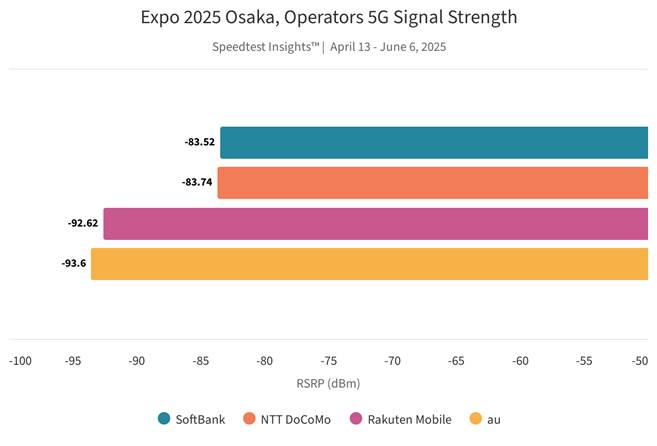
- SoftBank and NTT DoCoMo delivered the strongest 5G signal strength, while all four operators showed similar signal quality levels. SoftBank and DoCoMo recorded mean RSRP values around –83 dBm, indicating good 5G coverage across the venue. Rakuten Mobile and au trailed with weaker signal strength, although RSRQ results across all networks clustered between –12.58 dB and –13.01 dB.
- au led all operators in 5G download speed at Expo 2025, with a median of 384.68 Mbps, followed by DoCoMo and SoftBank. Speedtest® data shows a clear gap between operators, especially in the lower 10th percentile, where au maintained strong throughput while Rakuten’s performance dropped significantly.
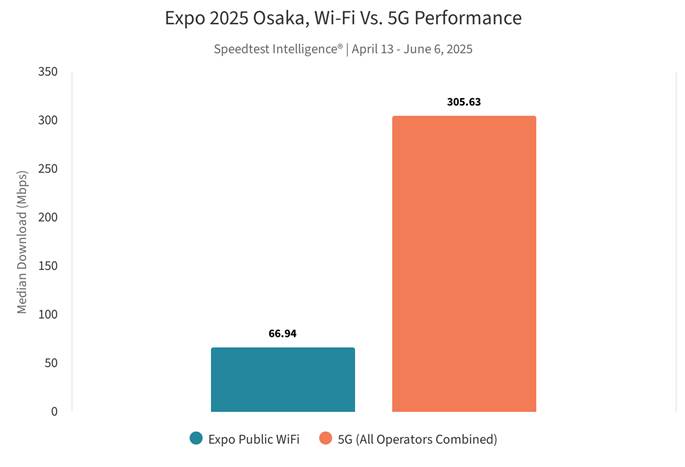
- Expo 2025’s public Wi-Fi fell far behind 5G in download performance, highlighting the complementary roles of both networks. Visitors who are able to access the public Wi-Fi experienced median download speeds of 66.94 Mbps, compared to 5G’s combined median download of 305.63 Mbps.
SoftBank and DoCoMo Reported Stronger 5G Signal Strength At Expo 2025
To meet the demands of the event, major Japanese operators have reportedly deployed additional 5G base stations in and around Yumeshima Island. Despite these deployments, the Expo encountered initial wireless network outages on its opening day, leading to operational disruptions. This highlighted the inherent complexities of managing high-density network traffic in a dynamic, large-scale event.
Using data from Speedtest Insights™, collected from April 13 to June 6, 2025, we evaluated the Expo visitor’s 5G experience by measuring the average Reference Signal Received Power (RSRP) and Reference Signal Received Quality (RSRQ). RSRP represents the network signal strength received by a mobile phone. An RSRP value stronger than -80 dBm indicates superior coverage. Measurements between -80 dBm and -90 dBm represent good coverage, while those from -90 dBm to -100 dBm are considered fair coverage. Below this range, expect slower download speeds and potential network disconnections. RSRQ is a metric used to evaluate the quality of the reference signal received by a device. A value of -10 dB or higher indicates excellent network quality while a value between -10 dB and -15 dB is considered good. An RSRQ value lower than -15 dB is poor or indicates no signal at all.
The 5G signal strength comparison between mobile operators is depicted in the plots below. Softbank and NTT Docomo exhibit good to excellent 5G coverage in most locations, at -90 dBm or better. In contrast, within the Expo area, Rakuten and au show a significant portion with 5G signal strength of -90 dBm or lower, indicated by the prevalence of light green and orange tiles.
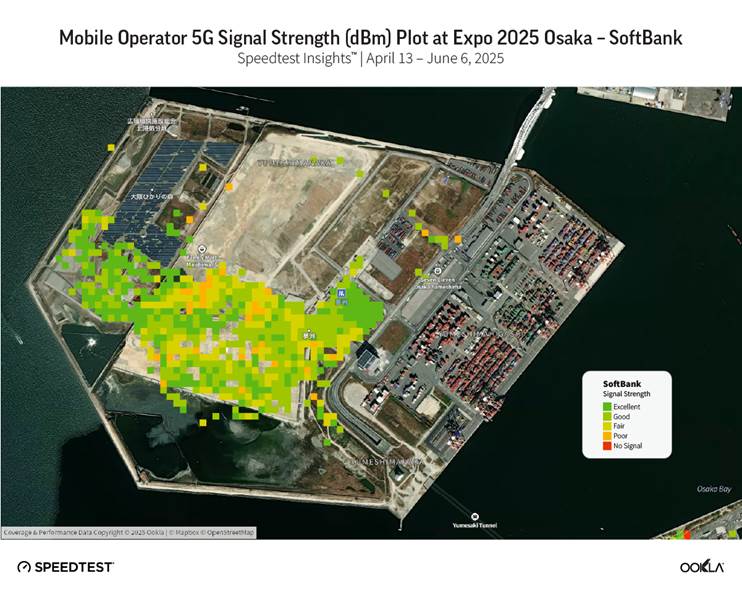
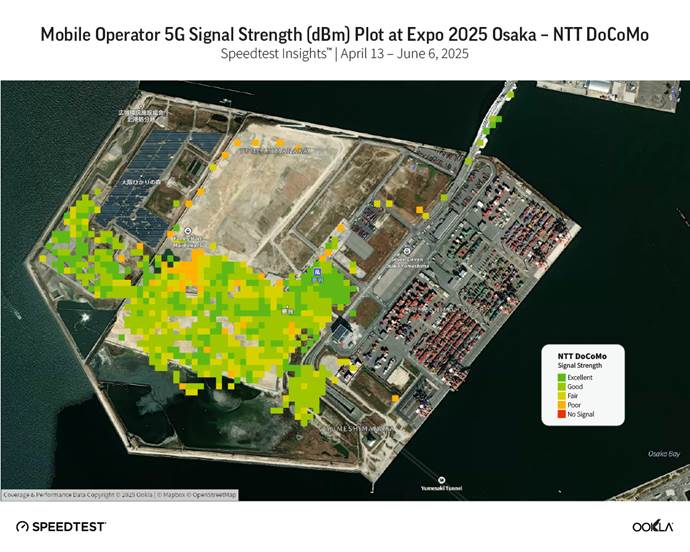

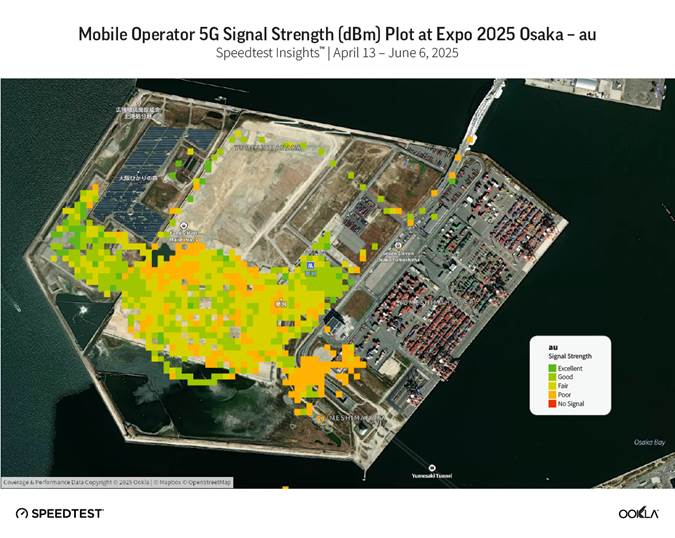
The data shows that SoftBank and NTT DoCoMo demonstrated good coverage, exhibiting nearly identical average 5G signal strength. SoftBank reported a mean RSRP of -83.52 dBm, while NTT DoCoMo followed closely with -83.74 dBm. Rakuten Mobile and au, on the other hand, showed slightly weaker average 5G signal strength. Rakuten reported a mean RSRP of -92.62 dBm, and au recorded the lowest signal strength with a mean RSRP of –93.60 dBm, indicating a more limited signal reach or reduced performance in indoor or congested areas.
In terms of signal quality, the gap between operators was much narrower. Rakuten Mobile reported an average RSRQ of -12.58 dB, followed by SoftBank at -12.63 dB, au at -12.90 dB, and NTT DoCoMo at -13.01 dB. All four operators reported values within a tight range, suggesting similar levels of network load and interference.
5G Speed Performance at Expo 2025 Shows Clear Gaps Between Operators
Based on Speedtest Intelligence® data collected from April 13 to June 6, 2025, au delivered the fastest 5G performance among Japan’s major operators during the Expo period. The operator recorded a median download speed of 384.68 Mbps, with the bottom 10 percent of users still achieving 354.34 Mbps, while the top-performing 10 percent reached 411.94 Mbps. This consistency across all user percentiles reflects strong network capacity and a well-optimized 5G deployment across the event site.
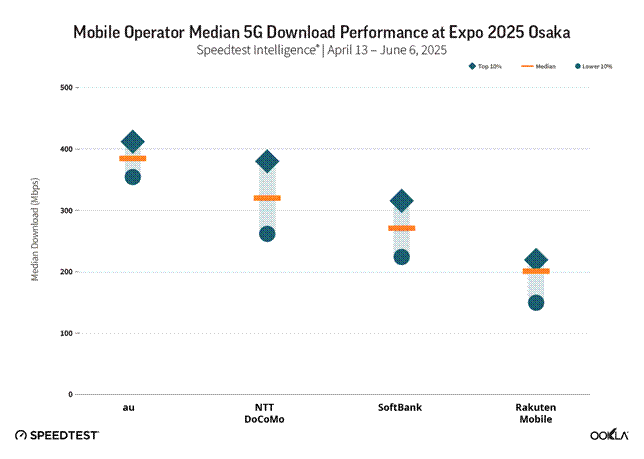
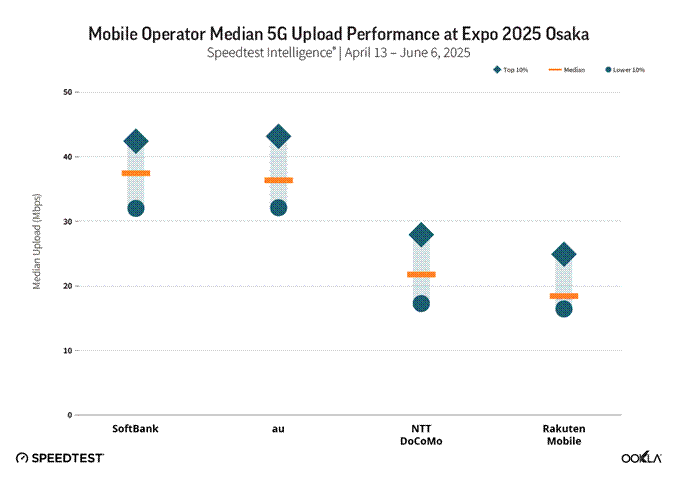
NTT DoCoMo followed with a median download speed of 320.07 Mbps. DoCoMo still maintained solid performance, with the lower 10 percent of speeds at 261.74 Mbps and the top 10 percent reaching 379.94 Mbps. SoftBank trailed further behind, recording a median of 270.98 Mbps. Rakuten Mobile showed the slowest 5G performance, with a median download speed of just 200.96 Mbps. The lower 10 percent of users recorded only 149.58 Mbps, and even the top 10 percent capped at 219.30 Mbps. Upload performance results followed a similar trend. SoftBank reported the highest median upload speed at 37.45 Mbps, closely followed by au at 36.36 Mbps. NTT DoCoMo and Rakuten Mobile recorded considerably lower uploads at 21.78 Mbps and 18.43 Mbps, respectively.
Initial Wi-Fi Network Strain Underscored the Need for Robust Mobile Access
On the opening day of the Expo, visitors reported several connectivity issues, including limited Wi-Fi availability, authentication problems, and unstable access during peak traffic periods. The Expo organizing committee acknowledged the disruptions and stated that backup systems and additional bandwidth were deployed within the first 48 hours. By April 15, several access points were reconfigured, and temporary signal boosters were installed in high-traffic zones to stabilize the Wi-Fi network.
Using Speedtest Insights data, we analyzed the Wi-Fi performance based on the public SSID meant for visitors to the expo to access. Based on the data, the public Wi-Fi network delivered a median download speed of 66.94. This speed was sufficient for general browsing, messaging, social media use, and video calls. However, they were significantly lower than the median speeds offered by 5G mobile networks throughout the event period. For comparison, 5G speed for all operators combined recorded a median download speed of 305.63 Mbps, 4.5 times faster than the public Wi-Fi benchmark.
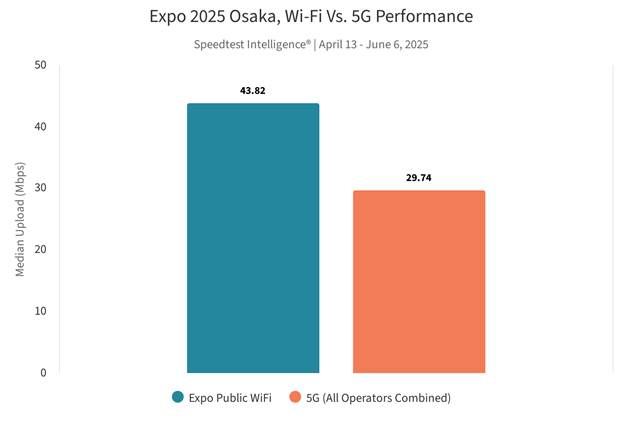
While 5G networks led in median download speeds, public Wi-Fi provided faster upload speeds during the same period. Data collected from April 13 to June 6 shows that Expo’s public Wi-Fi delivered a median upload speed of 43.82 Mbps. In contrast, the combined median upload speed across all 5G mobile operators was 29.74 Mbps.
The comparison highlights a broader trend seen at large-scale events: while public Wi-Fi offers convenience in areas where access is available, it remained supplementary rather than primary for high-bandwidth tasks. The bandwidth and throughput of 5G networks provided more stable and higher-speed alternatives for most visitors.
The early issues at Expo 2025 highlighted the inherent complexities of managing high-density network traffic. Please contact us to learn how Ookla® can help you determine if your network is prepared for the massive crowds that accompany a marquee event, and analyze how your network performs both indoors and out, down to the building level.
Ookla retains ownership of this article including all of the intellectual property rights, data, content graphs and analysis. This article may not be quoted, reproduced, distributed or published for any commercial purpose without prior consent. Members of the press and others using the findings in this article for non-commercial purposes are welcome to publicly share and link to report information with attribution to Ookla.
