


Friday 12 June, 2026
Robust power redundancy markedly reduced outage impacts for one operator, while limited backup systems led to widespread service collapse for another, highlighting the importance of resilience planning and investment.
Mobile operators, equipment vendors, and policymakers throughout Europe are grappling with the challenge of hardening telecom infrastructure to withstand increasingly frequent and severe disruptions caused by power outages, sabotage, and extreme weather events.
Earlier this year, the Iberian grid blackout placed Portugal’s mobile operators at the coalface of this resilience challenge, creating a real-world stress test of their infrastructure on an unprecedented scale. Effective power redundancy, supported by battery and generator backups, coupled with energy conservation measures that strategically adjusted network configurations to preserve site availability, emerged as critical tools for limiting outage impact.
However, new analysis of Ookla® background signal scan data from the outage reveals that each operator’s ability to mitigate the disruption varied significantly, offering important lessons for future improvements in Portugal and beyond. This research builds upon our earlier findings in Spain, where we cross-referenced crowdsourced ‘no service’ data with satellite imagery to demonstrate that the profile of network disruptions and recovery moved in lockstep with power grid developments.
Key Takeaways:
- At the height of the network disruptions on the evening of April 28th, more than one in three mobile network users in Portugal was left without service. The voltage drop triggered by the grid collapse rapidly cascaded through Portugal’s mobile networks, driving the share of users experiencing total service loss (unable to call, text, or use data as sites went dark) from a pre-blackout baseline below 0.1% to over 10% within two hours. At the peak late on April 28th, as battery and generator backups were progressively depleted, more than 60% of users across the worst-affected areas of Portugal were left without service.
- While severe network outages affected all Portuguese operators during the blackout, mobile users on DIGI’s network were significantly more likely to experience a total loss of service. With up to 90% of DIGI subscribers left without any mobile coverage for over twenty-four hours, the outage exposed critical gaps in redundancy across multiple infrastructure layers, from mobile sites at the edge all the way to the core, potentially reflecting the limitations of DIGI’s less mature network buildout in Portugal.
- MEO’s network demonstrated significantly greater resilience across Portugal during the April 28th blackout, illustrating how deep and widely deployed battery reserves can materially flatten and delay outage impacts triggered by power loss. At the peak of service disruption six to eight hours after the power loss, MEO’s subscribers were on average half as likely to lose service as those on NOS’s network, four times less likely than Vodafone’s subscribers, and six times less likely than DIGI’s. As a result, at least tens of thousands more MEO subscribers likely stayed connected for calls, texts, and data throughout April 28th.
- The variation in outage impact between operators in Portugal was significantly greater than in Spain, revealing much deeper asymmetry in the level of power resilience across Portugal’s mobile networks. As in Spain, however, the pattern of service restoration reflected the geographically phased re-energisation of the power grid, with network disruptions persisting later into the night in Lisbon than in Porto, consistent with transmission operator REN’s blackstart process, which began in the north and moved south.
Blackout cascaded through Portugal’s mobile networks, forcing aggressive energy conservation measures as traffic demand surged and power backups were depleted
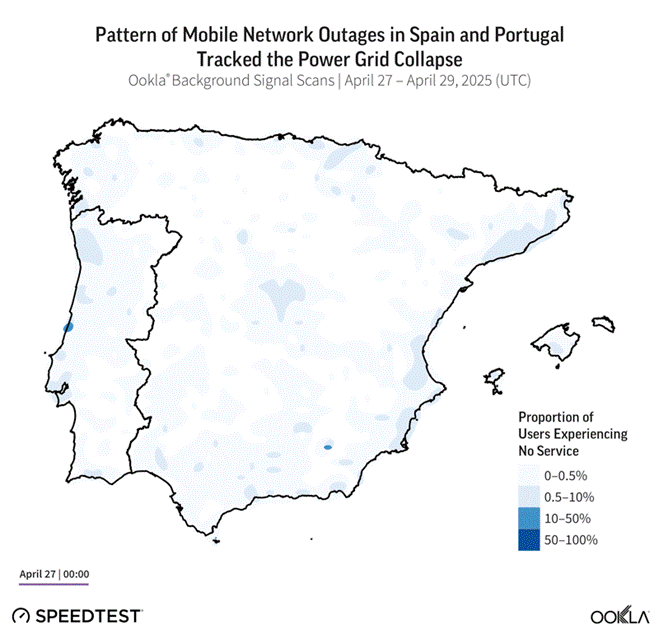
When the grid-wide collapse severed power to virtually all of mainland Portugal at 11:33 local time on April 28th, mobile sites were immediately forced off mains electricity and had to rely on batteries or generator backups, triggering a nationwide race between grid restoration and the exhaustion of backup reserves across telecom networks. Sites lacking any power autonomy vanished immediately (such as dense urban small cells), triggering a stepwise collapse in overall network density that resembled a cliff drop followed by a gradually declining tail.
The sudden loss of residential electricity rendered fixed networks and in-home Wi-Fi CPEs unusable, forcing users onto mobile networks and unleashing a massive surge in traffic that put intense pressure on capacity, particularly in urban areas. This was reflected in a rapid degradation of mobile network performance across all metrics, as illustrated in analysis of Speedtest Intelligence® data published in our earlier research.
The spike in demand on the country’s mobile infrastructure occurred just as operators were racing to implement aggressive energy conservation measures to extend the life of backup power at mobile sites. These efforts included phased 5G switch-offs (as 3.5 GHz massive MIMO radios typically draw two to three times the power of a low-band 4G sector), prioritizing core voice and text services, and reducing cell-edge transmit power where network loads were light.
Blackout produced a composite outage curve made of one large step (DIGI) superimposed on several peaked pulses (Vodafone, NOS, and MEO)
Although all of Portugal’s mobile operators implemented similar energy conservation measures during the blackout, the depth and distribution of power autonomy within each operator’s site portfolio, including the partially shared footprint between NOS and Vodafone, ultimately shaped their network resilience. This is evident in the distinct outage trajectories revealed by analysis of background signal scan data, which shows whether a device could connect to any network (2G, 3G, 4G, or 5G) based on a very large, geographically diverse sample across Portugal.
DIGI’s still-nascent network, which is leaner and heavily concentrated in cities (therefore making deployment of power autonomy more challenging at space-constrained rooftop sites), proved particularly brittle. Within four hours of the voltage drop, the share of subscribers on its network with no signal shot up from less than 0.1% to more than 90%, a classic step-function collapse. The operator’s entire radio layer appeared to disappear almost simultaneously, driven by shallow site-level batteries and little layered fallback. In addition, network access remained crippled for more than a day, likely pointing to a catastrophic failure of deeper elements such as the Evolved Packet Core (EPC) in Lisbon, which may have lacked geo-redundancy or sufficient power autonomy.
While Vodafone’s outage curve did not exhibit the same cliff-like profile as DIGI’s, instead following more of a triangular or peaked pulse shape, it still reached a very sharp peak. The heterogeneous distribution of backup power across Vodafone’s site footprint produced a multi-step survival curve, with each autonomy band expiring (for example, sites with four-hour batteries) causing another visible kink in the aggregate outage trajectory.
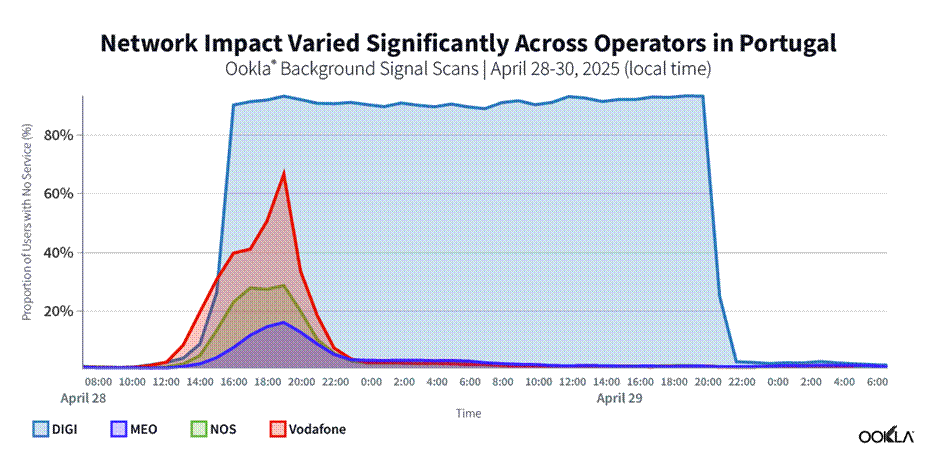
By 19:30 local time, almost 70% of Vodafone’s subscribers were left without service as the last reserves of backup power began to deplete ahead of grid restoration. While this was still materially lower than the more than 90% service loss seen on DIGI’s network in Portugal, it was nearly twice as high as the peak outage experienced by any operator in Spain on April 28th. Service was, however, rapidly restored on Vodafone’s network from 20:00 in a phased geographic sequence, aligning with the restoration of the grid, with the no service ratio falling below 5% by midnight.
Unlike other operators in Portugal, Vodafone and NOS have extensive RAN sharing, with a joint venture owning and operating actively shared sites in rural and interior areas, while sites in urban areas are passively shared. Despite this, the outage profile for NOS was notably less severe. This indicates that NOS’s network features relatively deeper power resilience in locations where its infrastructure is not actively shared, compared with Vodafone’s independently managed sites. On NOS’s network, the proportion of subscribers without service peaked early at nearly 30%, closely resembling the impact profile of the worst-affected operator in Spain, and remained at this level until power was restored.
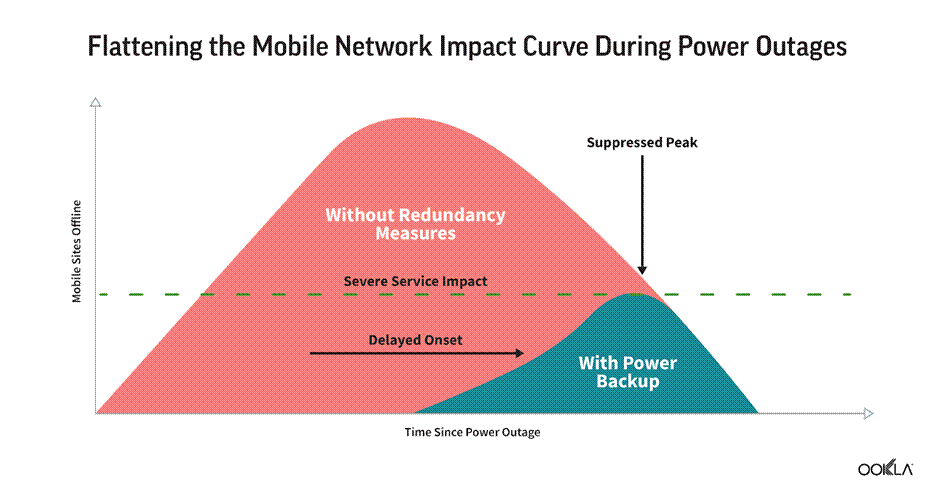
The merits of widely deployed and deep battery reserves in flattening and delaying the outage curve (much like masks and vaccines suppress infection spread during a pandemic) were clearly demonstrated in MEO’s case. Its outage peak was lower and the tail shorter, with the proportion of subscribers left without service peaking at just over 16%, which was the best performance observed across Spain and Portugal on April 28th.
Outage experience demonstrates the role of power autonomy and geo-redundancy in hardening telecom infrastructure against external shocks
When the grid collapsed, every Portuguese operator reached for the same first lever by killing off the power-hungry 5G layer, but what happened next diverged. The breadth and depth of each operator’s power autonomy (at the site level) and the extent of geo-redundancy (at the core level), along with their ability to cascade lower-band layers, throttle traffic, and reshuffle spectrum, dictated how much of their network stayed online and for how long during the blackout.
The pronounced asymmetry in outage impacts observed across operators’ subscriber bases highlights the urgent need to harden mobile networks and raise all infrastructure layers to a higher baseline of resilience ahead of future severe events. There is now broad consensus, which is expected to be enshrined in the European Commission’s forthcoming Digital Networks Act (DNA), that telecom networks are critical infrastructure essential for societal functioning, and that even brief service disruptions can quickly escalate into serious public safety risks.
Ookla retains ownership of this article including all of the intellectual property rights, data, content graphs and analysis. This article may not be quoted, reproduced, distributed or published for any commercial purpose without prior consent. Members of the press and others using the findings in this article for non-commercial purposes are welcome to publicly share and link to report information with attribution to Ookla.
