



The COVID-19 pandemic has amplified many of the challenges already facing employment, reinforcing the need to upskill and train the youth to avail new employment opportunities. On the UN World youth skills day, we share excerpts from our recent research – Powering Youth Employment through the Mobile Industry in Sub-Saharan Africa by 2025 – to reflect on the existing skills-gap that need to be bridged for a better future through the mobile industry.
Skills gap: the biggest challenge for youth employment through the mobile industry in Sub-Saharan Africa
The mobile industry plays a two-pronged role in youth employment: on the supply side, creating opportunities for decent work, and on the demand side, enabling access to job opportunities, providing decent working conditions and opportunities for training, upskilling and career advancement for employees. In order to understand the challenges to employment through the mobile industry in Sub-Saharan Africa (SSA), we spoke to a group of 45 experts including mobile operators and industry experts. Our research concluded that ‘skills gap’ – a situation in which the level or types of skills available does not correspond with labour market needs – is by far the biggest challenge in youth employment in SSA.
Ineffective education contributes to this issue, but equally the disconnect between the mobile industry and educational institutions causes youth to lack the key skills needed to acquire, retain and progress in their jobs. The school and university curricula are often not designed with market needs in mind. Moreover, there is a shortage of early work experience opportunities like internships and apprenticeships, which are often the first step for fresh graduates to get acquainted with skills needed in the job market.
Behavioural and digital skills are most in demand, but in shortest supply
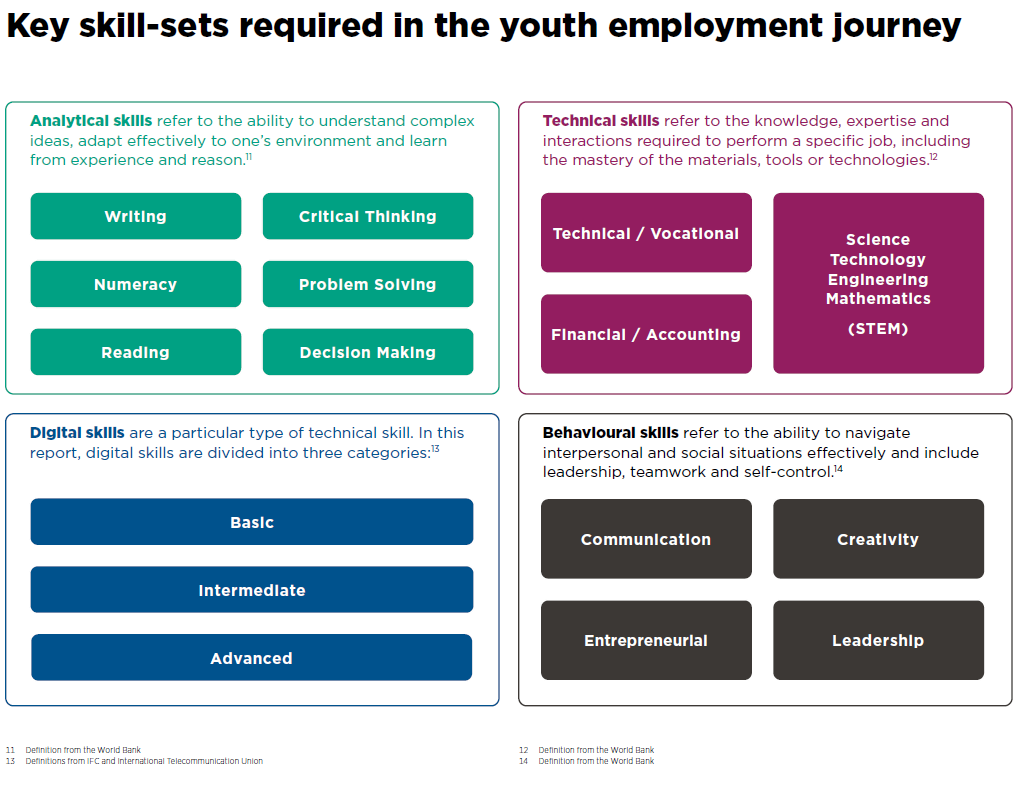
Figure: Key skill-sets required in the youth employment journey Source: GSMA Mobile for Development
The key skills sets required by the youth can be divided into four sets namely analytical skills (eg. writing, numeracy, critical thinking), technical skills (eg. financial, accounting, STEM subjects), digital skills and behavioural skills (eg. communication, creativity, leadership).
While one might expect technical skills to be of most value in a tech-driven sector, it is in fact behavioural skills, such as communication, negotiation, teamwork and leadership, that are most in demand. As a member of our expert group put it, “Hard skills can get you through the doors, but it is soft skills that keep you in.” Interestingly, behavioural skills were also identified as those in shortest supply in the region, signifying a clear gap between in-demand and available behavioural skills, followed closely by digital skills.
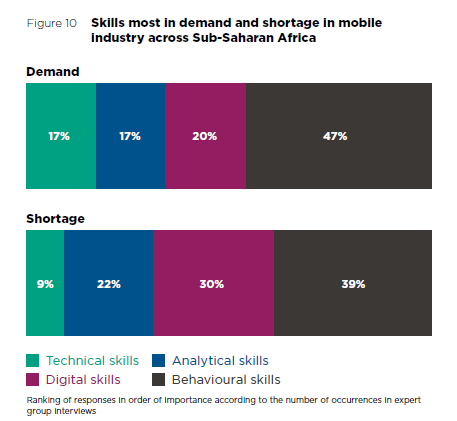
Figure: Skills most in demand and shortage in mobile industry across Sub-Saharan Africa Source: GSMA Mobile for Development
The skills gap differs by job type
It is worth noting that different job types and levels, require different skill sets. For instance:
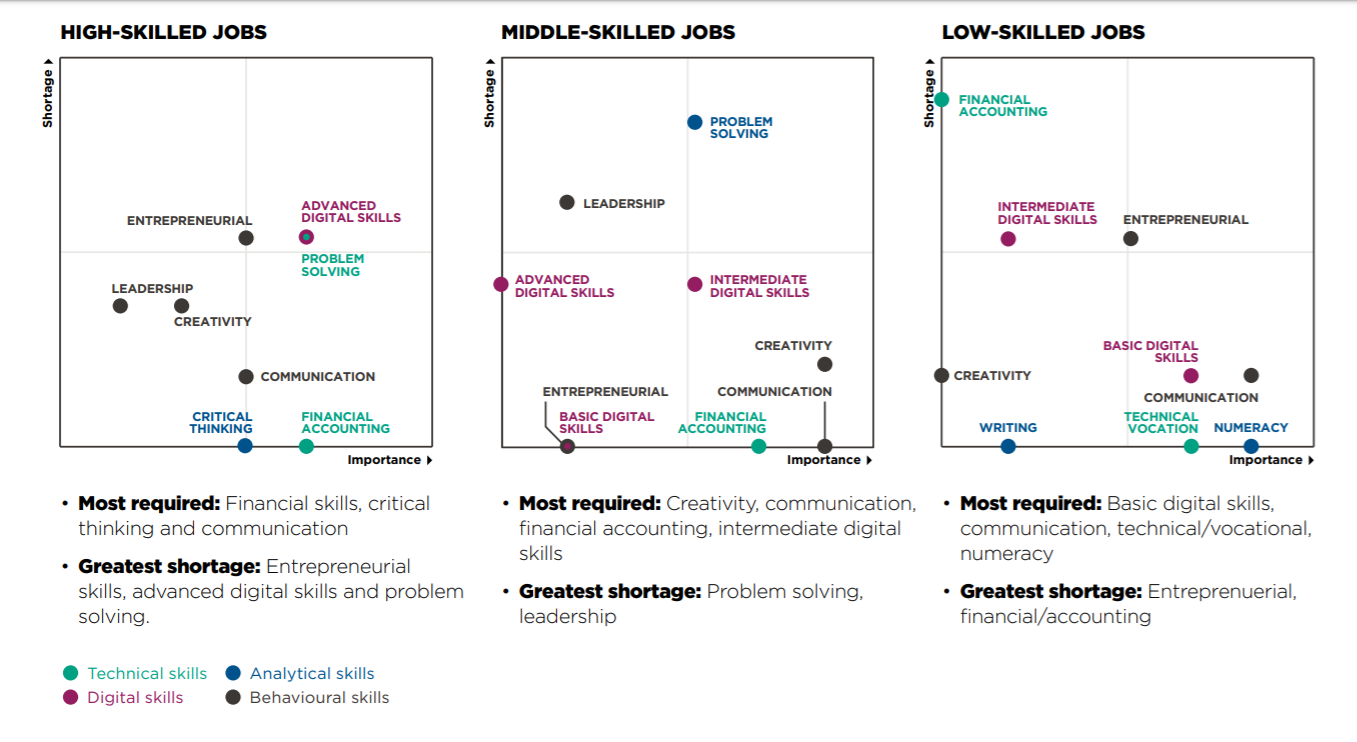
In low-skilled jobs, i.e. jobs that require almost no qualifications and can be learned through experience or on-the-job (e.g. airtime resellers and street hawkers selling mobile services) the lack of basic digital skills is increasingly hindering youth from accessing better opportunities.
For middle-skilled jobs, i.e. jobs that require at least technical/vocational/specialised training to occupy skilled or semi-skilled job positions (e.g. web technicians, technical support advisor, sales assistant, customer services advisor, marketing assistant), the skills most in shortage are those related to problem solving and leadership.
Whereas, for high skilled jobs that require qualifications, usually acquired through tertiary education with an assumed understanding of interrelated issues and concerns, entrepreneurial and problem solving skills are in greatest shortage. One of our expert panel members said, “Young people finishing school today lack problem-solving skills: which is what we do at work! They need to be able to take decisions.”
Bridging the skills gap
The mobile industry has a role to play in bridging the skills gap by supporting educational institutions to build their capacity, by developing apprenticeship programmes as well as support, accelerate and invest in youth upskilling programmes. A good example is the MTN Nigeria Foundation, who award annual scholarships to STEM (science, technology, engineering and mathematics) students and visually impaired students attending Nigeria’s public universities. While some mobile operators are involved in awareness building at an early age eg. Vodafone’s Instant Schools that provide online access to educational resources from primary to secondary level. Other industry players are training job seekers and small and medium enterprises on digital tools eg. Google Digital Skills for Africa. Collaborative efforts from mobile operators, development organisations and private sector companies, including the tech sector, could support upskilling programmes at scale and help bridge the skills gap.
Though our research, which specifically look at the mobile industries challenges for youth employment in Sub-Saharan Africa, one could argue that many of these observations stand true for most of the low and middle income countries. As more of the youth experience the power of digitisation and mobile communication during the COVID-19 pandemic, the urgency for bridging gaps in digital and behavioural skills has become far greater. Our research tries to address how to do this through a roadmap of short, middle and long strategies for the mobile industry.