


This is a guest post from Graham Wright who helped design and establish MicroSave and is currently its Group Managing Director. Graham has authored over 20 papers and briefing notes, as well as an array of training materials on mobile banking. His experience in mobile banking has also covered a variety of markets including Bangladesh, Colombia, India, Indonesia, Kenya, Papua New Guinea, South Africa and Tanzania.
India is attempting to create financial inclusion using direct benefit transfers as the flywheel that turns the engine of an electronic payment system, the creating volumes and interoperability necessary for real financial inclusion. In fact, volumes at rural agents are not yet adequate – resulting in very low commissions and debilitating levels of agent churn, and enhancing the level of interoperability of the systems might benefit poor customers, providers, and the government. See MicroSave’s “Integration and Interoperability of Financial Services” and MMU’s “Expanding the Ecosystem of Mobile Money: Considerations for Interoperability”
But India is seeking to do this largely without the mobile network operators (MNOs), preferring a bank-led business model, and customer due diligence based on bio-metric cards Worldwide, almost all, successful digital finance services are MNO-led and are adopting proportional risk-based know-your-customer procedures (See MMU’s Deployment tracker.) In their paper “A Digital Pathway to Financial Inclusion”, Dan Radcliffe and Rodger Voohies of Bill & Melinda Gates Foundation outlined how basic mobile connectivity and digital remote payments are the first two necessary steps towards an inclusive digital economy.
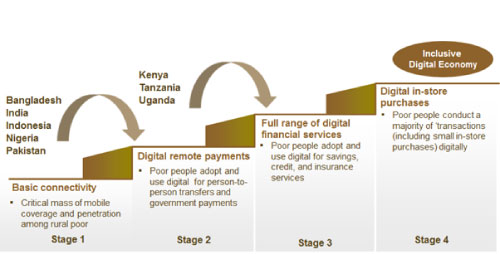
Radcliffe and Voories, The Digital Pathway to Financial Inclusion, 2012
So can India really achieve financial inclusion without involving the mobile network operators?
MicroSave’s work with Equity Bank has clearly shown that an agent-based banking model can indeed be successful and rapidly achieve high volumes of transactions. Indeed, Equity Bank’s agent-based banking model looks set to take Kenyan customers to Radcliffe and Voorhies’ Stage 3 of a full range of digital financial services. But it is unlikely that Equity Bank could have achieved this rapid up-take without the ground-breaking work of M-PESA in Kenya, which created trust in agent-based systems amongst the population.
While we have questioned how rapidly MNOs might bring financial inclusion, it is clear that they will continue to play a key role bringing access to financial services to the un- and under-banked.
Moreover, the GSMA has provided further evidence of why MNOs are well-suited to achieve digital inclusion in a rapid and sound way. MNOs are better suited to managing high volumes of low value transactions (the mere mention of which is enough to give most bankers nightmares). Furthermore, most banks simply do not see the business proposition at the base of the pyramid or are too busy responding to more traditional high value, low volume opportunities offered by the burgeoning middle classes in most developing countries. Furthermore mobile- (as opposed to card-) based systems allow person-to-person and person-to-business payments (utility bills, etc.) without using agents – thus offering an important user value proposition.
MNOs can (and perhaps must) play a catalytic role to bring banks into the market and thus achieve Radclifffe and Voorhies’ Stage 3 … by demonstrating that they can and will play an important role in the payments systems, and in the case of M-Shwari, beyond. This is turn will persuade banks leverage digital financial services to serve the base of the pyramid.
MNO-led systems therefore have a hugely important role to play to create the market – to build people’s confidence in digital financial services and local agent-based systems – and thus lay the foundation for digital financial inclusion. In India, emerging models such as the Axis Bank-Airtel and ICICI Bank-Vodafone tie-ups bode well for the future (step 3 of Radcliffe Voories), although the restrictive approach of RBI is slowing down the achievement of the Step 2 outcome (a solid and widespread used mobile money platform for remote transfers and payments).
But if the Reserve Bank of India really wanted to turbo charge financial inclusion it would allow MNOs to act as issuers of e-money with proportionate supervision as discussed by CGAP in the box below. The reality is that clear and simple rules applied to non-bank mobile money providers can mitigate potential liquidity and solvency risks, as has been pointed out by the GSMA.
