



Monday 13 July, 2026
Japan is one of the world’s most disaster-prone countries, frequently facing typhoons, floods, earthquakes, and increasingly severe heatwaves. As climate change intensifies both acute and chronic physical risks, ensuring the resilience of communication networks during emergencies has become one of the fundamental and most critical responsibilities for telecommunications providers. Reliable connectivity is essential not only for business continuity but also for public safety, emergency response, and societal resilience.
KDDI has long considered climate adaptation measures not as standalone sustainability initiatives but as vital management issues integrated into its business operations to address social, corporate, and customer environmental challenges. The company emphasises digital transformation (DX) and artificial intelligence (AI) for energy efficiency, IoT and drones for disaster visualisation, and green energy management, including solar power and renewable energy utilisation.
Furthermore, based on exposure assessments to extreme weather events, KDDI strengthens fuel supply systems and redundancy at communication network centers and base stations during emergencies. It adopts a comprehensive approach to identify and address climate-related physical risks in network planning and operation. These efforts have led KDDI to be recognised with the highest rating, “A,” for four consecutive years by CDP, an international organisation evaluating corporate climate strategies.
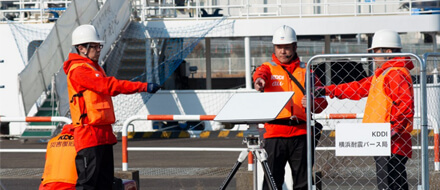
KDDI supports service continuity through various measures such as deploying base stations on ships, developing mobile phone signal capture systems using helicopters and drones, and utilising satellite communications via Starlink. These initiatives align with scenario-based physical risk assessments in accordance with the Task Force on Climate-related Financial Disclosures (TCFD), ensuring that both short-term shocks and long-term climate change trends are reflected in investment and planning decisions.
These measures also deliver tangible business and societal benefits. They reduce network downtime and improve recovery times during extreme weather events, enabling faster support for affected regions and strengthening collaboration with local governments. By embedding resilience into network design, KDDI has enhanced long-term operational stability while successfully controlling emissions. A key lesson is that climate adaptation must be embedded into everyday decision-making processes and governance structures.
As heavy rain, typhoons (hurricanes), and floods become more severe in Japan, domestic telecommunications companies, including KDDI, have strengthened frameworks for mutual support in restoring communication services during disasters. KDDI’s experience demonstrates the vital role that telecom providers can play in enhancing national climate resilience and offers increasingly relevant insights for global operators amid rising physical climate risks.
