



Monday 13 July, 2026
KDDI operates Telehouse-branded data centres both domestically and internationally. Data centres are facilities that require a large amount of electricity to operate servers stably. KDDI has achieved a 100% proportion of renewable energy for the electricity used in its global data centres by fiscal year 2025, through a combination of PPAs, renewable energy retail products, utility renewable energy programs, and environmental attribute certificates (EACs), including RECs, REGOs and GOOs. This is a step toward the KDDI Group’s goal of achieving net zero emissions by 2040. Such initiatives are meaningful not only for KDDI but also for the countries hosting these data centres.
Data centres account for approximately half of KDDI Group’s total global electricity consumption, making energy efficiency a critical priority.
Since fiscal year 2024, KDDI has deployed an AI-based air-conditioning control system, achieving approximately a 35% reduction in cooling-related power consumption. The system visualises temperature distribution within server rooms in real time using heat maps and automatically controls air-conditioning units to maintain optimal conditions around server racks. By operating only the minimum required equipment, it eliminates hot spots and significantly improves cooling efficiency.
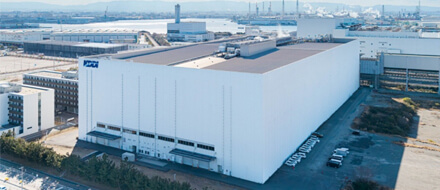
In addition to these initiatives, the Osaka Sakai Data Centre, which commenced operations in January 2026, has introduced direct liquid cooling (DLC) alongside conventional air cooling for high-performance AI servers, including NVIDIA GB200 NVL72.
This hybrid cooling system circulates coolant through GPUs mounted on cold plates to efficiently dissipate heat, while other components such as circuit boards continue to be air-cooled. Compared to traditional air-cooling systems, this approach reduces cooling-related power consumption by approximately 60%.
To support the large-scale power and cooling capacity required for AI data centres, KDDI reused an existing factory. By leveraging existing infrastructure, the construction period—typically exceeding three years—was reduced to approximately ten months, enabling a rapid response to surging AI demand.
The facility also reuses key infrastructure, including high-capacity power and cooling facility like transformer and turbo chillers, as well as structural components such as foundations and the building frame.
This approach minimises material usage and construction processes, reducing upfront carbon emissions and contributing to lower environmental impact during the construction phase.
The Osaka Sakai Data Centre serves as a key infrastructure platform supporting the expansion of AI. By enabling the advancement and automation of operations across various industries through AI technologies and big data, it is expected to accelerate the adoption of AI in society.
