Monday 13 July, 2026
The wave of ICT technological advancements, represented by 5G and intelligent computing, is driving the evolution of greater data transmission capacity and faster computational power. However, the research, development, and manufacturing of ZTE’s products have led to a rapid increase in power consumption. To address this, expanding the use and integration of renewable energy is essential to achieving the goal of 80% renewable energy consumption by 2040—an indispensable step toward energy conservation and carbon reduction.
In recent years, ZTE has actively increased the share of clean energy in its campus operations through photovoltaic (PV) power generation and green power purchases. The company has planned and built self-sustaining PV power stations at its production bases in Shenzhen, Heyuan, Nanjing, Xi’an, and Changsha. By the end of 2024, ZTE’s cumulative PV installed capacity reached 37.6 MW, marking a 12-fold increase over the past two years. Additionally, in 2024, ZTE successfully established a streamlined process for green electricity procurement and completed its first purchase of 5.33 million kWh in green power certificates.
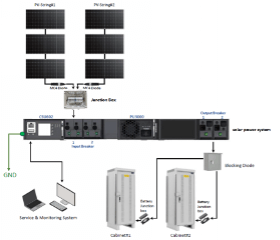
Through energy-saving innovations and large-scale implementation, ZTE is extending its proven solutions across various industries, contributing to the development of a low-carbon society. The company focuses on energy efficiency in the highest-consuming ICT sectors—wireless sites and data centres—by constructing highly efficient green networks. Meanwhile, it provides renewable energy power solutions, such as the sPV all-scenario overlay solution (see Figure 1), which increases solar power generation by over 20%.
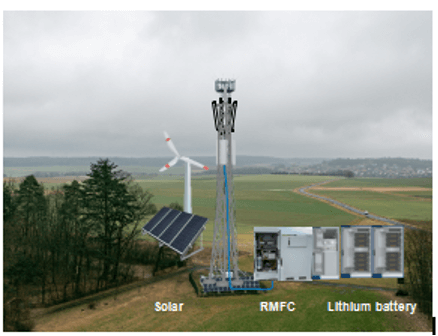
As of 2024, ZTE has deployed more than 400 MW of solar power generation capacity globally, saving over 447 million kWh of electricity and 320,946 tCO2e of carbon emissions annually. Furthermore, in collaboration with Telefónica O2 in Germany, ZTE has commercially deployed the Solar+RMFC hybrid zero-carbon site solution in Kirchdorf, integrating solar PV, methanol-to-hydrogen fuel cells, and lithium battery storage technologies (see Figure 2).