



The mobile industry creates close to a million informal income-generating opportunities for youth in SSA.
Sub-Saharan Africa (SSA) is the youngest region in the world – over 43 per cent of the population are under the age of 15.1 There is a severe lack of jobs for entrants into the labour force every year2, therefore most youth find informal income-generating opportunities to build their livelihoods.
Based on modelled estimates, the mobile industry provides between 800,000 and a million youth (aged 15-34) with informal income-generating opportunities in the region, primarily in retail and distribution3. We surveyed over 2,400 youth working informally in the mobile industry in six sub-Saharan African countries, including Cote d’Ivoire, Kenya, Ghana, Nigeria, South Africa and Uganda, between December 2020 and February 2021. Over 70 per cent of survey respondents (aged 18-34) working informally primarily sold airtime, SIM cards, voice, data and entertainment bundles, mobile phones and accessories or worked as mobile money agents. Many took up these opportunities as part of other small businesses or as a side “hustle” while they gained education or worked in other employment.
More young women than young men take up informal retail opportunities in the mobile industry, which offers them a range of benefits.
Our survey data show that more young women than men take up informal economic opportunities in retail and distribution roles in the mobile industry (Figure 1). 62 per cent of survey respondents whose primary income-generating activity in the mobile industry value chain is mobile money services are women, while 56 per cent of retailers who primarily sell airtime and SIM cards (referred to in Figure 1 as connectivity retail) are women. 40 per cent of retailers who primarily sell handsets to derive an income are also women.
Figure 1: Share of youth working informally in retail in the mobile industry who are women
Percentage of the total number of youth employed informally in retail and phone repair, all countries
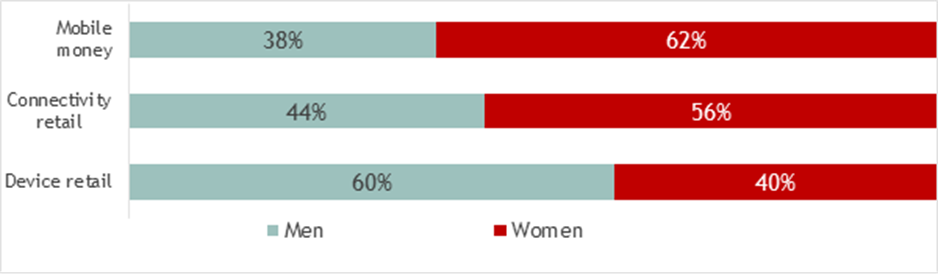
Base: Youth (aged 18 to 34) working informally in the mobile industry. N=2,412 for all countries surveyed.
Connectivity retail and mobile money services are activities that have relatively low barriers to entry and offer more flexible working opportunities, which suit many women who have caring responsibilities. Previous studies on women working as informal retailers and mobile money agents also suggest that women working in retail and mobile money agent roles in the industry enjoy a range of benefits beyond strictly financial ones4. These include greater independence, increased confidence from contributing to household income, the ability to juggle income generation with caring for their families as well as upskilling, including improving their sales, entrepreneurship and accounting skills.
For some young women working in informal roles in the mobile industry, these are short-term income-generating strategies, while for others they are critical to building their livelihoods.
This is reflected in the stories of Nuru and Catherine, two of our interviewees below.
Nuru is a 32-year-old mobile money agent and single mother living in the city of Kampala in Uganda. Nuru uses a wheelchair. She used to be formally employed and do mobile money as a “side hustle” on evenings and during weekends. She learned the trade from other mobile money agents she worked for at the beginning. Eventually, she was laid off from her formal job and made mobile money her main activity six years ago. Nuru has diversified her activity and started processing utility bills for people through Payway three years ago. Additionally, she does embroidery to earn extra cash. Six months ago, Nuru started sub-renting a shop in a shopping centre in a busy location in Kampala. Nuru does not regret her former job in the formal sector as she can make more money as a mobile money agent and has been able to buy land to build a house. She feels she has built a strong skillset as mobile money requires marketing, customer care, accounting, and quick computing skills.
Nuru has big plans for the future: “I want to develop my business by growing more branches of mobile money services, I want to train workers for embroidery, and I want to expand to agent banking”.
Catherine is 21 years old from rural Kenya who works part-time as a mobile money agent. She is studying economics at the University of Nairobi. She returns to her hometown in Muranga county during the holidays and works as a mobile money agent there. She is employed by a bookstore owner who has an M-Pesa desk in his shop. Working in an M-Pesa outlet as a part timer is something which is common in her hometown. It was easy for her to get the position. Her parents are able to support her for both her studies and her living expenses in Nairobi. She does this job to earn extra cash on the side.
In Catherine’s opinion, the key skills needed for her job are mostly arithmetic and customer care skills. While she feels she was well equipped to do the maths necessary for the job thanks to her education, she learned customer care on the job. She benefited from several trainings from Safaricom on how to conduct transactions, on safety and on fraud prevention.
“I learned customer care on the job through interactions with customers and guidance from my employer. I have learned to solve problems and deal with complicated situations”.
Although this is not a contract-based employment, Catherine has a fixed schedule and a fixed salary. During the Covid-19 crisis, her salary remained stable despite a fall in business which was in part driven by the fear that Covid-19 could be spread via banknotes. Catherine will not keep on working as a mobile money agent once she finishes her studies. She wants to apply for a formal job at a bank or at another financial institution.
Women working informally in retail and distribution roles also provide an invaluable contribution to the industry and to other women, in particular in rural areas.
There is widespread evidence from The GSMA Mobile for Development (M4D) team’s research, as well as research by a number of development agencies that women retailers and mobile money agents play a critical role in encouraging other women to use mobile phones and mobile digital services, bringing them a host of advantages5. Women mobile money agents also elicit higher trust, especially from other women, and therefore have a key role to play in women’s digital financial inclusion, especially in rural areas where adoption of mobile phones and mobile financial services can be more challenging6. Interview data from our research on informal youth employment in the industry corroborates these findings; women are perceived as having superior customer service skills in retail and mobile money services roles.
In recognition of this contribution and to support women and youth build more sustainable enterprises in the industry, several mobile network operators in the region including MTN, Safaricom, Airtel and Orange have led campaigns to actively recruit female agents to advance the financial inclusion of women, as well as launching programs in entrepreneurship training and skills development specifically for young women.
However, gender biases persist, leaving women less well represented in more lucrative retail roles.
Despite young women’s significant participation in connectivity retail and as mobile money agents, interview data show that women are less likely than men to own their own shops and work higher up the value chain where incomes tend to be higher. For example, less young women than men in the survey primarily retail mobile phones, which is more lucrative than connectivity retail (Figure 1). The discrepancy suggests that gender biases and norms keep women from progressing in growing their businesses beyond subsistence enterprises and transitioning to higher-income activities. Overcoming this bias requires advocacy as well as targeted training programmes and resources for young women in entrepreneurship so that they can build more sustainable enterprises.
Young women are less well-represented in other informal income-generating roles in the mobile industry that are lucrative and have high job satisfaction.
Our research found that apart from retail and mobile money agent roles, youth working informally in the mobile industry may be involved in short-term employment deploying network infrastructure, in phone repair and in mobile-related content and application (app) development. In our survey, none of the infrastructure workers or mobile app developers were young women and only 15 per cent of young women were phone repairers. Both phone repair and mobile app development generally have high job satisfaction and higher earnings than retail roles. The lack of women in these roles may be due, in part, to cultural biases that consider phone repair and STEM training to be the domain of men and in part also gender norms that make women more time-poor. Mentorship as well as targeted skills training for young women in both phone repair and mobile app development is needed so that more can avail of income-generating opportunities in these roles.
For more details on youth working informally in the mobile industry in sub-Saharan Africa, read our unique report below:
This research is funded by the UK Foreign, Commonwealth & Development Office (FCDO), and supported by the GSMA and its members. The views expressed do not necessarily reflect the UK government’s official policies.

[1] Fox, L. & Gandhi, D. (2021). Youth Employment in sub-Saharan Africa.
[2] Brookings Institute (2021). Youth Employment in sub-Saharan Africa; Progress and Prospects.
[3] GSMA. (2020). Powering Youth Employment through the Mobile Industry in Sub-Saharan Africa by 2025.
[4] Cherie Blair Foundation. (2012). Women Entrepreneurs in Mobile Retail Channels; Empowering Women, Driving Growth.
[5] See Cherie Blair Foundation. (2012). Women Entrepreneurs in Mobile Retail Channels; Empowering Women, Driving Growth. GSMA. (2014). Case Study; Dialog’s 5 Star Partner Program: Integrating Women into the Rural Retail Chain. World Bank Blogs. (Nov. 9, 2020). Does agent gender matter for women’s financial inclusion?
[6] World Bank Blogs. (Nov. 9, 2020). Does agent gender matter for women’s financial inclusion?