


Improving affordability is fundamental to increased digital inclusion especially in emerging economies where sector-specific taxation is creating barriers to access.
The Digital Inclusion programme is working actively in developing markets to support the creation of policy frameworks which enhance the affordability of mobile services and support mobile growth. As part of this effort, the GSMA in partnership with Deloitte is carrying out research and collecting evidence on mobile taxation worldwide. A recently published report “Digital Inclusion and Mobile Sector Taxation 2015” provides a global review of taxes that apply to mobile consumers and operators, and in particular of those sector-specific taxes levied only on mobile.
A significant proportion of consumer and operator payments is attributable to mobile-specific taxes.
The report finds that despite the positive socio-economic impact of mobile communications a number of developing countries impose sector-specific taxes on mobile that increases barriers to mobile access by affecting both affordability and the incentives to invest in network expansion.
- Across 26 selected countries, the total tax and fee payments from the mobile sector amounted to US$ 39 billion in 2013, while market revenues were US$ 117.5 billion.
- Total mobile tax payments from taxation on both consumers and operators are estimated to range from 10.6% as a proportion of market revenues in Nigeria to 58.3% in Turkey, excluding non-recurring payments such as spectrum auction fees.
- Over the sample, sector-specific taxes make up on average 32.1% of the recurring payments on mobile services, including taxes on both consumers and operators.
- Taxes and fees on each mobile connection cost US$ 35.6 on average per year across 26 selected countries.
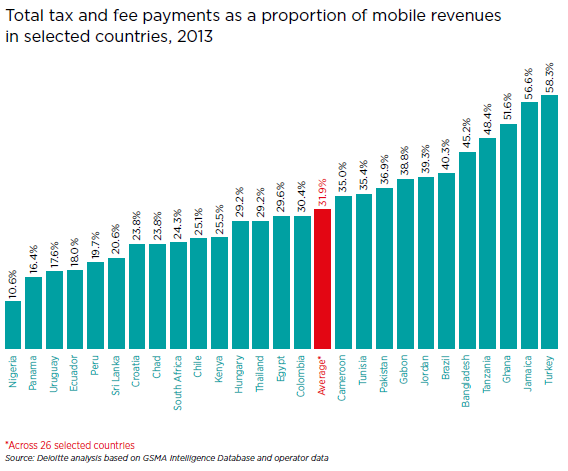
In many developing countries, consumers face higher taxation on mobile than on other goods and services.
The costs borne by consumers in order to own and use a mobile phone include expenditure on calls, SMS and data, as well as connection/activation and handset costs, and can be expressed as the Total Cost of Mobile Ownership (TCMO). Each of these cost elements is subject to taxation and the report estimates that in 2014, taxes applied directly on mobile consumers represented 20% of TCMO across 110 countries surveyed. Notably:
- Today, among the 110 countries surveyed, 44 levy taxes that are specific to or are applied at higher rates on mobile services. Of these 44 countries, 17 are in Africa, seven are in Latin America, seven are in Asia Pacific, and five are in Middle East and North Africa (MENA).
- 37 countries levy industry-specific taxes on mobile usage, such as airtime and data tax or additional VAT over the standard rate. 24 countries apply specific usage taxes on mobile data, and seven impose higher VAT on these services compared to the standard rate.
- 25 countries impose a special tax or additional VAT on handsets, in addition to custom duties on imported devices that are in some cases higher for mobile than for other goods.
- 10 countries, including Jamaica, Tunisia, Pakistan and Bangladesh, apply an activation tax that is paid upon purchase or activation of a SIM card, and hence represents a barrier to access for lower income consumers.
- Compared to goods or services that are only subject to VAT, mobile services receive about 33% more taxation in the countries that impose mobile-specific consumer taxes. In these countries, consumers pay on average US$ 8 more in tax than on a standard good for each US$ 100 spent.

By transitioning to a taxation system where mobile is treated in the same way as standard goods and services, governments can promote digital inclusion, economic growth and fiscal stability.
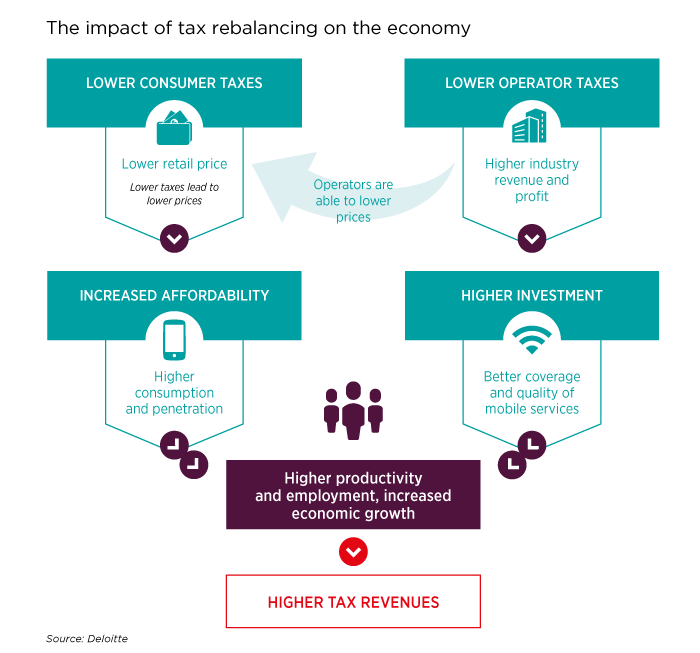
By increasing mobile penetration and promoting economic growth, reducing taxation on mobile will increase the tax base, presenting the potential for the government to recover lost revenue, while at the same time unlocking the full benefits of mobile technologies and extending them to a wider part of the population.
- Tax rebalancing lowers barriers to affordability and increase network investment, in turn promoting mobile penetration.
- In the medium term, this spurs economic and infrastructure development, increased productivity and employment across the economy. It is estimated that a 1% increase in mobile penetration can lead to an increase in the GDP growth rate of 0.28%, while a 1% increase in internet penetration can lead to an increase of up to 0.077% in the GDP growth rate. In low and middle-income countries, the World Bank finds that every 10% increase in broadband penetration can accelerate economic growth by up to 1.38%1.
- Through the effect on mobile penetration, tax rebalancing has positive effects on education, healthcare and overall development.
- In the medium-term, higher sector revenues and increased economic growth throughout the economy results in increased tax revenue for the government.
A number of areas for tax reform have been identified based on international taxation best practice and in consultation with mobile operators. These support the uptake of mobile to further contribute to economic growth and government revenues over and above its current impact.
- Reduce specific taxation of the mobile sector: Higher than normal taxation on mobile operators and consumers distorts production and consumption behaviour. It may also limit usage of digital services, reduce the ability of mobile operators to finance investment in digital infrastructure, and can in the long term reduce government revenues. Reducing specific taxation on mobile will remove these distortions, making mobile services more affordable and incentivising operator investment.
- Apply phased reductions of taxes on established services: Phased reduction of mobile-specific taxes on operators’ revenues and on usage create opportunities for governments to benefit from the economic contribution from mobile whilst limiting short-term fiscal costs.
- Reduce taxation on access: 44 countries still impose mobile-specific taxes on access. It is important to reduce barriers to access mobile broadband, especially in emerging markets. Governments can benefit in the medium term by reduction in access charges as more users consume mobile services.
- Reduce complexity and uncertainty of mobile taxation: Taxation on mobile operators varies rapidly and unexpectedly. Any unpredicted tax change that occurs after investment in spectrum licence is made may negatively impact an operator’s business plan. The risk of future tax rises is priced into investment decisions and can therefore be expected to reduce both Foreign Direct Investment (FDI) and domestic investment in the medium-term.
- Facilitate the development of emerging services through supportive taxation: The growth of mobile data and M2M communications opens up the possibility for the sector to increase its economic value through a whole new generation of products and services ranging from health care to education and finance. Governments in countries such as Turkey and Brazil recognised this potential and reduced SIM taxes on M2M SIM cards.
The global study “Digital Inclusion and Mobile Sector Taxation 2015” is available here.
Country-specific studies on mobile sector taxation have been published for Bangladesh, Pakistan, Ghana, Tanzania and Jordan and are available here.
This is based on GSMA 2012 and Qiang, C. Z. W., Rossotto, C.M., 2009.