The Voluntary Carbon Market

A guide for startups

The voluntary carbon market (VCM) can present startups with opportunities to unlock financial benefits for driving climate action. 

The VCM provides a growing revenue stream that enables enterprises to scale and attract funding. As the market focuses on enhancing integrity and quality, startups have substantial opportunities to leverage this growth.

$ 535 m
Value in 2024
$ 5 – $50 bn
Projected market size by 2030
01

Understanding the VCM

This section explores carbon market essentials: Structure, fundamental concepts, project-level insights, and key ecosystem players.

What are the carbon markets?

The global effort to mitigate climate change through the reduction of greenhouse gas (GHG) emissions has given rise to two distinct carbon market mechanisms: i) Compliance markets, and ii) Voluntary Carbon Markets (VCM). Both play crucial roles in climate action, but they work differently and serve their own specific functions. The compliance market is much larger than the VCM. In 2021, around $850 billion worth of credits were traded in the compliance market, compared to roughly $2 billion in the voluntary markets.

The compliance market

These are regulatory frameworks established by governments or international bodies that mandate carbon reductions in carbon-intensive industries. Companies or organisations that emit more than their allocated quota can buy carbon credits from those that emit less, encouraging reductions where they are cheapest.

The voluntary carbon market

The VCM enables companies, organisations, and individuals to voluntarily purchase carbon credits to offset emissions. It caters to those pursuing carbon neutrality or enhancing corporate social responsibility (CSR) efforts, beyond legal any obligations.

Introduction to Article 6

Article 6 of the Paris Agreement creates new ways for countries and organisations to trade carbon credits and collaborate on reducing emissions. It has two key parts:

  • Article 6.2 allows countries to trade emissions reductions to 
help meet their climate goals.
  • Article 6.4 aims to set up a global carbon market, overseen by 
the UN, to ensure high standards for carbon credits.

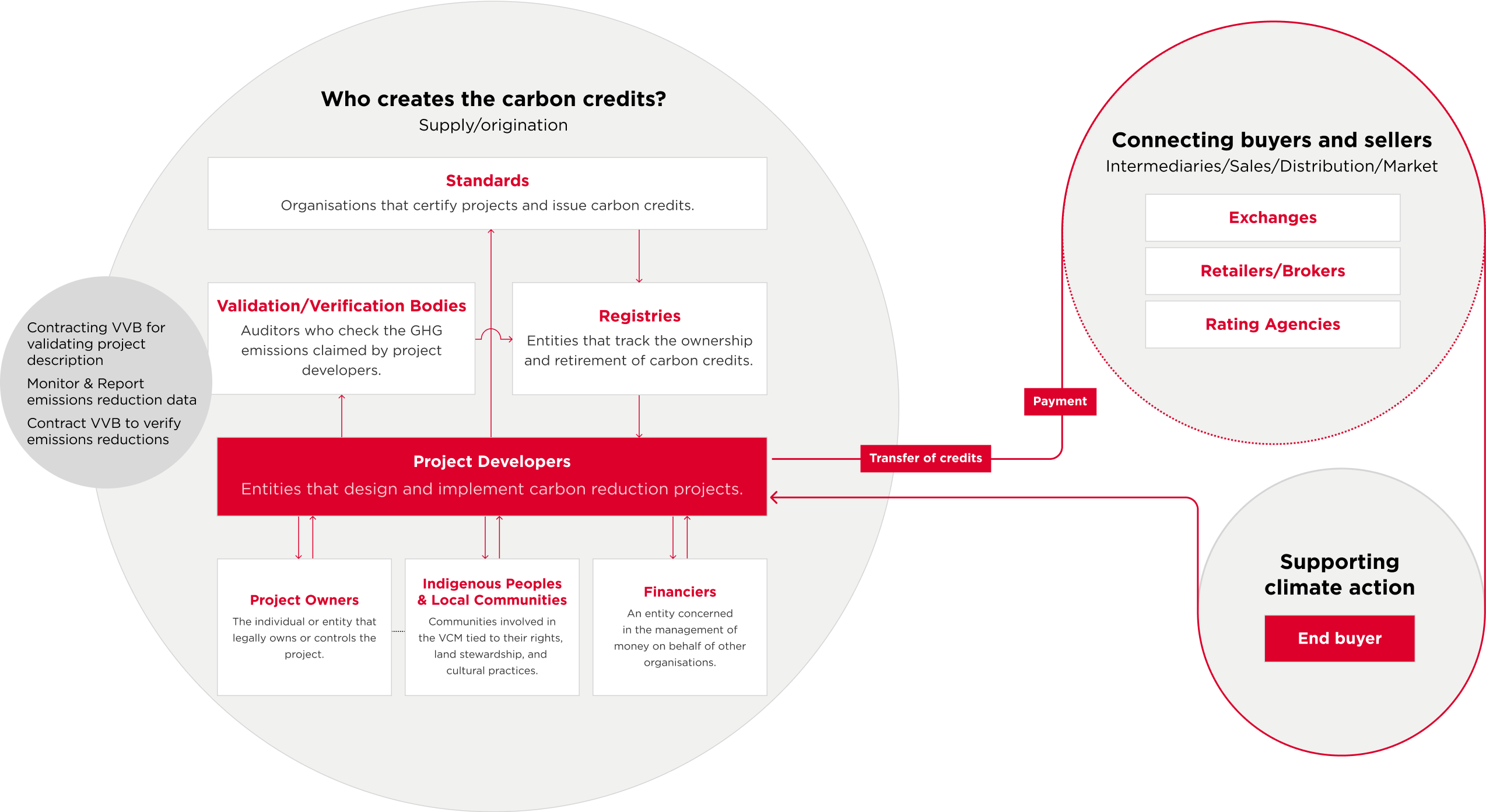
Key players in the VCM ecosystem

Project Developers and Owners create projects to reduce emissions.

Validation and Verification Bodies (VVBs) ensure the projects meet strict standards.

Registries and Standards Organisations issue carbon credits for approved projects.

Intermediaries like exchanges, brokers, and rating agencies help trade and evaluate these credits.

Buyers (like companies or individuals) purchase the credits to offset their carbon emissions.

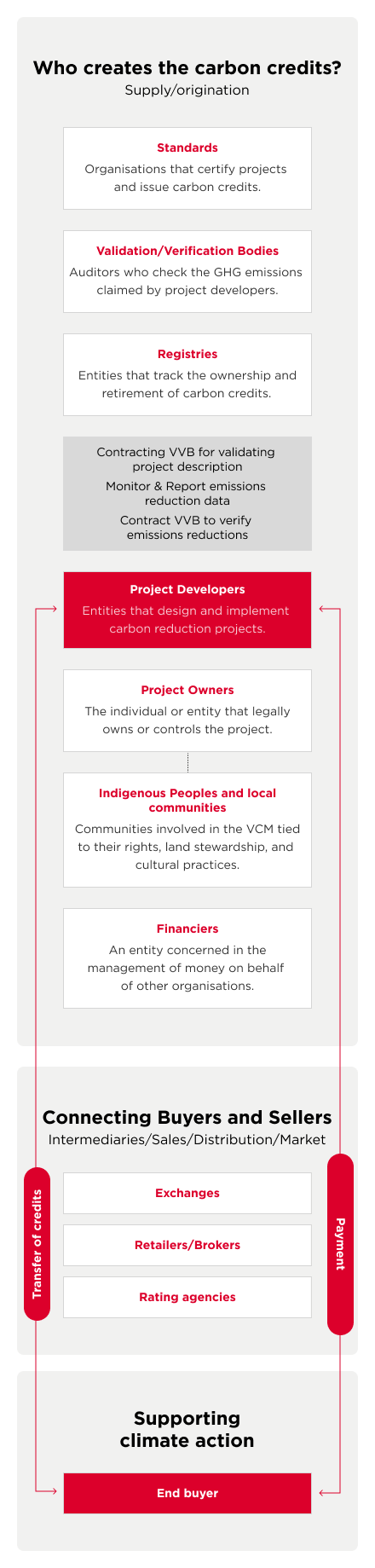
Flowchart illustrating the creation and distribution of carbon credits. It shows the process through project developers, including validation, issuance, and transfer of credits to buyers and sellers like exchanges and rating agencies. End buyers are highlighted in a supporting role. Flowchart titled "Who creates the carbon credits? Supply/Origination" illustrating entities like Standard, Validators/Verifiers, Project Developers, Project Owners, Communities, and Financiers involved in creating carbon credits. Ends with connecting buyers and sellers for climate action.
Key players in the VCM ecosystem – based on VCM role and function – 2025 | Source: GSMA

Generating carbon credits

A carbon credit is a tradable certificate or permit representing one metric tonne of carbon dioxide equivalent (CO2e). Carbon credits are generated through projects that reduce, remove, or avoid GHG emissions. These projects must meet specific criteria set by standards bodies to ensure their environmental integrity. The process involves several steps, including project design, validation, monitoring, and verification.

The role of standards bodies

Standards bodies play a crucial role in the VCM by setting the rules and requirements for projects, certifying their emissions reductions, and issuing carbon credits. Some of the most well-known standards bodies include the Verified Carbon Standard (VCS), the Gold Standard, and the Climate Action Reserve (CAR).

A carbon credit needs to accurately represent one metric tonne of additional, measurable, permanent, and unique GHG offset. For this, it needs to at least fulfill the following criteria:

  • Additional: Emissions reductions or removals must be beyond what 
would have happened without carbon finance.
  • Permanent: GHG reductions or removals must be maintained for an extended period to be effective.
  • Guarantee no leakage: The project activity should not result in an attributable and measurable increase in GHG emissions outside of the project area.
  • Prevent double counting: Carbon credits should be counted towards 
a goal or target only once.

The market value of credits

The value of carbon credits in the VCM can vary widely depending on factors such as the type of project, the standards body certifying the credits, and market demand. High-quality credits from projects with strong environmental and social co-benefits tend to command higher prices

In the full guide you will find information on:

  • Key definitions and concepts 
  • A section of FAQs and answers
  • Further details of the key players in the ecosystem

Read the detailed guide for a comprehensive explanation on understanding the VCM.

Types of Carbon Credits

Icon of an open hand with a cuff, holding a plant with three leaves. The outline is pink on a transparent background.

Avoidance credits

Generated by projects that prevent GHG emissions from occurring, such as renewable energy projects.

A white line drawing on a black background shows a stylized Earth encircled by a swirling line that ends in a leaf. This symbolizes environmental consciousness or eco-friendliness, combining Earth and nature elements to suggest planetary protection or sustainability.

Reduction credits

Generated by projects that reduce existing greenhouse gas emissions, such as energy efficiency improvements.

Simple white tree icon with stylized trunk and rounded canopy on a black background. The trunk splits evenly, supporting a bushy, cloud-like treetop. The drawing uses clean lines, conveying a minimalist and modern design.

Removal credits

Generated by projects that remove greenhouse gases from the atmosphere, such as reforestation.

Navigating the voluntary carbon markets as a startup

The VCM presents both complexities and potential rewards for startups. Success requires a thorough understanding of the regulatory environment, project eligibility criteria, and the steps to generate and sell carbon credits. While navigating these elements can be demanding, participating effectively in the VCM can unlock financial benefits and support meaningful contributions to global climate goals

02

Assess your project

A four step guide to help startups explore accreditation, sell carbon credits and assess if the VCM is suited to their project.

Step 1: Check project eligibility

The voluntary nature of the VCM means that there is no uniform set of eligibility criteria for participating in the VCM. Each standards body establishes its own rules and requirements for the projects they register and issue credits for. However, there are three main components that apply across all standards bodies and will determine if your project is eligible for carbon finance.

The regulations around carbon credits are evolving quickly in many countries, which could affect ownership and taxes in the future. It is important to check the regulations in your country, especially about Article 6 and any specific laws on owning carbon credits and taxing carbon revenues.

1.1 Can my project clearly demonstrate additionally?

To demonstrate additionality, you will need to prove that the GHG reductions or removals delivered by your project activities would not have happened without carbon finance.

1.2 Does my project align with an existing methodology?

Carbon credits must be developed in line with a methodology set out by the standards body. Methodologies define the parameters and criteria needed to calculate a project’s emissions reductions.

1.3 Is there a risk of double counting?


You can only sell credits if no one else has already claimed them. Third parties cannot claim credits if they support your project and that end users of your products or services transfer the ultimate ownership of any credits resulting from project activities to you.

Step 2: Evaluate financial viability

When determining whether to pursue a carbon project, it’s essential to consider the potential financial implications for your enterprise. In entering the market, your organisation will likely incur costs, which means that a breakeven assessment is needed. You should consider:

2.1 How many credits will I generate?


At a fundamental level, determining the number of carbon credits that a project will generate has two key components: i) Calculating GHG emissions under the project scenario, and ii) Comparing these to the baseline scenario (what they would have been if the project had not happened).

2.2 What costs should I expect?


In the early stages of assessing a carbon project’s feasibility, you need to consider the likely costs and weigh these against potential revenues. There are a variety of costs associated with developing a carbon project including fixed costs like registration and verification fees and variable costs like credit issuance fees. Depending on your chosen route to market, the fee model may vary significantly.

Step 3: Define your 
go-to-market strategy

Having established whether your project is eligible to generate carbon credits and the project’s financial viability, you now need to consider how to get the project off the ground and the credits into the market. This includes assessing the implications of your chosen standard on sales options, determining financing requirements, and identifying your preferred sales channels.

Step 4: Plan implementation roadmap

Once you’ve decided to enter the VCM, you’ll need to choose between established and emerging routes-to-market.

  • Established standards are the main registries within the VCM. Examples include: Verra, Gold Standard, the American Carbon Registry and the Climate Action Reserve.
  • Emerging standards are new players who have entered the VCM in recent years, looking to offer alternative routes to generating and issuing credits leveraged by new technologies. Examples include: CarbonClear, Cavex, and Puro.earth.
A clean cooking enterprise

SustainaFlame

A hypothetical example of a SME evaluating their carbon credit benefits.

SustainaFlame plans to distribute 10,000 improved biomass cookstoves as part of their expansion in Kenya and wants to explore in detail the differences between registering their project with an established standard or an emerging platform.

  • No. of cookstoves: 10,000
  • Project lifespan: 7 years
  • Estimated carvon credits per cookstove (range): 1-3 credits
  • Total carbon credits (range): 70,000 – 210,000

The figures in this example are hypothetical and for illustrative purposes only.
Four traditional clay and metal charcoal stoves are arranged on a concrete surface. Each stove has a reddish-brown clay top with a central hollow and circular air holes for ventilation. The bases are metallic, providing sturdy support for cooking activities.
  • Market price of one carbon credit (2023): US $7.70
  • Total revenue (range): US $539,000 – US $1,617,000

Cost calculations for an established route to market

Opting for the established route to market can take between two to four years to get credits issued, with US $80,000-US $140,000 in upfront costs and US $30,000-US $50,000 in recurring costs during implementation.

The figures in this example are hypothetical and for illustrative purposes only.
Four traditional clay and metal charcoal stoves are arranged on a concrete surface. Each stove has a reddish-brown clay top with a central hollow and circular air holes for ventilation. The bases are metallic, providing sturdy support for cooking activities.
  • Total revenue: US $539,000
  • Total cost: US $206,500
  • Net income: US $332,500
The figures in this example are hypothetical and for illustrative purposes only.
Four traditional clay and metal charcoal stoves are arranged on a concrete surface. Each stove has a reddish-brown clay top with a central hollow and circular air holes for ventilation. The bases are metallic, providing sturdy support for cooking activities.
  • Total fixed costs: US $192,500
  • Total carbon revenue per cookstove: US $53.90
  • Total variable costs per cookstove: US $1.4
  • Total cookstove volume required to breakeven on 
carbon project costs at the 2023 average price: 3,667
The figures in this example are hypothetical and for illustrative purposes only.
Four traditional clay and metal charcoal stoves are arranged on a concrete surface. Each stove has a reddish-brown clay top with a central hollow and circular air holes for ventilation. The bases are metallic, providing sturdy support for cooking activities.

Opting for an emerging route with a revenue-share model

If SustainaFlame opts for an emerging platform, they won’t have any upfront costs but will need to allocate staff time to integrate their data with the platform of their choice. In this example, the platform will take 
a 30% share of the revenues from the sale of all carbon credits, which are sold at a fixed price of $26.

In the full guide you will find information on: 

  • Key definitions and concepts 
  • A section of FAQs and answers
  • Further details of the key players in the ecosystem
A smiling woman in a colorful dress and black headscarf looks at her smartphone. She stands in front of a market stall filled with tomatoes and leafy greens. The produce is displayed in bowls, creating a vibrant background of fresh vegetables.

Start Your Assessment: Trial the carbon credits breakeven calculator

Try it out yourself! Explore the breakeven calculator to better understand the potential costs and benefits of entering the VCM. Input your project details to explore the range of credits required to breakeven.

Disclaimer

The carbon credits breakeven calculator and the VCM startup guide are intended to provide broad estimates and should not be relied upon as the sole basis for entering the voluntary carbon market. The outputs from the calculator and the instructions listed on the guide will differ depending on your project’s specific details and may differ substantially from actual values. The GSMA makes no representation or warranty with respect to the accuracy or reliability of the outputs of the calculator and instructions in the guide.

Please be aware that the calculations do not cover all potential costs or complexities associated with selling credits and participating in the voluntary carbon market. If you’re considering moving forward with a project, we strongly recommend conducting your own due diligence, seeking professional advice and performing additional financial analysis before making any market entry decisions based on the results from the calculator.

03

Case studies

This section highlights how three sectors—clean cooking, solar home systems, and sanitation—thrive in the voluntary carbon market.

Logo featuring the word "ATEC" in black, sans-serif font. Next to the text is a triangular shape with rounded edges, divided into three segments colored purple, orange, and green from left to right. The segments meet at a central point, creating a smooth and unified appearance.

Combining clean cooking with digital MRV

ATEC provides sustainable, affordable and accessible clean cooking products for low-income households across 11 regions in Africa and Asia. With all their stoves IoT-enabled and integrated with a Pay As You Go (PAYGO) system using mobile money, ATEC aims to make modern electric cooking widely available and affordable. The usage data from the stoves provides the evidence to generate 100% verified carbon credits and significant SDG impact for 200 million women in low- and middle-income countries.

Explore full case study in the guide
A group of people gathered around a wooden table sharing a meal. A pot of soup with vegetables sits on an electric stove at the center. Surrounding it are plates of rice, fried chicken, and various dishes. Red chopsticks and small bowls of dipping sauce are visible on the table.
Logo of Engie featuring the word "ENGIE" in lowercase, bold, blue letters. Above the text is a stylized, light blue arc, resembling a horizon. The logo has a transparent background.

A different route to carbon credit generation and sales

ENGIE Energy Access is a leading mini-grid and off-grid PAYGO solar energy solutions company in Africa. Operating in nine countries across Eastern, Southern, and Western Africa, they have a mission to deliver affordable, reliable, and sustainable energy solutions with exceptional customer experience. Emissions reductions are created by replacing the use of fossil fuels in various forms, depending on the product they are installing. For off-grid solutions, they are replacing the use of high CO2-emitting energy sources such as kerosene lamps, diesel generators, and candle lights, all of which are dangerous and polluting.


Explore full case study in the guide
A solar panel array with four panels stands on a sandy landscape, surrounded by grass and small shrubs. In the background, there are thatched-roof buildings, a dirt path, and a vast open sky. The setting implies a remote, natural environment harnessing solar energy.
A black and white illustration of a cool sun with a face. The sun has wavy, stylized rays emanating outward. Its facial features include squinting eyes wearing sunglasses and a content smile. The artwork is simple and cartoonish, giving the sun a laid-back, cheerful appearance.

Pioneering carbon credits from container-based sanitation

The Sanergy Collaborative strives to solve the global sanitation crisis through the power of the circular economy. A member of the Container Based Sanitation Alliance and headquartered in Nairobi, it brings together several actors across the sanitation value chain working to offer better sanitation solutions for communities, reduce landfill, improve the health of residents, catalyse sustainable agricultural and energy production, and spur economic growth. Sanergy is in the process of developing a carbon project using a Verra methodology

Explore full case study in the guide
A smiling woman stands in front of a blue toilet unit labeled "Fresh Life." She wears a white and green patterned scarf and a dark dress with orange flowers. A sign on the toilet door includes Swahili text. The background shows corrugated metal structures and a sunny environment.

Download the full guide to understand 
the VCM in detail which includes:

Understanding the Voluntary Carbon Market

Carbon markets explained
Attributes of a VCM project
Meet the VCM players

Assessing your project

Check project eligibility
Evaluate financial viability
Define your go-to-market strategy
Plan implementation roadmap

Case studies

ATEC
ENGIE Energy
Sanergy

This guide was produced by the GSMA with research support from Social Finance (socialfinance.org.uk).

Two covers of a guide titled "Navigating the Voluntary Carbon Market: A guide for startups" by GSMA. The cover image features a person in a green headscarf and yellow pants, sitting near a stove with a pot, in a simple, green-walled room.

Stay up to date with the latest news

Sign up to the ClimateTech newsletter

This initiative is currently funded by UK International Development from the UK Government and the Swedish International Development Cooperation Agency (Sida), and is supported by the GSMA and its members.