


The GSMA Innovation Fund for Green Transition for Mobile – Frequently Asked Questions (FAQs)
The following responses are aimed at tackling queries applicable to the GSMA Innovation Fund for Green Transition for Mobile. However to get the full overview of the Fund we recommend that you read the Terms and Conditions.
Applying to the GSMA Innovation Fund
1. What types of projects are we looking for?
Through this Innovation Fund, the GSMA therefore aims to tackle the dual challenge of digital and clean energy transition and to explore innovative solutions for device circularity. Solutions that are aligned with, or directly contribute to, the mobile industry’s commitment to net zero are particularly welcome. The fund will focus on two key sectors, please note that the examples and sectors mentioned below are for illustrative purposes only.
The grants should be utilised to test digital innovations, enable scale, and address these dual challenges. Please note that the grants will not support the development or prototyping of any new hardware solutions.
1. Within energy solutions may include (but not limited to) the following:
- Small scale mini-grid solutions, mesh grids, energy efficiency and other renewable energy solutions, for instance through ABC (Anchor-Business-Community) business models which leverage telecom towers as anchor clients, while also providing energy to surrounding communities.
- Renewable energy solutions supporting productive use cases that lower the levelized cost of electricity of off-grid sites or sites that integrate on- and off-grid supply.
- Smart metering solutions that enable the management of on-grid and off-grid energy supplies
2. Projects with a focus on circularity, including innovative services and business models that enhance device longevity and promote circular practices through repair and refurbishment. These could include (but not limited to) the following,
- Device repair solutions
- Trade-in and buy-back focussed solutions
- Renewal and upgrade focussed solutions
- Refurbished device marketplaces
- Leasing, including device as a service (supporting repair and refurbishment)
- Responsible e-waste collection and recycling solutions
- Design and production of more circular devices
For additional reference, insights aligned with the GSMA’s recommendations can be found in the report “Rethinking Mobile Phones.”
2. What types of projects are likely to be more competitive than others?
Mainly, projects (1) that use mobile/digital technologies to solve socio-economic challenges in clear and innovative ways; (2) that are rooted within the local context of the country(ies) of implementation; and (3) that have a significant, measurable and scalable impact on the lives of low income, underserved or most vulnerable (e.g. women).
In contrast, the following types of projects will not be competitive:
- Projects proposing idea-stage innovations (e.g. minimum viable product (MVP), products that have not been tested)
- Projects that have limited potential to scale
- Projects that are not innovative (e.g. no substantive differences between competitors’ products in the ecosystem)
- Projects that do not leverage mobile technologies
- Projects that do not have a clear path to commercial sustainability
- Projects that do not have a clear pathway to impact the poor or most vulnerable
It is understood that projects that do not satisfy the eligibility criteria set out in the Terms and Conditions of the Fund will not be considered.
It is essential for applicants to thoroughly review these criteria before submitting their application to ensure compliance and enhance their chances of selection.
To learn about past grantees of the GSMA Innovation Fund, please explore the alumni portfolio of the GSMA Innovation Fund on our website and read the GSMA Innovation Fund impact portfolio.
3. How does the GSMA Innovation Fund select grantees?
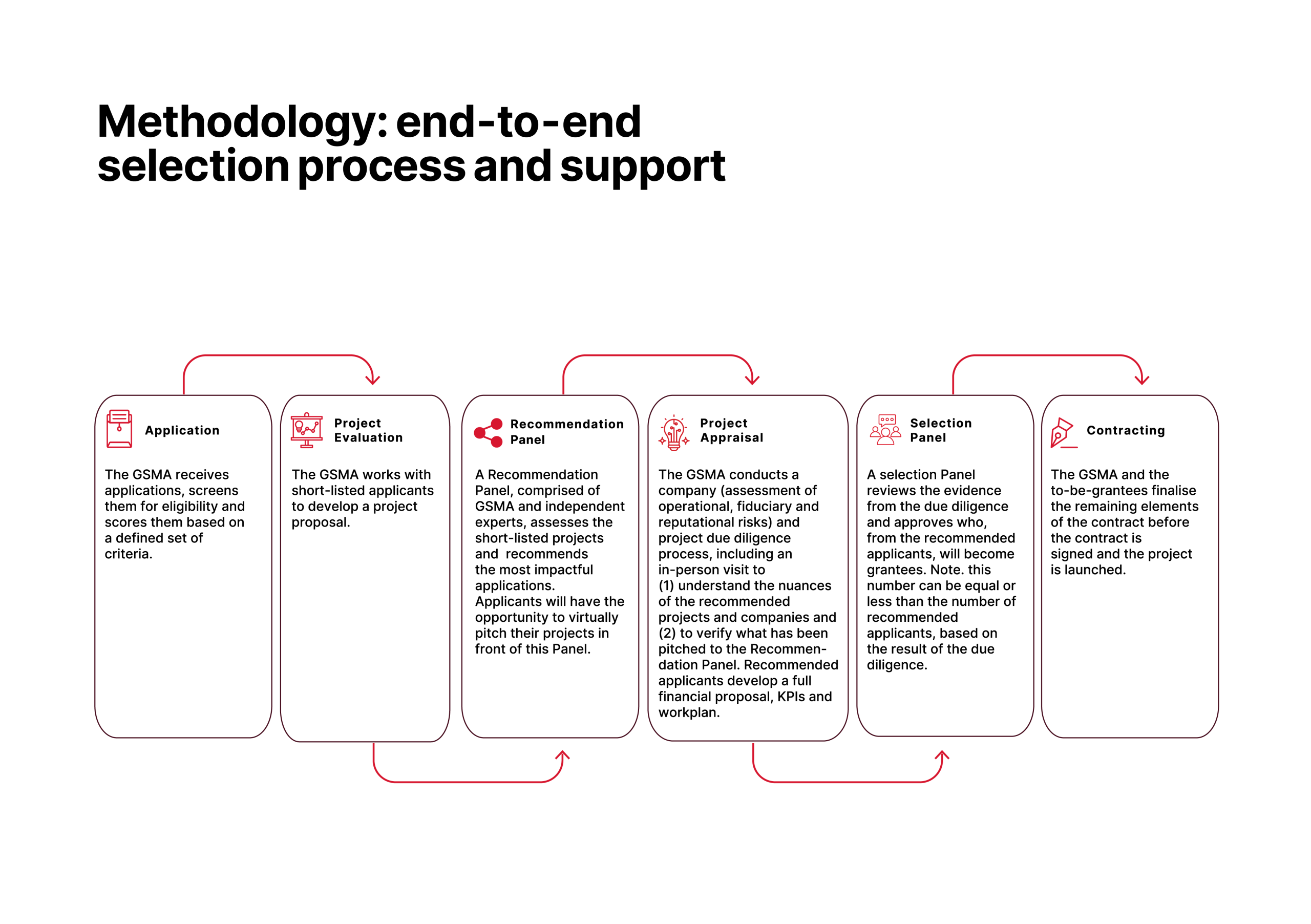
The GSMA Innovation Fund selects grantees based on a thorough process that is explained in the following figure. The entire process, from application to contracting, lasts around 10 months.
4. Can I receive guidance from the GSMA before I apply?
The GSMA will organise a series of online webinars to provide more details about the Innovation Fund round and answer anonymised questions from the audience. The dates of these webinars will be published here.
For any additional enquiries or questions not covered in the FAQs or the webinars, you can email to GSMAIF@gsma.com. Please expect a response within 2–3 working days.
Questions received after 30 March 2026 will not be answered.
5. I know an organisation that could be a great fit for the GSMA Innovation Fund. Can I refer this organisation to the GSMA?
We are interested in hearing about organisations that are eligible for the Fund. You can nominate eligible organisations by sending out an email to ‘GSMAIF@gsma.com’ with the subject ‘Organisation nomination’, please include:
- Organisation name
- Contact information (email and name of point of contact)
- Brief description of why you are nominating them
The GSMA will reach out and invite them to submit an application.
Application process to the GSMA Innovation Fund
1. What is the process to submit an application?
To submit an application, first register on our grant management platform. Please complete and submit the eligibility form. If eligible, you will receive immediate automated access to the application questionnaire. Please submit your application questionnaire by the closing date to be considered. Ineligible applicants will not be able to complete the application questionnaire.
2. Does my application need to be in English?
We only accept applications in English as we do not have the ability to review applications in other languages. However, English fluency will not be used as a criterion to assess applications.
3. Can I submit more than one application at the same time?
Multiple submissions for the same project are not permitted. In cases where this occurs, the first submission will be reviewed if it is eligible, and all duplicate submissions will be deemed ineligible and not reviewed.
A single organisation can submit multiple applications for different projects (such as organisations operating in multiple countries). However, no more than one application per entity will be advanced beyond the application stage.
4. Can I make updates to my application after I submitted it?
Applications cannot be edited once they have been submitted. Also, applications cannot be submitted after the deadline mentioned in the Terms and Conditions of the Fund, and any drafts including personal details will be deleted after this time.
5. Will I receive feedback on my application?
Unfortunately, due to the high volume of applications that we receive, we are not able to provide feedback on applications that are not shortlisted. If your application is shortlisted, we will provide you with detailed feedback in the next stages of the selection process.
6. Can you give any advice for submitting a competitive application?
In general, competitive applications are ones that:
- Are clear: for example, do not overwhelmingly use technical jargon
- Are truthful: for example, do not state incorrect information, since this will be discovered during the in-person due diligence assessment
- Can be clearly linked to the objectives of the Fund (as described in the Terms and Conditions: for example, you articulate the problem that you are tackling and the solution that you propose in terms that are aligned with the Fund’s objectives
- Clearly describe how the proposed solution will have a positive impact on the poor and most vulnerable (e.g. women)
- Are realistic about impact numbers and do not overinflate the project’s impact with unverifiable numbers
- Demonstrate a good understanding of local context by framing the problem statement and solution using a local lens and avoiding broad statements (e.g. “climate change is a worldwide issue”)
- Demonstrate a good understanding of the competitive landscape of the proposed solution
- Demonstrate a good understanding of the innovative aspect of the proposed product
- Can articulate the potential of the proposed project to scale
More specifically:
- Value proposition for a mobile network operator (MNO): where possible, the GSMA Innovation Fund will support grantees to build partnerships with MNOs. Such partnerships are valuable and documented in the GSMA Building Synergies framework. As such, this question is asked to understand whether you already partner with an MNO (and, if so, in what areas). If not, you are invited to indicate how an MNO may benefit from partnering with you. Please refer to the GSMA Building Synergies framework for examples.
- Gender aspect: the Innovation Fund strives to be gender inclusive and we strongly encourage applicants to consider how the proposed project can reach women as much as men.
7. I have applied to the GSMA before and registered my organisation in the grant management platform, can I retrieve the information previously submitted?
If you have previously applied to an Innovation Fund round using our grant management platform (Fluxx) please log in using your existing account instead of registering again. Once logged in, you will be able to view your organisation’s information and any previous applications.
If you are using a new email address but applying for a registered organisation you will be able to select the existing organisation during the registration process.
Eligibility
1. In which countries can I implement my project (“eligible countries”)?
The eligible countries are the following (organised by geographic region). These countries are part of the OECD Development Assistance Committee (DAC) list.
| Africa | Africa | Central & South America | South and South East Asia |
| Algeria* | Madagascar* | Argentina | Bangladesh* |
| Angola | Malawi | Belize | Bhutan |
| Benin | Mauritania* | Bolivia* | Cambodia* |
| Botswana | Mauritius | Brazil | India |
| Burkina Faso* | Morocco | Colombia | Indonesia |
| Burundi* | Mozambique* | Costa Rica | Lao People’s Democratic Republic |
| Cabo Verde | Namibia | Ecuador | Malaysia |
| Cameroon* | Niger * | El Salvador | Maldives |
| Comoros | Nigeria* | Guatemala | Nepal |
| Cote d’Ivoire | Republic of Congo (Brazzilville)* | Guyana | Pakistan* |
| Democratic Republic of the Congo** | Rwanda | Honduras | Philippines |
| Djibouti | Saint Helena | Mexico | Sri Lanka |
| Egypt* | Sao Tome and Principe | Panama | Thailand |
| Eswatini | Senegal | Paraguay | Timor-Leste |
| Ethiopia* | Sierra Leone* | Peru | Vietnam |
| Gabon | South Africa | Suriname | |
| Gambia | Tanzania | ||
| Ghana | Togo | ||
| Guinea* | Tunisia | ||
| Kenya | Uganda | ||
| Lesotho | Zambia | ||
| Liberia* |
2. Will I undertake different due diligence depending on the country where my project is implemented?
While the due diligence process is largely the same for all applicants, some additional due diligence checks and eligibility screenings may be required in certain countries. These countries are marked with * and ** signs in the country list above.
For specific countries, applicants must demonstrate at least three years of continuous operations to be eligible. These countries are marked with a ** sign in the country list above.
3. Can my project be implemented in several countries?
The Fund is open to applications for projects that focus on one country or multiple countries (where eligibility criteria is met for each country, such as having an existing entity registered and operating in the country).
Applications for projects in multiple countries must demonstrate that the projects can be managed effectively and completed within 15 to 18 months. As such, we advise applicants to limit their projects to two countries. Please note that it is preferable to apply for an impactful project in one country rather than overstretch your application to multiple countries, especially if you are unsure of your capacity to manage these projects.
4. Does my organisation need to be headquartered in an eligible country?
For most countries of implementation, your organisation does not need to be headquartered in an eligible country.
- If your organisation is not headquartered in an eligible country, your application will need to clearly demonstrate how you will oversee and manage implementation of your proposed project in the implementation country (such as via a downstream partner or local country office).
- Where funds will be sent to an entity other than the one in the country of implementation (e.g. HQ), the entity receiving the funds will also need to participate in due diligence. Please clearly outline such requests in your application form. This should include the rationale for having funds sent to another entity, a clear description of the relationship between the two entities and a brief description of the role each entity will play in project implementation and/or oversight. This will be explored more closely during due diligence, and we will advise you prior to the Selection Panel if this can be accommodated. Please note that this will likely require the parent company to be named as the lead applicant of the project or to become a third party to the grant contract.
For specific countries (those marked * and ** in question 1), applicants must be registered and operating in the country where the project will be implemented. During due diligence, we will confirm that the local entity satisfies all the usual indications of a legitimate commercial entity, such as business license or registration, a physical office, staff and/or listing in commercial directories in the country of implementation.
Please note that, in some cases, the GSMA may be restricted from sending funds to countries not included in the eligible country list and, in any case, will not be able to award funding to applicants headquartered in heavily sanctioned countries, including Cuba, Iran, North Korea, Russia and Syria, regardless of country of implementation.
5. Am I still eligible for a grant from the GSMA Innovation Fund if I previously received a grant from the GSMA )?
If you currently have an active grant with GSMA, you are not eligible to apply to this Innovation Fund. In cases where your grant will conclude during the application window, an exception may be allowed on the basis that the application will only be evaluated if an existing grant has fully closed before the application deadline.
If you have previously received a grant from the GSMA, you can apply to the Innovation Fund. However, it is important that you demonstrate the additionality of the requested funding compared to the previous one (i.e. the project you propose is substantially different from the one that was funded before).
6. Is there a requirement for how long my organisation must be registered before applying?
For most implementation countries, there is no minimum time requirement for an organisation to be registered or in operation. However, a short operating timeframe may influence your ability to meet some eligibility requirements. Namely, you will need to provide unqualified audit financials prior to contracting for the legal entity that is applying, which will require at least 9–12 months of recent financial history.
Please see questions 2 and 4 for additional requirements for countries marked * and **.
7. I am a startup. However, I am proposing a project that has not generated revenue yet. Am I still eligible to apply?
If you are a small and growing enterprise as per the definition in the Terms and Conditions, you will need to demonstrate that your company has generated some commercial revenue to date. This income is not necessarily from the proposed project but generated by the company as a whole.
If you are an early-stage small and growing enterprise whose revenue has come primarily from non-commercial sources (e.g. grants, membership fees, investments), you may be deemed eligible if you can demonstrate a clear and reliable roadmap to generate commercial revenue.
If you have not generated any revenue to date, you are not eligible to apply.
8. What is the purpose of Due Diligence and which standards will be used in assessing the maturity level of my organisation?
During Project Appraisal and prior to the in-person site visit, applicants recommended by the Recommendation Panel will be requested to complete an organisational due diligence questionnaire and participate in a virtual interview with The GSMA to provide additional clarifications. This due diligence is not a pass/fail exercise. The objective of this process is to assess the current maturity stage of the applicant and to ensure applicants have/are:
- Adequate financial systems to report regularly to the Fund and provide evidence of expenditure of grant funds and matching funds. Please note that successful applicants will be required to produce recent unqualified and audited financial accounts as a condition of funding.
- Adequate bank account to receive and hold grant payments.
- Adequate internal human resource capability to implement the proposed project and comply with the Fund’s reporting requirements within the planned timeframe.
- Compliant with all applicable laws and regulations across countries of operations.
- Compliant with fundamental human rights laws, the UK Modern Slavery Act and Gender Equality Act and Child Protection Policies.
- Compliant with the GSMA Safeguarding Policy (on Children and Vulnerable Adults) in all implementation markets.
- Adhere to the principles of the EU General Data Protection Regulation (GDPR) on data privacy.
You can view a detailed list of the documents that will be requested/reviewed during this assessment here
9. My organisation operates as a sole proprietorship. Am I eligible to apply?
Sole proprietorships are eligible to apply. During due diligence, we will assess your organisation’s governance and operating structure. Please note that the GSMA will only be able to award funds to entities that can demonstrate internal controls and segregation of authority. In cases of sole proprietorships, we would expect to see controls such as functional advisory boards, independent executive-level employees and clearly documented operational processes and procedures.
10. My organisation is not required to undergo regular financial audits. Can I still apply for funding?
To be considered for funding, you must be willing to undergo a financial audit prior to contracting, even where this is not required by local law. Such audits are used to ensure all successful applicants are measured against the same internationally accepted audit and accounting standards.
If you have not recently undergone a financial audit (within at least 1–2 years), you will need to provide unaudited financial statements for review during the due diligence process (prior to contracting ). Please note that if you are selected, your grant cannot proceed until this condition has been fully satisfied. In cases of extreme delays due to failure to meet this condition, this could result in the funding offer being rescinded.
Note. Applicants selected for grant funding may be subject to additional project related audits during or after the implementation of the projects.
Partners
1. Can I apply as a consortium?
You cannot apply as a consortium and become co-grantees. Only one organisation can apply for funding and become a grantee, and it must be the organisation that is in charge of delivering the majority of the outputs of the proposed project.
However, you can have downstream partners (see question 2) who play a role in the implementation of the grant project. There is space on the eligibility questionnaire to specify these partners.
2. What types of partners are allowed under the GSMA Innovation Fund?
As defined in the GSMA’s Downstream Partner Guidelines, downstream partners are defined as either:
- Subrecipients: organisations to which the grantee delegates responsibility for managing the delivery of certain project activities and spending a portion of the grant funds (rather than just receiving them as payment). Please note the restrictions set out in the Terms and Conditions for subrecipients.
- Consultants/subcontractors/suppliers: commercial providers of goods or services with which a grantee enters into a commercial arrangement after a competitive procurement process for the provision of specific goods or services for the project.
- Project stakeholders/partners: organisations that may be involved in the project (and may be key to its success) but are not receiving any grant funds. For example, MNOs, community-based organisations and government entities.
At the application stage, all applicants should name all the subrecipients of the proposed project as indicated in the eligibility questionnaire. If you are shortlisted, the GSMA will ask for a full picture of all proposed downstream partnerships to understand how applicants plan to deliver the project and the applicant’s maturity in terms of procurement processes. This includes confirmed partners or those to be determined at a later stage following procurement, such as consultants/subcontractors/suppliers.
The Fund encourages all applicants to have meaningful partnerships with relevant stakeholders (in particular, local to the country of implementation), especially when these partnerships increase the impact and value proposition of the proposed project.
3. Can I apply for funding for my organisation AND be included as a downstream partner in another application?
Yes, this is permissible, but with some restrictions:
- No more than one application per entity (as either lead applicant or subrecipient) will be advanced beyond the application stage.
- If applying as a lead applicant and providing commercial services (consultant/supplier) for another application, you will need to demonstrate a clear division between the two scopes of work. Any commercial services must be unrelated to the proposed grant project or services.
Grant amount and matching contribution
1. What funding amount should I apply for?
You can apply for a grant between GBP 100,000 and GBP 200,000. We strongly encourage you to apply for a realistic amount that is in line with what you want to accomplish in the proposed project.
If you are recommended by the Recommendation Panel, the GSMA will work with you to ensure the budget is right-sized in line with the objectives of the project, while ensuring that the budget items are allowed by the Fund and the budget demonstrates value for money and good use of donor funds.
Consequently, if you become a grantee of the Fund, the final approved budget may be the same or lower than the requested amount at the application stage.
2. How long should the project be?
The project can be between 15 and 18 months.
3. What can grant funding be used for?
Grant funding can only be used for costs that will be incurred during the grant period. This includes costs such as:
| Category | Examples | Guidance |
| Human resource costs | Payroll expenses, contractor fees, etc. | It is best practice to aim for no more than 30% of the requested amount. A higher percentage can, however, be allowed when justified. |
| Project operation costs | Consultancy fees, subscriptions, product development and testing, etc. | Expenses will be accepted on a cost-only basis. |
| Marketing and workshop costs | Marketing campaigns, event venue rentals. | |
| Travel costs | Airfare, accommodations, meals. | Costs will be reimbursed on an actuals basis; per diem rates are not allowed. |
| Assets and/or equipment | Retained assets (computers, furniture, machinery); inventory (equipment that will be sold/leased as part of project activities. | Limited to a maximum of 30% of the total grant, of which no more than £15,000 may be used to purchase retained (non-inventory) assets such as laptops and equipment. |
| Overhead/administrative costs | Rent, human resource costs for accounting staff. | Limited to no more than 10% of requested amount. |
Additional guidance will be provided during the project appraisal stage, with additional guidance on allowable use of funds, including acceptable thresholds for each of the categories listed above.
4. What can grant funding not be used for?
Grant funds cannot be used:
- To subsidise revenues (e.g. by providing discounts or credits to customers).
- To cover indirect costs. However, administration costs, such as the use of personnel for grant management or corporate functions (e.g. human resources, processing financial transactions) can be included as direct costs in proportion to the grant activities.
- To cover the cost of “business as usual”/nonproject-related requirements. For example, if an applicant will be housing project staff in an existing office, and not incurring any additional office costs as a result, the cost of the office (or a percentage of it) cannot be considered a project cost.
- To cover any ineligible use of funds as outlined in the Terms and Conditions.
Finally, grant funds cannot contain any profit element.
5. If I am selected for a grant, how will I receive the funds?
Fund disbursements are made on a milestone basis. During the contracting phase, grantees will work with the GSMA to define up to seven milestones that will trigger the release of a percentage of the grant. The release of funds is based on the successful completion of the tasks or deliverables associated with the milestones and the acceptance of reported project expenditure.
While the first milestone payment is issued in advance at the start of the project, all other milestone payments are reimbursements of grant spending, subject to the above conditions. As such, it is important that grantees consider their cash-flow constraints when defining their milestones.
Please note that the final milestone payment (10%) is made at grant closure, which is several weeks after the end of the project. It will only be disbursed once all grant-supported activities are complete and upon acceptance of the final outputs and final reporting. The final milestone payment will also always be a reconciling payment, with the amount reduced to reflect any underspend on the grant-supported activities. Under no circumstance can unspent grant funds be kept by recipients.
6. What is a matching contribution? Is it mandatory and what counts as match funding?
A matching contribution ensures that the applicant has “skin in the game”. It also demonstrates their interests are aligned with the Fund and that they are willing to share the risk and are invested in the success of the project. As such, this is a mandatory requirement for any Innovation Fund project. As mentioned in the Terms and Conditions, the matching contribution must be at least 25% of the requested grant amount. The matching contribution must be secured and evidenced prior to the Selection Panel and must be used for the proposed project and spent in full across the project cycle.
The contribution cannot be from other existing GSMA funding sources or in-kind support.
Matching contributions can be made in cash and/or in-kind. In-kind contributions cannot be used to fully satisfy the matching requirement (see below).
| Type of matching funds accepted | Description | Evidence required prior to contracting | Example (sources) |
| In cash | Direct financial contributions to the project from the applicant and/or third parties, such as a venture capital firm, impact investor, MNO or incubator/accelerator. Once secured, these contributions must be expensed towards project activity costs within the grant period. | Signed contract, bank statement or letter confirming the total amount disbursed or to be disbursed by the other party/parties. Evidence submitted to the Fund of matching commitments must include all conditions, timescales and any other considerations. | May include funding from: – Cash reserves/revenue – Investment funding/equity finance – Impact investment – Crowdfunding – Grants, such as from governments foundations or NGOs |
| In-kind | In-kind matching funds include any significant and quantifiable contribution to the project that is not supported by a financial transaction. Applicants must be able to quantify and demonstrate what results any matching given in-kind will achieve for the proposed project. | For example, a contractual agreement of support from a local incubator (providing the equivalent monetary value of the service). In cases where in-kind matching is offered, the Fund will reach agreement with the applicant on the contribution and valuation. | May include: – No cost or heavily discounted use of goods, services and facilities (such as software) – Provision and access to existing equipment – Existing stock or inventory |
Grantees will be expected to report on all match-funded transactions as part of regular financial reporting. Checks of evidence of expenditure (receipts, invoices, etc.) will be conducted during quarterly financial reviews to ensure compliance and ensure the matching contribution is spent.
7. We have existing inventory and/or equipment that we would like to use to implement the proposed project. Does this count as match funding and, if so, how will it be valued?
Yes, the use of existing assets such as inventory or equipment can be considered in-kind contributions. During the project appraisal stage, we will work with you to agree on a valuation of such items to be counted towards the minimum required match. This valuation will be based on the current book value of the items (purchase price minus depreciation) and allocation of use to the proposed project. Please note that items purchased using funding from the GSMA or donors of the fund cannot be used towards the match requirement.