


The Policy Leaders Forum at MWC26 Shanghai brought policymakers and industry leaders to explore one of the most pressing questions facing the mobile sector: how can today’s policy decisions unlock the full value of 5G while laying the foundations for 6G?
Across two complementary sessions, participants examined both the commercial realities of today’s networks and the spectrum strategies that will underpin tomorrow’s. The discussions reinforced that technology alone is not enough—long-term success depends on enabling policy, investment certainty and internationally harmonised spectrum decisions.
Making 5G deliver



As 5G reaches maturity in advanced mobile markets, the conversation is no longer centred on rollout, but on how operators can generate sustainable returns on the significant investments they have made.
Today, 5G accounts for over 3 billion connections globally, carrying around half of all mobile data traffic. Successive standards releases have significantly enhanced network capabilities, enabling higher speeds, greater reliability and support for increasingly sophisticated applications.
Participants identified four major pathways for 5G monetisation: fixed wireless access (FWA), enterprise and private networks, enhanced connectivity services and cloud and AI-enabled network capabilities
While consumer mobile broadband remains the foundation, future growth is expected to come increasingly from enterprise digital transformation, industrial connectivity and AI-powered services.
Commercial success will depend less on network technology itself and more on the ability to solve real customer challenges. Capabilities such as network slicing, ultra-low latency and differentiated quality of service are creating opportunities for operators to deliver tailored connectivity solutions for businesses, critical infrastructure and industry-specific applications. These capabilities represent an important shift from traditional connectivity towards value-based service offerings.
Policy as an enabler of investment
The discussion also highlighted that policy and regulatory frameworks play a central role in determining how quickly these commercial opportunities can be realised.
Several examples demonstrated how governments are supporting 5G deployment through long-term investment strategies, ambitious coverage objectives and digital infrastructure programmes. Attention is now increasingly turning towards accelerating enterprise adoption and supporting sectors such as manufacturing, logistics and public services to fully leverage 5G capabilities.
Cross-sector collaboration was identified as equally important. Future revenue opportunities increasingly depend on regulatory alignment across telecommunications, industry, transport and digital policy.
Building the foundations for the 6G era


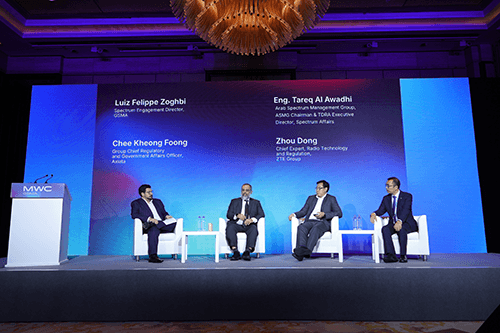
The second session looked ahead to the policy decisions that will shape the next generation of mobile technology.
As mobile traffic continues to grow and AI-driven applications become increasingly data-intensive, participants agreed that spectrum planning must begin years before commercial 6G deployment.
Forecasts showed continued acceleration in mobile data consumption, particularly as more markets transition towards advanced digital economies. For Greater China alone, future mobile networks are expected to require 2.5–3.3 GHz of mid-band spectrum between 2035 and 2040, while globally the estimated requirement is approximately 2–2.5 GHz.
The discussion also reinforced an important lesson from previous mobile generations: as network quality improves, users consume more data and entirely new applications emerge. Future 6G systems are expected to support AI-native operations, digital twins, integrated sensing, extended reality, satellite integration and highly automated industries.
Meeting these ambitions will require continued collaboration between governments, regulators, operators, equipment manufacturers and standards bodies.
Looking ahead
Across both sessions, one message resonated throughout the Policy Leaders Forum: the future of connectivity depends as much on policy as on technology.
Realising the full value of 5G will require policies that encourage investment, innovation and enterprise adoption. At the same time, preparing for 6G means making timely spectrum decisions that provide certainty, support globally harmonised ecosystems and enable the next generation of digital services.