Aviation is entering one of the most complex transitions in its history. Passenger demand is returning to pre-pandemic highs, airports are under pressure to increase efficiency, and regulators are opening the door to large-scale drone operations in shared airspace. At the same time, airlines and airports face rising expectations for real-time services, predictive operations, and seamless connectivity from gate to sky.
The challenge? These ambitions depend on networks that are intelligent, responsive, and secure, and right now, aviation connectivity is still fragmented.
Why Network APIs Matter Now
Standardised network APIs can open up new capabilities directly within mobile networks. For aviation, this means more than faster speeds. It enables precise control over network performance, secure identity verification, and real-time location intelligence, all critical for safety and efficiency.
Examples already emerging include:
- Smart airport operations using device verification and location APIs to integrate passenger biometrics with gate management.
- Quality on Demand (QoD) to prioritise crew and maintenance communications or to optimise Biometric video capture during peak times.
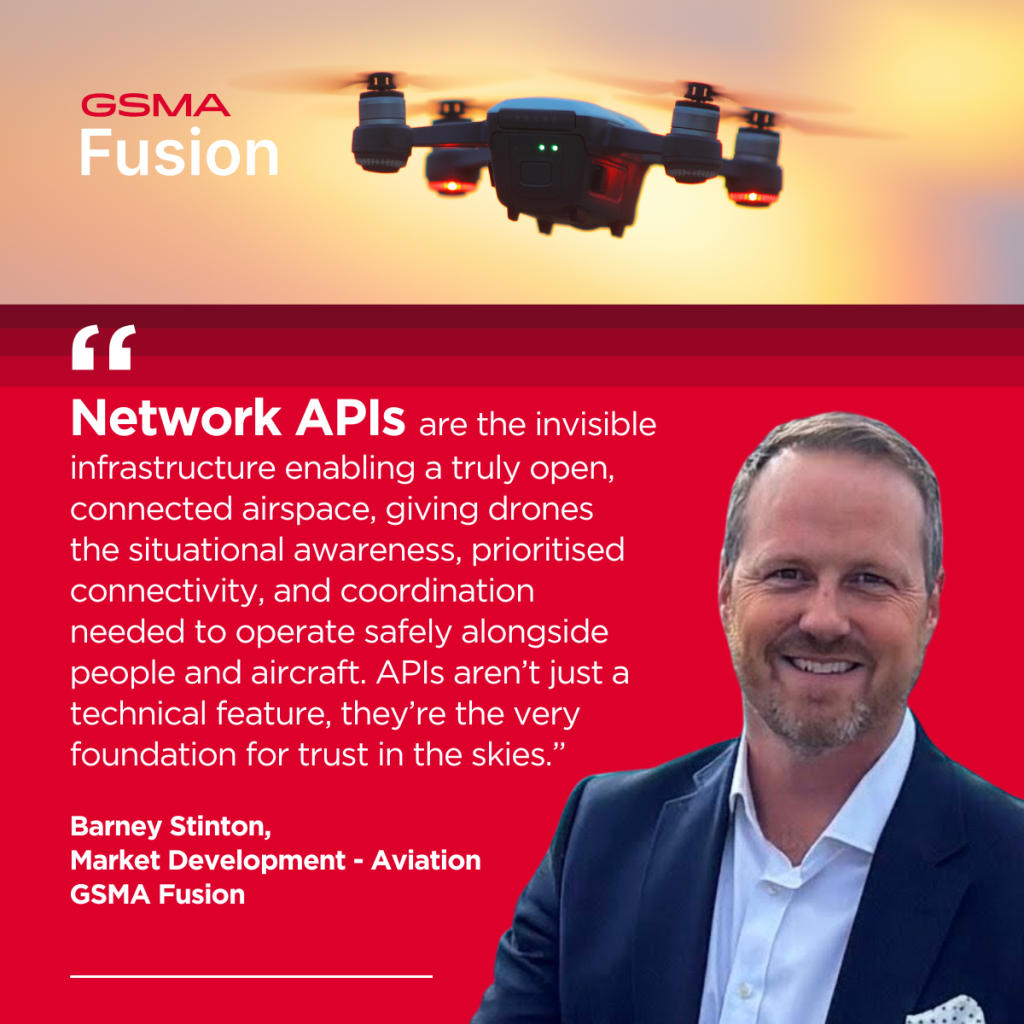
- Drone airspace coordination with APIs that verify device integrity and share live positional data with ground control.
- Emergency response where APIs temporarily boost connectivity for first-responder drones or incident investigation teams.
From Global Standard to Local Impact
GSMA Open Gateway is creating a global framework for these APIs, built through the CAMARA open-source project. This ensures an airline in North America, a drone operator in Europe, and an airport in Asia can all integrate the same APIs with consistent performance and security.
GSMA Fusion brings this to life by connecting telecom operators with vertical industries, running pilots, and building shared roadmaps for API adoption. In aviation, this work is already highlighting where APIs can deliver the greatest safety, efficiency, and revenue gains.
Join the Conversation
On 14 October 2025, Barney Stinton, Market Development Lead for Aviation at GSMA Fusion, will moderate a high-level roundtable at MWC Las Vegas.
The session will bring together leaders from airlines, airports, UAV companies, MNOs, and regulators to define the connectivity and API priorities required to build a safer, more connected, and commercially scalable aviation ecosystem.
This is an invite-only session, with a limited number of additional seats available.
📩 Register your interest HERE to join the conversation and help shape the future of connected aviation.