


Foreword:
The GSMA Operator Platform initiative, which was created in 2020, standardises a common architecture for exposing operator services to developers, enabling a “connect once, connect to many” model. It provides the technical basis for the GSMA Open Gateway initiative. The GSMA believe that the Operator Platform, as part of Open Gateway, should only support standardised or open source APIs such as those provided by CAMARA or TMForum, and that efforts should be made to put any proprietary APIs into these common frameworks to reduce barriers to adoption.
In this guest blog, Nokia reminds us of the importance of the Operator Platform in the implementation, adoption and monetization of network APIs.
The Operator Platform must support a degree of automation for efficiency as well as supporting both standards-based and proprietary south bound interfaces (SBIs) to integrate into the highly customised and individual operator BSS/OSS domains.
The role of the Operator Platform in implementing network APIs
By Mikko Jarva – Head of portfolio and architecture Network Monetization Platform BU, Nokia

Disentangling the Operator Platform and API Aggregation Layer
Network APIs hold great promise for the telecom industry. They will speed the introduction of services for application providers, provide new ways for telecom operators to monetize their investments in 5G and 5G-Advanced networks, and offer services beyond basic connectivity. The telecom industry is excited by the potential of APIs, which hinges on the standardization and presentation of APIs to developers in a kind of plug-n-play fashion via an API Aggregation Layer and easy integration with developer tools.
There is a second, less talked-about abstraction layer, however, that also needs to be built into each telecom operator’s network, which acts as a northbound gateway to organize and expose capabilities from operator networks to the Aggregation Layer. In the GSMA Open Gateway Initiative (OGI) taxonomy, this is referred to as the “Operator Platform”.
The Operator Platform and the API Aggregation Layer are often confused and the separate effort required for, and the purpose of, each layer is not well understood. This article will set out the differences and complementary relationship between these two layers and argue for increased focus on the operator platform.
API Monetization
The concept of using APIs to expose network capabilities, while not new, when combined with the cloud and today’s robust application development community, represents a paradigm shift in how the telecom industry will deliver services in the future. Developers can use network APIs to enhance and introduce services for their customers faster and more efficiently by leveraging the scale and sophistication of telecom networks. When standardized across the industry and presented in a single easy-to-use repository, an API aggregation layer represents a single global point of access to the world’s connectivity platforms.
The capacity to expose capabilities to developers was anticipated in the design of the fifth-generation mobile network, but not all of the technical aspects of how this would be done are provided. The objective of the GSMA’s Operator Platform initiative is to standardize a common architecture for how services are exposed.
Tasks such as onboarding of applications, managing privacy, and subscriber charging are differently configured in each operator’s network, thus the need for a platform that can provide a standard interface into these functions in each network. Along with providing access to network functions such as the RAN or edge cloud, the Operator Platform could also provide an interface for federating services between operators, such as support for subscriber roaming. Whereas the APIs exposed at the Aggregation Layer are meant to be the same for every function, the Operator Platform will be custom configured for each operator.
The Operator Platform
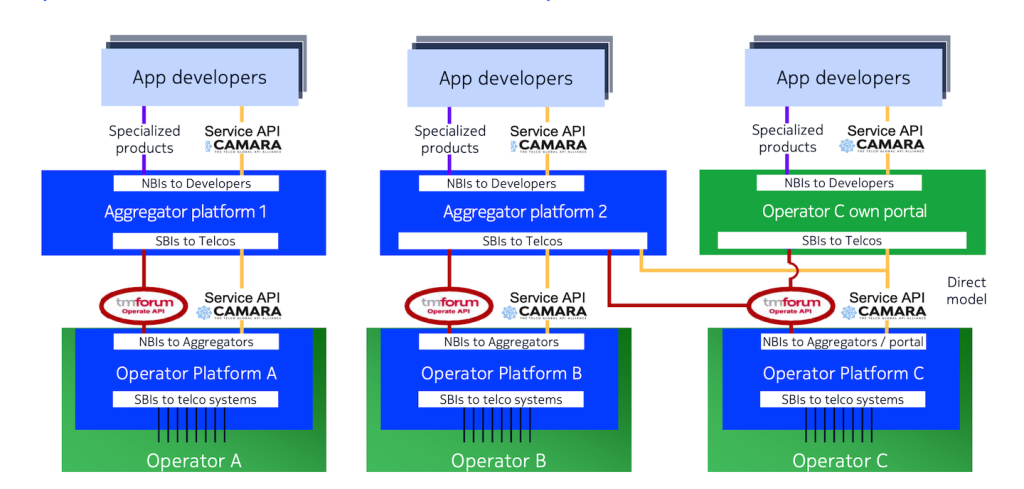
As shown in the illustration below, as part of the GSMA Open Gateway concept, the Operator Platform is depicted within each CSP environment where the primary role is to manage how information within the CSPs’ various telco systems is connected to the standards-based CAMARA and TM Forum Operate APIs for northbound exposure toward Aggregator platforms. Each Aggregator platform will then have the role to extend these CSP-specific interfaces northbound to the Developer community; either by extending the CAMARA APIs or, by creating specialized products:
Automation is a key aspect of how API calls, whether standard or proprietary, manifest in the operator’s network. To that end, the Operator Platform should include support for analytics, generative AI and other AI/ML applications that will provide intelligence and enhance flexibility in how different APIs access information or trigger certain deterministic behaviour in the network. This also includes ways to reduce the overhead associated with API calls by centralizing and intelligently managing end-to-end automated processes, especially for more elaborate APIs that demand deterministic Quality-of-Service or create and manage virtual private networks, or dynamic network slices.
Along with ensuring that these implementations are sufficiently scalable, efficient and adaptable to meet the intent of the API calls, they also need to meet a very high level of security across the entire chain of network and OSS/BSS interactions. In considering the requirements for the Operator Platform, the GSMA has clearly specified the highest level of security including robust protection for all API interactions.
The GSMA has also set forth standards for exposure of network capabilities, which should be met by the Operator Platform.
Implementing Operator Platforms
The Operator Platform represents a paradigm shift in how to operate and deploy telecom services, specifically providing telecom services, such as network capabilities to be exposed and consumed by an ecosystem as services. Such paradigm shift requires skills, process and operational adaptation in multiple areas, including security, privacy, SLA management, API governance etc.
In summary, an Operator Platform is critical in ensuring that each operators integration into the network API economy is cost-efficient, secure and operationally effective. The network API opportunity means smoothly integrating within an ecosystem of aggregators, hyperscalers and other players, which imposes a host of new requirements on the telco. A well-executed Operator Platform will enhance network programmability, tap into new innovative service offerings from developers and ensure that the operator can meet the quickly evolving needs of enterprises and cloud application providers.