



Simplifying access to mobile operator networks
By Henry Calvert, Head of Networks, GSMA and Markus Kümmerle, CAMARA
In today’s digital world, Application Programming Interfaces (APIs) are the invisible engines behind many of the services we rely on every day. They allow different software systems to communicate with each other, enabling everything from ride-hailing apps to online banking. But while APIs have revolutionized cloud computing and web services, one area has remained relatively untapped: mobile networks.
That’s where network APIs come in – standardized interfaces that allow developers to access and control capabilities within mobile networks, such as verifying a user’s phone number, checking device location, or managing network quality, without needing to understand the complex infrastructure behind them. Just as cloud APIs made computing power and storage universally accessible, network APIs are now doing the same for mobile connectivity.
This shift is opening up a new frontier for innovation. By making mobile networks programmable, developers can build smarter, more secure, and more responsive applications that integrate directly with the network itself to unlock real-time fraud detection, seamless identity verification, and location-based services – without needing to navigate the complexity of hundreds of mobile operators. At the heart of this transformation is GSMA Open Gateway.
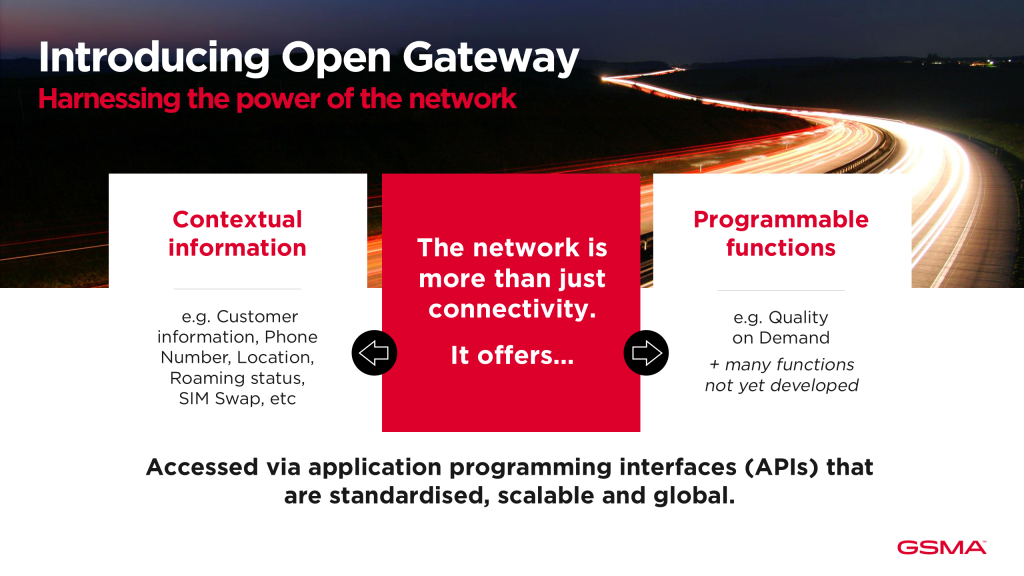
Open Gateway is a global initiative that’s transforming how mobile networks interact with the digital world. By standardizing network APIs through the CAMARA project, and aligning operators, aggregators,
and developers under a common framework, Open Gateway is making telecom capabilities programmable, accessible, and scalable.
Why now?
The rise of 5G has introduced a new era of connectivity – faster, more reliable, and more flexible than ever before. But for enterprises and developers, tapping into these capabilities hasn’t been easy. Historically, integrating with mobile networks meant dealing with fragmented systems, inconsistent interfaces, and complex provisioning processes.
Open Gateway changes that. By exposing network capabilities through standardized APIs, it allows developers to build applications that interact directly with mobile networks – without needing to understand the intricacies of telecoms infrastructure.
As Henry Calvert, Head of Networks at GSMA, puts it: “The goal is to ensure that enterprises can have a simple, programmable network. They’re in control. They can provision and consume services to deliver better experiences to their customers.”
How Open Gateway works
At the heart of Open Gateway is CAMARA, an open-source project developed in collaboration with the Linux Foundation. CAMARA defines the APIs, such as Number Verification, Location Verification, and Quality On Demand. These APIs are designed to be simple and developer friendly.
Open Gateway focuses on how these APIs are exposed by operators. It ensures consistency across markets, supports consent and capacity management, and enables monetization.
To increase accessibility, GSMA has launched a global API availability map and developer portal, where developers can explore APIs, test them in sandboxes, and see which operators support them in each market.
The result? A unified, global framework that makes it easy for developers to access network capabilities – no matter where they are.
Real-world impact: network APIs in action
Open Gateway is already delivering real value across industries.
- China Telecom: ride-hailing for the elderly
Using the Location Verification API, China Telecom helped launch a ride-hailing service tailored for elderly users who may not be comfortable with smartphones. By verifying the caller’s location through the network, the service ensures accurate pickups; no app required.
- ABA Bank: seamless authentication
In Cambodia, ABA Bank used the Number Verification API to streamline user registration and authentication. This reduced friction for customers and improved security, without one-time SMS passwords. - Cabify: faster onboarding
The ride-hailing platform Cabify integrated Number Verification to speed up user onboarding in Brazil. The smoother user experience saw fewer drop-offs during registration - Vodafone: fighting fraud with scam signal
Vodafone implemented the Scam Signal API to detect and block fraudulent calls in real time. This proactive approach to fraud prevention protects users and builds trust in digital services
These are just a few of the case studies already published by GSMA and CAMARA, and more are being added regularly.
What’s driving API adoption?
One of the biggest drivers of adoption is the need for better user experiences. APIs like Silent Authentication and Age Verification are replacing outdated methods like SMS codes and manual ID checks. As Markus Kümmerle from CAMARA notes, “One-time passwords via SMS are not only insecure – they are a terrible user experience. APIs offer a better way.”
Another key factor is regulatory pressure. In the U.S., EU, and Australia, new laws are requiring stricter age verification for online services. Mobile operators are uniquely positioned to provide this, and Open Gateway gives them the tools to do it at scale.
And then there’s commercial opportunity. APIs open new revenue streams for operators, replacing declining SMS revenues with programmable services that developers are willing to pay for.
Challenges to overcome
Building a global API ecosystem isn’t without its challenges. Operators need to align on standards, manage consent and privacy, and support with affordable solutions. As Markus puts it, “It’s all about coverage. We need to help smaller operators adopt the standards so developers can reach every market.”
Another challenge is simplifying the developer experience. That’s why GSMA and its partners are investing in better documentation, sandboxes, and developer education.
A glimpse into the future of Open Gateway
GSMA is working with “market champions” in over 15 countries to align operators and launch APIs in unison. The goal is to reach 50+ markets by the end of the year, with a focus on high impact use cases like anti-fraud and authentication.
Meanwhile, new vertical use cases are being developed. “We’re starting to see demand-driven innovation,” explains Henry Calvert. Automotive companies want APIs to improve in-car safety. Aviation firms are exploring ways to enhance airport experiences. And financial services are demanding APIs that support inclusion and secure mobile payments. “Industries are telling us what they need, and we’re building the APIs to match”.

Why Open Gateway matters?
Open Gateway represents a fundamental shift in how mobile networks are used. By making networks accessible through APIs, Open Gateway is enabling a broader range of secure, real-time digital services across industries.
And for developers, it means one thing: the power of the global mobile ecosystem is now just an API call away.