Monday 13 July, 2026
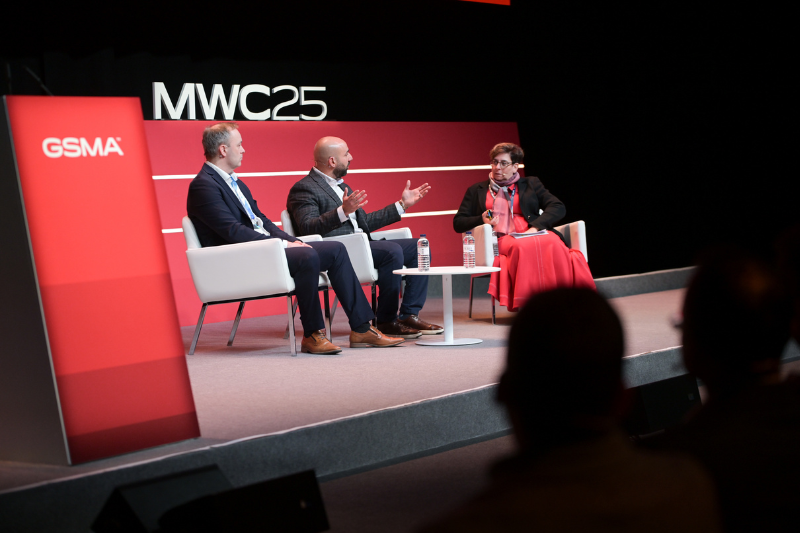
MWC 25 Connect 5G Summit focuses on the new value created by 5G SA and 5G-Advanced
The rollout of new technologies, such as mobile artificial intelligence, network slicing, non-terrestrial networks, and massive IoT connectivity, is set to create major new value for both the mobile industry and its customers, according to expert speakers at the Connect 5G Summit, hosted by the GSMA at MWC25.
5G standalone (SA) networks, which have a cloud-native core, and 5G Advanced technologies will meet consumers’ and enterprises’ demand for reliable connectivity everywhere, explained Sunil Patil, Vice President Product Management at Qualcomm. In particular, he highlighted four technological pillars – AL/ML (machine learning), carrier aggregation to increase bandwidth, 5G RedCap (a low-cost form of 5G) and satellite-based connectivity.
Citing a survey of 44,000 consumers conducted by Qualcomm in 11 countries, Sunil Patil said “consumers would like to see improvements in subways, shopping malls, congested networks and that’s precisely the goal of some of the 5G-Advanced features that Qualcomm is working on,” The research also found that 49% of respondents are willing to pay more for a 5G-Advanced capable device.
In a similar vein, Jeevithan Muttu, Vice President of Product and R&D at Motive, highlighted “a shift in terms of the user expectation and willingness to pay when it comes to getting better speeds, better QoE (quality of experience).” Rather than focusing on selling data, operators should “focus on selling the experience, selling that assurance because we know that people are willing to pay for that,” he added.
Jeevithan Muttu also highlighted the opportunities for mobile operators to monetise RCS messaging, which is now supported by Apple, as well as Google, and standardised network APIs. Suggesting that RCS business messaging could evolve into a sort of super app, he noted “a lot of other customer engagements are going to shift towards RCS and it is in the hands of the operators to manage, so there is a bit more trust compared to using OTT platforms.”
A key use case for network APIs is so-called silent authentication, whereby an individual’s phone number is securely verified by an API call. “For us, what is important also is the customer reach, because without silent authentication you can’t cover VPN connectivity in Wi-Fi,” explained Alexandre Harmand, Head of Network Platforms at Telefonica. “But with this number verification solution, we can reach a much wider set of connectivity scenarios.”
Slices, satellites and new services
5G SA’s ability to support network slices could also open up new monetisation opportunities for mobile operators. “We just launched network slicing in Spain in the B2B segment, so we are quite proud of having our first customers,” Alexandre Harmand told the Summit.
Another opportunity for mobile operators is to integrate satellite connectivity into their overall proposition, as envisioned by the latest 3GPP standards. At the Summit, Brian Aziz, Vice President of Global Sales at satellite company Iridium, explained: “What 3GPP is allowing us to do is leverage our global network, our global spectrum and collaborate with the cellular mobile ecosystem to kind of broaden our reach and allow us to participate in this convergence between terrestrial networks and satellites.” Iridium is particularly excited about the opportunity to use low earth orbit (LEO) satellites to extend the Internet of Things (IoT). “One of the markets that have been really difficult to crack has been… residential smart metering for really remote residential areas in countries like Brazil, for example,” Brian Aziz added. In those markets, “the volumes are tremendous compared to what we’re serving today.”
To fully unlock this opportunity, semiconductor and device makers will need to overcome several challenges, noted Kristian Saether, Product Director, Cellular IoT, Nordic Semiconductor. “From a device point of view, it’s tougher to find that lower orbit satellite, track it and know when to wake up and send data,” he explained. “That’s the challenge we have on our side to solve. But if you can do that, I think we can bring low power and simple solutions to the IoT market.” He also stressed the importance of reducing the complexity of satellite connectivity for device makers.
AI and 5G-Advanced working together
In the consumer segment, a key application for 5G-Advanced networks is likely to be supporting agentic AI. Carol Lin, Vice President, Global Business Center at ZHIPU·AI, described how her company has developed AI agents that can interact with various apps on behalf of consumers. In response to voice commands, these agents can find and book a suitable restaurant, for example, or send tailored messages to the individual’s contacts. “We definitely need advanced network around the world to help the user experience,” she added.
Echoing that view, Javan Erfanian, Senior Director of Strategy at GTI, stressed the importance of the network in supporting “distributed intelligence…we see more on-device AI in the coming years and more of mobile AI in a collaborative, negotiating way.” He also highlighted how network slices could support the “intent-based orchestration of sub-tasks.”
One of the priorities for standards bodies is to support trustworthy AI and related data sharing architectures, explained Jan Ellsberger, Director General of ETSI. Along with quantum and other new technologies, “data sharing, and monetisation of industrial data is something which is a big area upcoming” for his organisation, he added.