




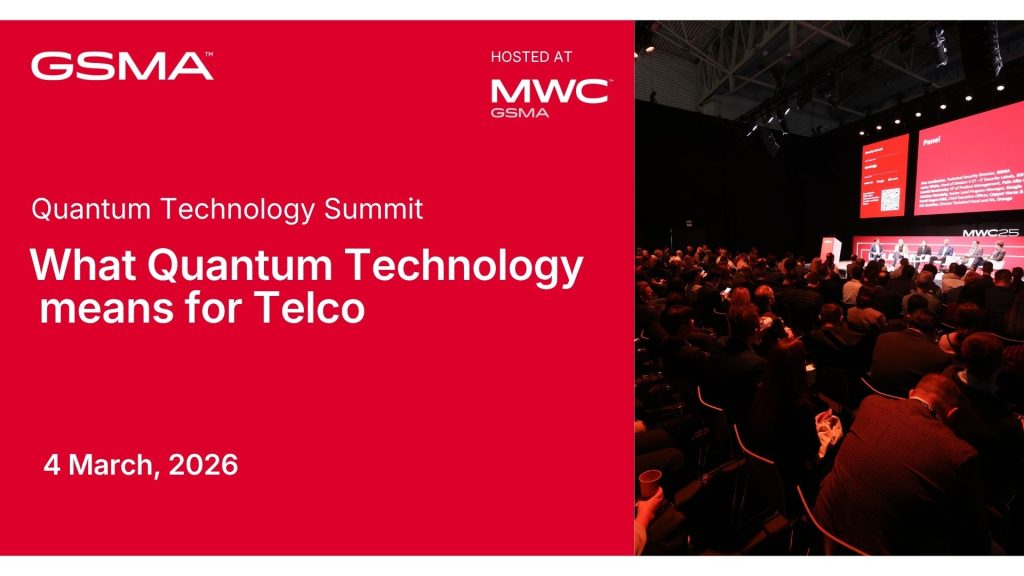
Quantum technologies made a strong impact at MWC26. Wednesday’s Quantum Summit built on the success of last year’s inaugural session, bringing together an engaging line-up of real-world quantum deployments and innovation across the telco ecosystem.
Leading global telecommunications operators, s, cloud service providers, and quantum technology specialists shared a common message: quantum technologies are no longer theoretical concepts for the telco sector. Practical applications are emerging, and momentum is expected to accelerate in the years ahead.
Quantum technology providers increasingly view telecom as a credible driver of commercial quantum innovation for real deployment. Among the Tier 1 operators, momentum is also growing, with companies including Telefónica, China Telecom, and Deutsche Telekom showcasing progress made over the past year.
This growing visibility aligns with this year’s MWC theme – The IQ Era, represents a world that is increasingly data-saturated and requires new approaches to optimise networks and manage vast volumes of information. Quantum technologies offer powerful capabilities in this context, enabling new approaches to network optimisation, data transport, and highly precise sensing and measurement. The Summit opened with an announcement of a new white paper from the GSMA Quantum Networks and Services Working Group, providing a comprehensive review of quantum technology use cases across the telco sector. By highlighting practical applications for quantum computing, communication, and sensing, the white paper supports the telco industry to explore possibilities for integrating quantum technologies into telco networks and services.
Simon Müller, Senior Technology Strategy Manager at Telefónica Deutschland and chair of GSMA’s QNS working group, said “the working group allows us to shape and drive the development of quantum technologies, both within the telco community and in the broader ecosystem.”
The transformative potential of quantum computing
During the Summit, Microsoft highlighted how quantum computing can deliver practical outcomes including improved optimisation, more accurate simulation, faster machine learning, and the potential to unlock new scientific breakthroughs.
The emerging access model for quantum computing is cloud-based. Microsoft – alongside other technology companies – offers a platform with integrated access to high-performance computing, AI infrastructure, and quantum compute. This reflects an important principle: quantum computing will not replace traditional methods but instead complement existing technologies to deliver significant performance benefits.
Microsoft also highlighted near-term and medium-term opportunities for telco operators – presenting clear pathways for telco operators to begin capturing early benefits.
In the near-term, hybrid optimisation could improve network planning and operations including routing, fibre or tower placement, and dynamic spectrum allocation. In some cases, measurable improvements are already demonstrated.
In the medium term, as accessible quantum compute capacity grows, optimisation benefits are expected to expand further. Potential outcomes include reduced network route lengths and faster network design cycles. Over this same timeframe, quantum sensing applications are also likely to mature, with potential integration into network operation centres and the development of quantum timing services delivered over fibre.
Overall, Microsoft’s outlook suggests a positive trajectory, with clear pathways for telco operators to begin capturing early benefits.
Watch the session: Quantum computing and AI revolution
Quantum AI techniques unlock new frontiers for network security
French quantum computing company Quandela together with Orange Innovation presented work addressing the role quantum computing can play to strengthen the telco security landscape.
Their approach applies quantum AI techniques to detect malware. Over 450,000 new malware and potentially unwanted applications are identified each day, a number boosted in recent years by use of generative AI, driving the need for efficient, scalable detection methods. Quantum machine learning offers a potential advantage to traditional methods – it can efficiently encode high-dimensional datasets, enabling deeper analysis of complex patterns.
Using a photonic quantum computer with 12 qubits – only a small number compared with the millions expected in the future – the Quandela and Orange Innovation teams were able to match state-of-the-art classical performance while requiring less energy and compute time. As quantum computers continue to scale, the accuracy and efficiency of these techniques are expected to improve further.
This collaboration between Orange Innovation cybersecurity specialists and Quandela photonic computing experts demonstrates the benefits of strong cross-industry partnerships between telco operators and quantum technology providers.
Watch the session: Quantum and AI in network operations
Quantum communication unlocks strategic opportunities for telcos – today and in the long-term
Over the past few years, quantum communication networks have demonstrated the ability to transmit quantum information directly between nodes, a challenging task given that quantum information is notoriously fragile and easy to disrupt. Widespread quantum communication networks already exist in Europe [1] and numerous APAC countries [2, 3, 4].
While this introduces new infrastructure and implementation challenges for telco operators, it also presents significant strategic opportunities both immediately, and in the long-term.
ID Quantique and Colt Technology Services highlighted how quantum key distribution (QKD) can support organisations handling highly sensitive data and long-term confidentiality requirements, including sectors such as healthcare and defence
QKD is gaining importance across the broader quantum ecosystem, enabling secure quantum data centre interconnects and suggesting new opportunities to cryptographic isolation in data centre colocation or network slicing.
ID Quantique outlining several potential monetisation approaches for QKD – from infrastructure-as-a-service to software-as-a-service, highlighting the variety of roles that telco operators could play in the emerging quantum ecosystem. As the market evolves, operators have an important opportunity to secure their place in the value chain.
Watch the session: Quantum entropy for telco
Advancing towards the quantum internet: from QKD trials to distributed networks
Telefónica and AWS presented results from a joint quantum optimisation and connectivity trial. Confidential site placement data was securely transmitted from Telefónica facilities to an AWS data centre using QKD-based encryption. The data was then processed using Amazon’s 256-qubit quantum computer Aquila to generate optimised antenna placement design under network coverage constraints. This shows how integrated quantum workflows could operate in practice – secure, end-to-end, pipelines supporting specific optimisation tasks.
Telefónica and AWS also outlined a long-term vision for the quantum internet, moving from today’s QKD networks to fully interconnected quantum computers by around 2035. Achieving this vision will require significant advances, including quantum hardware like repeaters and memories, to validation of commercially sustainable models.
Momentum is already building across the sector. In the week before MWC, quantum networking company Qunnect announced important technical milestones with Deutsche Telekom [5] and Cisco [6] – while Cisco and IBM revealed a partnership in late 2025 to build a distributed quantum network by 2030 [7].
Ultimately, the quantum internet represents a critical opportunity for the telco sector, requiring new widespread networking capabilities with carrier-grade reliability and resilience.
Watch the session: Quantum key distribution and the Telco role
What’s next for quantum technology in the telco sector?
MWC Barcelona’s Quantum Summit provided an important platform for telco operators, vendors, and quantum technology specialists to highlight the innovative work underway across the industry.
Simon Müller stressed the role of the Quantum Summit in “highlighting pioneering projects and lighthouses to increase awareness and create the network to drive further innovation.” For Telefónica, “quantum is very important. At MWC this year, the quantum telco was one of the key themes.”
Juan Moreno from AWS, highlighted the rapid development of quantum technologies within the telco ecosystem – compared to last year’s Summit, “it’s a lot less about education and a lot more about having a practical use case, understanding how that [can be implemented] using a specific technology…it’s a very exciting space.”
Grégoire Barrue, a cybersecurity and quantum expert at Orange, discussed the strategic value of getting involved with quantum technologies at an early stage. “It’s especially important to develop proofs of concept that are ready for the arrival of [fault-tolerant] quantum computers,” allowing telco companies to rapidly scale applications as hardware matures. “We see this is evolving really fast.”
Andres Gil valued the opportunity the Summit provided to “see the whole ecosystem and the energy from the speakers and the audience,” adding “we are working totally as a team and a community.” The Quantum Summit at MWC was supported by GSMA’s year-round work to support quantum technologies across the telecom ecosystem.
Two key initiatives support this work:
1. The Quantum Networks and Services working group brings together telco operators, network vendors, and quantum specialists to drive technical alignment and industry requirements. Organisations are encouraged to engage and contribute their prospective to this cross-industry initiative shaping the future of quantum technologies in the telecom sector. For more information, please contact: quantumtech@gsma.com
2. GSMA Foundry provides a collaborative platform for the telecom industry to accelerate innovation, develop new capabilities, and establish economic clarity for emerging technologies. Organisations with projects exploring the application of quantum technologies to deliver value and innovation across the telecom ecosystem are invited to submit their proposal: foundry@gsma.com
Citations
- https://digital-strategy.ec.europa.eu/en/policies/european-quantum-communication-infrastructure-euroqci
- https://www.idquantique.com/quantum-safe-security/nation-wide-quantum-safe-key-distribution-network-in-south-korea/
- https://www.singtel.com/about-us/media-centre/news-releases/singtel-launches-southeast-asias-first-hybrid-quantum-safe-network-to-deliver-flexible-scalable-security-for-enterprises
- https://www.nature.com/articles/s41586-026-10152-z
- https://laboratories.telekom.com/deutsche-telekom-and-qunnect-successfully-test-quantum-teleportation-over-live-berlin-network/
- https://outshift.cisco.com/blog/scalable-quantum-entanglement-networking
- https://newsroom.ibm.com/2025-11-20-ibm-and-cisco-announce-plans-to-build-a-network-of-large-scale,-fault-tolerant-quantum-computers
You may be interested in
Event by GSMA
Wed, Apr 29, 2026, 2:00 PM (your local time)