


WRC Series: WRC-23 and WRC-27 and the Future of Mobile
The World Radiocommunication Conference (WRC) plays a critical role in shaping the future of mobile connectivity. Decisions taken through the WRC series impact billions of people worldwide by determining how spectrum is allocated for mobile broadband, 5G and future generations of technology.

The World Radiocommunication Conference (WRC) is a cornerstone of global spectrum policy, with decisions that shape the future of mobile connectivity for decades. The outcomes from WRC-23 have set the stage for the mobile sector’s continued evolution, while the agenda for WRC-27, starting on 18 October 2027, will define the next phase of spectrum support for future networks.
This page brings together key updates from the WRC series, covering major decisions, milestones, and the roadmap ahead.
WRC-23: Key outcomes from the World Radiocommunication Conference
1. New spectrum horizons
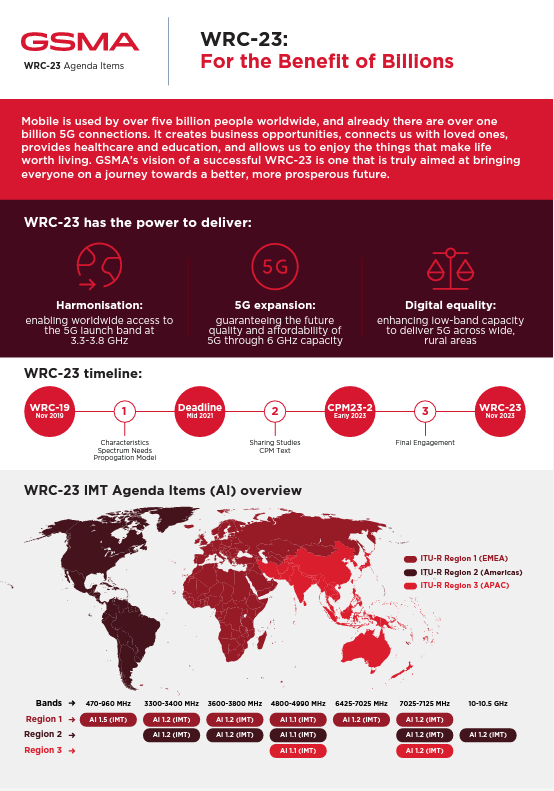
The World Radiocommunication Conference 2023 (WRC-23) agreed on allocating new mobile low-band spectrum (below 1 GHz) and mid-band spectrum in the 3.5 GHz and 6 GHz ranges. This capacity can be used for continued innovation in the mobile sector and will be crucial to realising the digital ambitions of policymakers all over the world.
2. Final harmonisation of the 3.5 GHz band
The 3.5 GHz band (3.3-3.8 GHz), recognised as the pioneer 5G band, has achieved final harmonisation across EMEA. This achievement marks a significant milestone in the advancement of 5G technology.
3. 6 GHz band: The harmonised home for 5G-Advanced and beyond
The 6 GHz band (6.425-7.125 GHz) has been identified for mobile use in every ITU Region – EMEA, the Americas, and APAC. Countries representing over 60% of the world’s population have actively sought inclusion in the identification of this band for licensed mobile. Technical conditions for 6 GHz spectrum are now globally harmonised, laying the foundation for expanding mobile capacity, especially for 5G-Advanced and beyond.
4. Low-band spectrum: Paving the way for digital equality
WRC-23 has paved a path towards greater digital equality by defining mobile use of more low-band spectrum in the 470-694 MHz band in EMEA. Low bands play a crucial role in expanding capacity for internet connectivity, particularly benefiting rural communities with signals reaching over wide areas.
The road to WRC-27
The conference also defined the agenda for WRC-27. The new WRC cycle includes the following bands for IMT: 4 400-4 800 MHz, 7 125-8 400 MHz, and 14.8-15.35 GHz. These bands will be crucial for enabling the new generation of mobile connectivity in the 2030s. Learn more about the next World Radiocommunication Conference (WRC-27) here.
Download GSMA resources in support of the WRC process

WRC-23 results
WRC-23 Agenda Items
6 GHz and the future of 5G

Regional group insights

Regional group insights
Mid-band spectrum needs
Socio-economic benefits of mid-band 5G spectrum
Low-band spectrum needs
Socio-economic benefits of low-band 5G spectrum
Watch the WRC-23 pledge from GSMA members
International Telecommunication Union (ITU) resources

ITU WRC-23 Website

ITU Inter-regional Workshop on WRC-23

ITU Radio Regulations 2024 Edition

Regional Preparation for WRC-27