



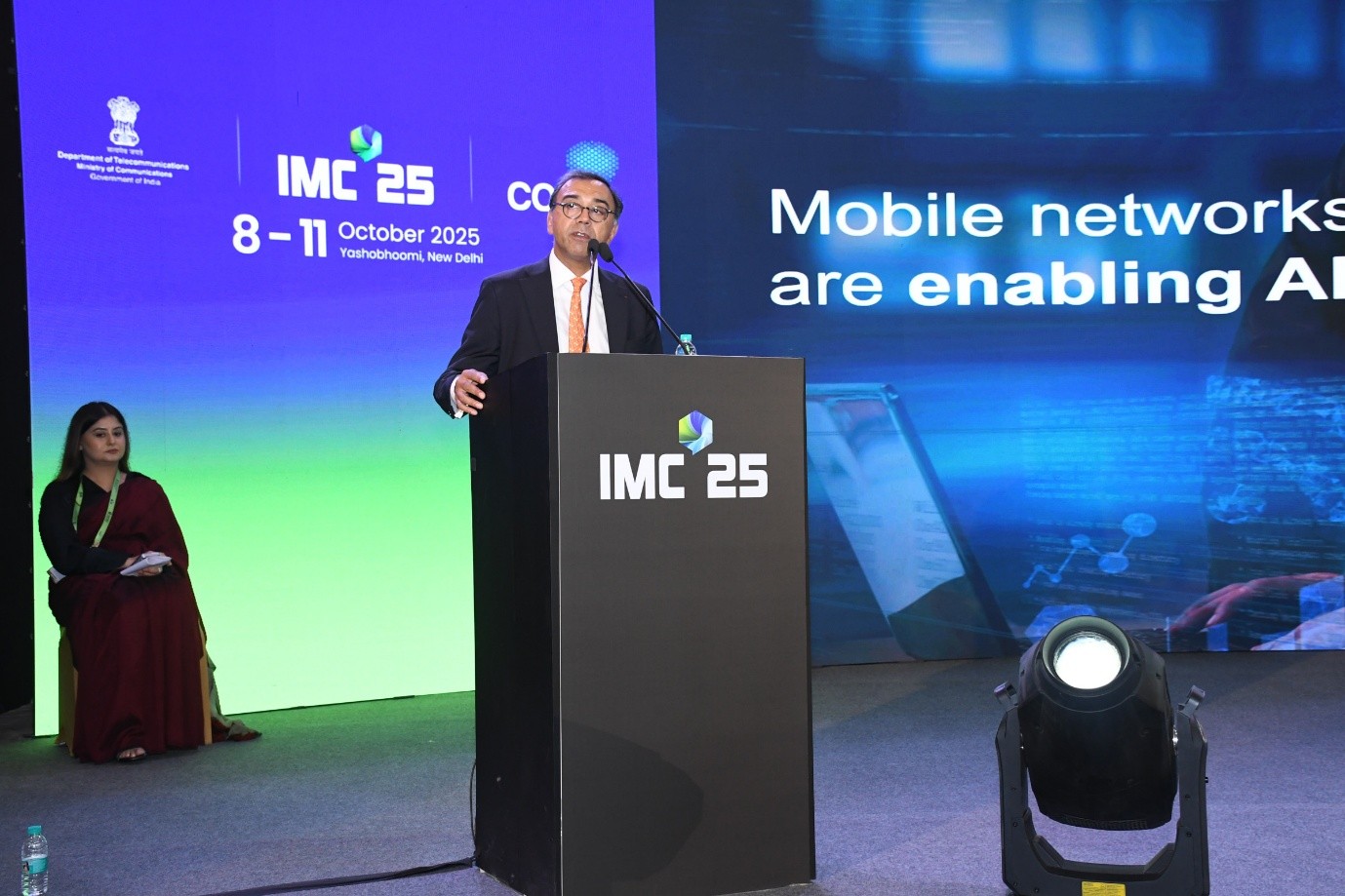
At Yashobhoomi in Dwarka, India Mobile Congress 2025 unfolded like a live map of India’s digital ambitions and the GSMA was right at the centre of it. Across bustling halls and packed stages, GSMA didn’t just show up; it stitched together the people, ideas, and rails that make the country’s telecom and digital ecosystem move.
You could feel that role in the small human moments. In one scene, against a bright GSMA backdrop, students and young founders leaned in for a selfie with senior leaders equal parts excitement and expectation. Elsewhere, a quiet conference room filled up early, badges flashing green as engineers, policy leaders, and product leads settled in; the ceiling’s geometric panels mirrored the tenor of the day structured, thoughtful, ambitious. These snapshots captured the mood: India’s network future is not abstract; it’s personal, near-at-hand, and moving quickly.
GSMA’s leadership presence was unmistakable. The Director General Vivek Badrinath and a senior bench from London and APAC engaged in a steady cadence of high-level meetings with India’s policy and industry leadership. Handshakes and side-stage huddles bookended formal sessions; conversations flowed from spectrum and APIs to scam resilience, edge intelligence, and privacy implementation. The substance was clear: India’s rapid scale-up in 5G/6G, AI, and DPI needs global standards and convening power; the world benefits when India’s scale meets interoperable, open frameworks.
Media engagements added momentum. In the red-walled GSMA zone, cameras rolled as spokespeople distilled complex ideas—why network intelligence matters for safety, how open APIs unlock innovation, and where India can lead in setting global practice. The message was consistent across interviews and briefings: make networks programmable, keep privacy and safety first, and widen the tent for startups and SMEs through shared tooling and clear, portable standards.
If the meetings set the tone, the hackathon made it tangible. Co-developed with Nokia and Indian MNOs including Vodafone Idea, Jio, and Airtel, the challenge turned GSMA Open Gateway APIs into a canvas for real-world use cases. Over a fast, focused sprint, teams pushed on identity and risk assertions (think SIM-swap signals and number-device checks), fraud mitigation, and frictionless customer experience. The vibe was practical: don’t build ornate demos; solve for India’s scale and constraints including low-end devices, patchy connectivity, multilingual UX, and shared-device realities. Judges weren’t just looking for clever code; they pressed for consent flows, purpose limitation, and auditability baked into the design. That emphasis said something important: India’s innovation story will be stronger when trust is designed in from the start.
The curated GSMA sessions braided these themes together. The images from the main stage captured that convening power. One panel on open and interoperable networks lined up a cross-section of India’s telecom leadership; another focused on policy, where the debate was lively but constructive—how to keep rules proportionate and predictable, and make sure India maintains its innovation first approach. The conversations never strayed far from India’s immediate priorities: rural coverage, SME enablement, and secure, citizen-centred public services and data privacy.
There were quieter victories, too. Demos at the GSMA booth drew senior officials for hands-on walkthroughs—less showmanship, more proof. One saw curiosity turn to conviction as GSMA staff explained how a simple risk assertion can stop a scam before it starts, or how an API-exposed network insight can speed up a startup’s go-to-market by weeks. In the hallways, quick debriefs aligned next steps: share reference implementations, publish developer templates, feed hackathon learnings into a sandbox, and keep the procurement conversation focused on privacy-by-design, interoperability, and SME access.
By the time the lights dimmed, a coherent narrative had taken shape. GSMA’s value in India is not just global credibility or technical standard-setting (though both matter). It is the ability to translate between communities such as operators and app builders, policymakers and product teams and to turn that translation into concrete rails: open APIs, shared safety signals, conformance profiles, and session playbooks that make policy real. In a country racing to scale AI, 5G, and DPI, those rails are what turn ambition into outcomes.
IMC 2025 at Yashobhoomi will be remembered for marquee speeches and big announcements. But the GSMA story there reads differently: a series of meetings, media bays, hack benches and panel stages, where India’s telecom future was not just discussed but assembled. A future where networks are programmable, privacy is practical, APIs are interoperable, and inclusion is intentional. And where a global convener helps India do what it does best: build for a billion and share it with the world.