


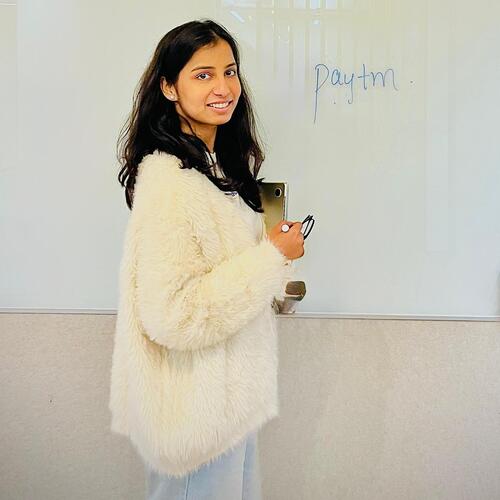
Team Malaai (ML And AI) from India — Winner, GSMA Hackathon 2025
Half the population could not ask for help
In rural India, millions of women carry pain in silence. There are smartphones in their homes, but those phones belong to the men. Husbands scroll, sons download, and women watch from a distance, never quite learning, never quite allowed. When illness comes, the barrier is not just geographic. It is deeply personal. A woman hesitating to describe her own body, to a male doctor, through a device she does not control, in a language the interface does not speak, is a woman the healthcare system has already failed before she even tried.
I understood this fully one evening, sitting beside my mother, when her phone rang. A relative calling from a village far away. Her voice was tired, the kind of tiredness that comes from months of carrying something alone. She described a heaviness she couldn’t name, a fatigue that sat in her bones, cycles that had changed in ways nobody had prepared her for. She was in the middle of menopause and had no idea. Nobody had told her it existed. Not a doctor, not her mother, not anyone. Her body was changing, and she thought she was quietly falling apart.
What broke me wasn’t the symptom. It was what she said next. Sorry. Twice. Just for calling. Just for asking whether what she felt was worth anyone’s time.
She had been dismissed so many times, handed a painkiller, told it was stress, sent home, that she no longer trusted her own body’s signals. She even tried searching her symptoms on her mobile, but these tools were designed by people who assumed you could read, type, and navigate freely. They never once imagined a woman whispering her symptoms to a family member, hoping he remembers them correctly. This is not just about one woman in one village. This is about millions of women whose health problems are never named, never discussed, never taken seriously.
That is not a technology gap. That is a humanity gap. And until we admit that most healthcare apps were built with men at the centre and women as an afterthought, we will keep designing solutions that help everyone except those who need help most.
The Problem Isn’t Access; it is Everything Before Access.
The woman on that call already knew where the clinic was. She had passed it a hundred times, but the problem wasn’t the road; it was every invisible wall between her and the door she already knew existed.
Only 20% of rural Indian women make healthcare decisions independently, without needing permission from a male family member (NFHS-5, 2019–21). Less than 30% have ever independently used a smartphone (GSMA, 2023). India loses 44,000 mothers every year to entirely preventable complications, the highest number on earth (WHO, 2023). 57% of Indian women are anaemic, a number that has barely shifted in a decade. Women’s cardiac symptoms are misdiagnosed 50% more often than men’s, globally, and far worse in low-resource settings (The Lancet, 2021).
These are not numbers. These are women who reached out and found nothing on the other end built to receive them.
What If the Technology Started With Her, Not With the System?
That was the question that changed everything for us.
Every health app ever built started from the system’s side of what a clinic needs. What a doctor expects. What a database can store. The woman on the other end was simply expected to translate herself into a format the system could process. She had to be literate enough to read an interface that was never written in her language. Connected enough to load an app that assumed she had a reliable and confident signal, enough to believe her symptoms deserved a response.
We started from the other side. We started with her.
What does she actually have? A voice. A basic phone. An intermittent signal. A few minutes when no one is watching. That is what we built for.
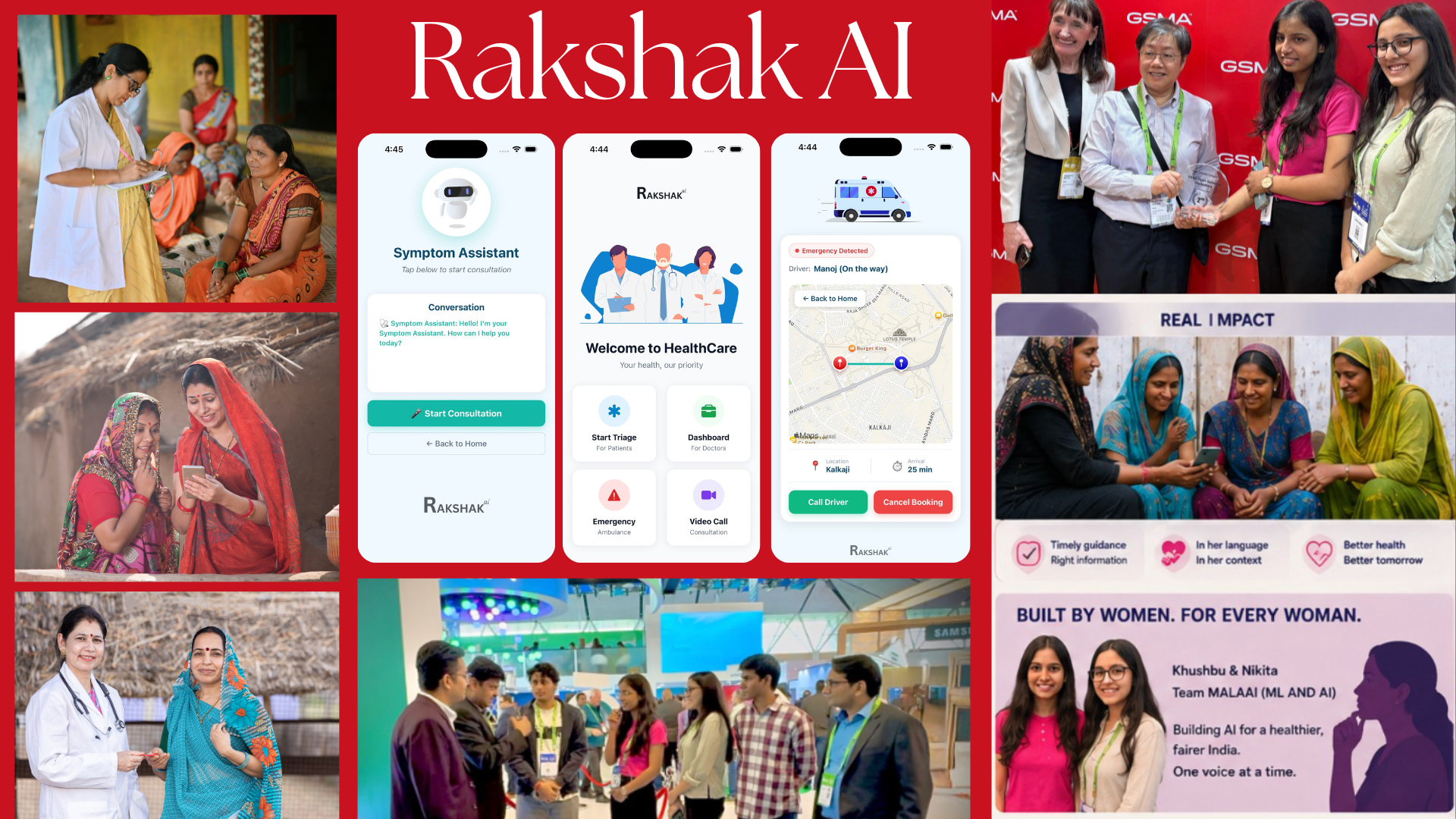
RakshakAI is a voice-first AI health system that works entirely through conversation, no app, no screen, no typing, no account. She calls. The AI answers. It speaks in Hindi, Tamil, Bengali, Marathi, or any of 12 regional languages, not in the clipped, formal tone of a call centre. Still, in the way people actually describe how they feel. It asks where the pain is, whether it gets worse at night or after eating. It is the clinical conversation she should have had with a doctor years ago, happening right now, on a feature phone, in her own language, at her own pace.
When the AI connects her to a verified doctor, that doctor already has everything on screen: her symptoms, their duration, their severity, and the AI’s preliminary assessment. The conversation begins with care, not with paperwork.
When the consultation ends, the AI reads her prescription and converts it into a voice message in her own dialect. Not “Tab. Metformin 500mg OD PC” but take the small white tablet every morning after eating, not with tea, for 30 days, and we will remind you each morning. It then finds the nearest verified pharmacy or government health scheme outlet, because knowing what medicine you need and being unable to afford it is a failure that happens quietly and gets counted as nothing.
Voice reminders follow. Check-ins at 48 hours. Weekly follow-ups for pregnant women. A private mental health screen for those showing early signs of postpartum depression, confidential, with no family member aware she accessed it. The care does not end at the prescription. It follows her home.
HerVoice Initiative Impact
In early deployments across rural and semi-urban India, RakshakAI supported hundreds of women through NGO partnerships, health programs, and local healthcare workers. More than 78% of women completed consultations independently, while 85% reported feeling safer discussing sensitive health concerns through voice-based AI in their native language. Operating successfully across 12 Indian regional languages and low-network environments, the platform became a major milestone in making AI-driven healthcare accessible to women who had previously been excluded from digital health systems. What began as one unheard voice evolved into a trusted support system where women could finally seek care privately, confidently, and without fear or judgment. The initiative was developed by Women Team MALAAI from India as part of their mission to build inclusive AI for real-world healthcare accessibility.
What We Learned Building This
Building RakshakAI taught us that technology becomes meaningful only when it is built with empathy, trust, and real human understanding. As young women engineers, this journey inspired us to create systems that listen before they respond and support women who are often unheard by traditional healthcare systems. The people we met, the stories we heard, and the realities we witnessed shaped not only our learning but also our dedication toward building a future where technology feels more human, inclusive, and accessible. More than a project, RakshakAI became our commitment toward building technology that truly reaches the people who need it most.
References
- National Family Health Survey-5 (NFHS-5), 2019–21 — Ministry of Health and Family Welfare, Government of India. http://rchiips.org/nfhs/NFHS-5Reports/NFHS-5_INDIA_REPORT.pdf
- GSMA Connected Women: The Mobile Gender Gap Report, 2023. https://www.gsma.com/r/gender-gap/
- WHO Maternal Mortality Report, 2023. https://www.who.int/publications/i/item/9789240068759
- TRAI Annual Report, 2022–23. https://www.trai.gov.in
- Vogel, B. et al. (2021) — The Lancet Women and Cardiovascular Disease Commission. The Lancet, 397(10292). https://doi.org/10.1016/S0140-6736(21)00684-X
RakshakAI — AI Telemedicine Journey & Product Walkthrough Podcast
RakshakAI — Khusbu Rai & Nikita Babbar | Team MALAAI | GSMA Hackathon Winners 2025