


As I began working closely with women across Pakistan, I quickly saw how digital spaces, from social media to finance, often excluded them. What struck me most was how invisible they became within financial systems. Time and again, I met women entrepreneurs who, despite their reliability and steady cash flows, were turned away by banks. They lacked collateral, salary slips, or guarantors – requirements designed for another world.
Millions of women in Pakistan, and across emerging markets, power their families and local economies yet remain invisible to the financial system. That invisibility had consequences that could not be ignored: businesses left to stagnate, children pulled out of school, and health emergencies spiralling into crises.
But I also noticed something that gave hope. Many of these women already held the key to a different future, a mobile phone in their hands. It was clear that if we could design inclusive digital tools, we could begin to reshape their stories. Not technology for its own sake but for the dignity and recognition it could bring.
Building ReadyCash
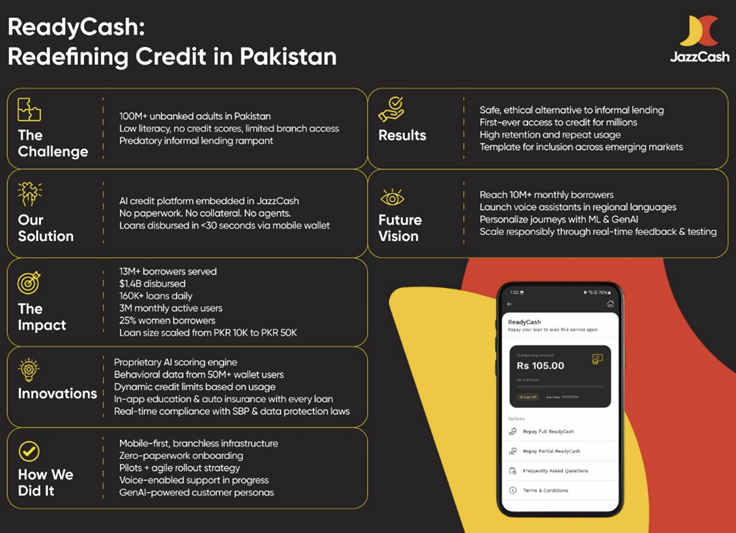
That realization led us to create ReadyCash with a very different philosophy. We didn’t want another product that excluded women out. Instead, we wanted something designed around the realities of their lives. By embedding ReadyCash within the JazzCash app, we built a system that didn’t rely on collateral or traditional credit scores. Instead, we leveraged AI to identify women as an underserved yet high-potential segment and applied alternative, data-driven credit scoring models. These models drew on multiple data points and behavioural triggers linked to women’s financial activities, creating a comprehensive data map of how they were already managing money.
The impact was immediate. In a country where more than 100 million adults had never accessed formal credit, ReadyCash opened new doors. Today, it has reached over 15.8 million people, with one in four of them women. Every single day, more than 160,000 loans are disbursed digitally, in under 30 seconds, without paperwork or guarantors. For the women I met who once had no pathway to capital, these AI-enabled loans have meant not just survival, but dignity and growth.
Trust at the Heart
But numbers alone were not enough. I realized that without trust, inclusion could never last. Women needed to feel that their money, their data, and their dignity were safe. In societies where women are disproportionately targeted by fraud and scams, that trust mattered more than anything else.
So we focused on transparency. No hidden fees, no misleading terms, just simple, clear communication. Shehnaz’s story reflects this. When her husband lost his job, she accessed her first ReadyCash loan instantly, without paperwork or collateral. With that loan, she started a tuition center in her neighborhood. Today, she collects fees directly through her JazzCash wallet, pays bills digitally, and sustains her business with short-term AI-powered loans. Her journey shows that trust is not abstract but a lived reality.
The Ripple Effect
As I’ve travelled and spoken to women, I have seen how these small changes create ripples that extend far beyond one household. When women gain reliable credit, households become more resilient. School fees get paid on time. Families can seek medical treatment without falling into debt. Businesses grow, creating jobs and strengthening communities.
Bundling ReadyCash loans with life and health insurance deepened that impact. We’ve seen women breathe easier knowing they had a safety net. These changes underscored that women’s empowerment isn’t a side initiative, but central to national development.
Women as Creators, Not Just Users

Along the way, I also came to believe that true empowerment cannot end with women as customers. It must extend to women as creators of technology itself. If women are excluded from building AI and fintech, the risk is that systems will continue to reproduce old biases. That’s why we built women-only call centers, creating safe workplaces where women could build careers and gain confidence. We partnered with top universities to open opportunities for young women in technology. Through mentorship, I’ve watched a new pipeline of female fintech leaders emerge. Embedding women’s perspectives at every stage has shown me that digital trust grows strongest when built from within.
The Road Ahead

Even with progress, I know we still have a long way to go. Today, women make up about 30 percent of JazzCash’s customer base. Our goal is to raise that to 50 percent of new additions by 2027 and enable 300,000 women-led businesses and freelancers to access digital finance.
But technology must remain a tool of empowerment, not exclusion. We’re acutely aware that if unchecked, the same AI that opens doors can reinforce inequalities or create new forms of exclusion. That is why we are committed to putting safeguards in place – fairness, transparency, and strong governance. Innovation must always serve women, not control them.
I also look beyond Pakistan. In the Philippines, disruptors like Tonik and Salmon are extending credit through alternative data. In Kenya, platforms like M-Shwari have disbursed billions in loans. In Latin America, inDrive Money is unlocking access for gig workers. These global parallels remind me that inclusive AI is not just our story, it is a movement reshaping financial inclusion worldwide.
A Future with Women at the Center
I think often of the women I met who were dismissed by banks despite their reliability. Their stories are the daily reality of millions. But I’ve also seen those stories change. With inclusive AI and digital trust, a woman with a phone in her hand is no longer invisible. She is recognized, protected, and empowered.
To me, this is not only about financial access, it is about dignity, safety, and opportunity. When women can engage confidently in digital finance, they strengthen families, fuel businesses, and reshape societies.
The future of technology must be built with women at the center, not only as users but as innovators and leaders. Only then will inclusive AI fulfill its promise: moving beyond access, building trust, and delivering lasting empowerment.