


She grows the food. She works the longest hours. So why does the answer she needs always reach her last — and what is generative AI finally doing about it?
A leaf curls. White patches spread across one corner of a field. The rain that should have come three days ago has not arrived. Somewhere in rural India, a woman is standing in that field, watching it happen, knowing exactly what she needs to ask — and knowing the answer will reach her last.
It will arrive through a husband back from the market, a neighbour, a trader with stock to sell, or an extension officer who may not reach her village this week. By then, the field has often already changed. I have spent years working across India’s farming communities, and of every inequality I have seen, this is the one I cannot stop thinking about. The woman who does the most work on the land has the least direct access to the knowledge that protects it.
On a small farm, timing sits very close to survival. For women farmers, the clock has always run a little slower.
We talk about the gender gap as if it were a single line to cross. It is not. It is a stack of smaller gaps that compound. A woman is less likely to own the phone — only about a third of women worldwide do. If she owns one, she is less likely to control when she can use it; the household phone often leaves with someone else by morning, exactly when the field needs a decision. If she has the phone and the time, the advice still tends to arrive as text, in an interface built for someone else. And beneath all of it sits the oldest gap of all: even when she knows the land better than anyone, she is often not the one expected to decide.
This is why the gap is so stubborn. It was never only about access. It was about who technology was designed for, and who was assumed to be making the decisions. When you build for an “average” farmer, you quietly build for a man with his own phone and the authority to act on what it tells him. The woman in the field becomes an afterthought — and an afterthought, multiplied across millions of farms, hardens into structural exclusion. Women are over 42 percent of India’s agricultural workforce, yet when systems are designed without them in the room, their realities are not rejected. They are simply overlooked. At scale, being overlooked is its own form of bias.
And here I have to be honest about something that sits even deeper than the farm. The absence of women is not only in the field; it is at the table where the technology itself is decided. In agriculture, there is an almost absolute absence of women in the rooms where solutions are designed. I have spent a long time in the tech world, and we all know the pattern — a leaky pipeline, a steady drop-off, and an imbalance that grows starker the closer you get to leadership. Now place that at the intersection of AI and agriculture, and ask the obvious question: who in that room actually understands what a woman farmer needs?
We are trying to solve the problem of women farmers without their representation. That cannot be an afterthought.
This is the part I feel most strongly about. When people ask me what sustainability really means, I keep arriving at the same word: inclusion. If half of the people who farm are women, a solution that does not include them from the very beginning is not sustainable — it is simply unfinished. And inclusion does not mean designing on a woman’s behalf because I believe I know what she wants. It means she helps design it. She voices it. She contributes to it. Anything less, and ten years from now we will find we have quietly lost this battle, having built the future of agriculture around everyone except the people holding it up.
In Bihar, a farmer named Lakshmi Devi once told me what it was like to need an answer she could not trust:
“When we ask local shopkeepers for advice, they sometimes push the products they have not been able to sell.”
What stayed with me was the dependence underneath it. At Digital Green, our answer to that dependence has been years in the making. We began long before today’s AI, building local videos with farmers, in their own languages, to bridge the advisory gap. Those years taught us what farmers actually need, what they use, how they consume information. The objective never changed; only the technology evolved. So when generative AI arrived, we asked a simple question shaped by all that learning: what if the answer did not have to travel through anyone at all?
That question shaped FarmerChat, our AI-powered agricultural assistant. A farmer can photograph a diseased leaf, send a voice note, ask about a sowing window or a market price — in her own language, by voice or image, without touching a written menu. We built it with farming communities, not merely for them, so a woman does not have to reshape herself to fit the technology before it will help her.
What gives me hope is that generative AI dismantles the very barriers that kept her out. Voice replaces the need to read or type. Local dialect replaces the unfamiliar interface. An instant answer replaces the wait for someone to come home and explain. For the first time, the technology is bending to fit her life instead of demanding she bend to fit it.
Kothapalli Jyothi, farming a single acre in Andhra Pradesh, used it to diagnose a disease destroying her brinjal crop and saved the harvest. The next season she planned differently — choosing heat-tolerant crops, matching varieties to her soil, reading nearby markets. Today she farms six acres. “Earlier, I was always reacting to problems,” she told me. “Now I plan with confidence.”
And when information reaches a woman directly, something larger shifts than her yield. She stops carrying out decisions made elsewhere and starts making them. Other women in the village watch, and try it themselves; confidence spreads the way doubt once did. The change is quiet, but it reaches into the fabric of the household and the village — who is consulted, who is believed, who is seen as a farmer in her own right.
The lesson I value most, though, came from a failure. After we launched in 2024, women were just 27 percent of our users in Bihar — even though smartphone ownership among women there was significantly higher. Access, it turned out, was not the same as inclusion. It was the clearest possible proof of the very thing I had been arguing: you cannot serve women well if women are not part of shaping how you serve them. So we invested in the slower work — community trust, and constant attention to who was being left at the edge — because:
Inclusion is not achieved at launch and filed away. It has to be monitored, adjusted and rebuilt as the system meets real life.
The test we now hold our technology to is not how advanced it is, but who it is built for. Can the woman in the field — speaking a dialect, holding a shared phone, with no time to learn an interface — get a trustworthy answer the moment she needs it? Design for her, and you have designed for almost everyone. The evidence shows it works: In India, FarmerChat has reached over 900,000 farmers and answered more than 1.6 million queries. Over 45% of users are women, and among active users, 96% report feeling more confident in their decisions, while 18% say they would have no agricultural advisory at all without FarmerChat.
I do not want to overstate it. The gap is narrowing, not closed. Millions of women still share a phone, still farm outside every formal advisory system, still decide on incomplete information. Technology alone will not finish this work; it has to be matched by trust, by community effort, by women in the rooms where the technology is designed, and by a deliberate refusal to let them slip out of view as these systems scale.
India’s vision of Viksit Bharat 2047 places agriculture at the centre of its future, and nearly half of the workforce carrying it there is female. Women farmers will shape that future whether or not we name them as leaders within it. The only real question is whether the digital systems we build now will treat them as central or incidental.
The future of Indian agriculture will still depend on rain, seed, soil and markets. But increasingly it will depend on a choice within our power: whether the woman who has always stood at the centre of the work can finally stand at the centre of the decision — and at the table where the technology is built. The tools to put her there now exist. Our task — as builders, funders and policymakers across the Asia-Pacific — is to make sure that when we build AI for agriculture, we build it with her, and for her, first. She was always in the field. It is the rest of the system that is only now catching up.
———
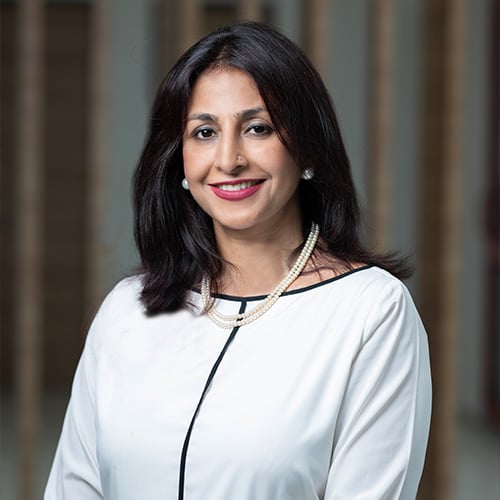
Bio:
With over 25 years of experience in social development, program management, and nonprofit leadership, Nidhi Bhasin brings a wealth of expertise to her role as CEO of Digital Green India. Prior to joining Digital Green, she served as CEO of Nasscom Foundation, where she transformed the organization and took it to the next level by championing technology for social good and worked to bridge the digital divide in underserved communities across India by impacting over 15M lives positively. Before that, she spent two decades at Concern India Foundation as Deputy CEO, leading initiatives in education, health, and disaster rehabilitation, community development, particularly for women. She is passionate to serve the intersectionality of technology, gender, climate and agriculture. Bhasin is an alumna of India’s prestigious Delhi School of Social Work, Delhi University. She is also a fellow of the Japan-India Transformative Technology Network (JITTN) by Salzburg Global, and has been featured among the “50 Women in Technology Leadership” by one of India’s leading IT magazines.