


This article is part of the Spectrum Policy Trends 2025 report. Download the full report for a handy compilation of the top five spectrum policy trends for 2025.
With spectrum licences approaching expiry in more than 30 countries in 2025, more nations are expected to adopt innovative licensing frameworks to advance connectivity and reduce the financial burden on operators. Operators will need to proactively and transparently articulate their requirements with regulators, backed by clear use cases.
Why is it important?
The mobile industry differs from most other industries in that the ongoing right to a critical resource is often not guaranteed but is subject to periodic reviews by authorities. Many countries continue to license the use of the spectrum for finite and/or short periods. Depending on the approach to licence renewals, this may lead to uncertainty for operators and customers, harming investment, innovation, competition, and efficiency.
Governments and regulators are increasingly mindful of this and are adopting innovative pricing and licensing models to ease the financial pressure on operators while encouraging investments in connectivity and coverage. For instance, Spain has extended spectrum licences by 10 years at no additional cost, incentivising investments.
What are the policy considerations?
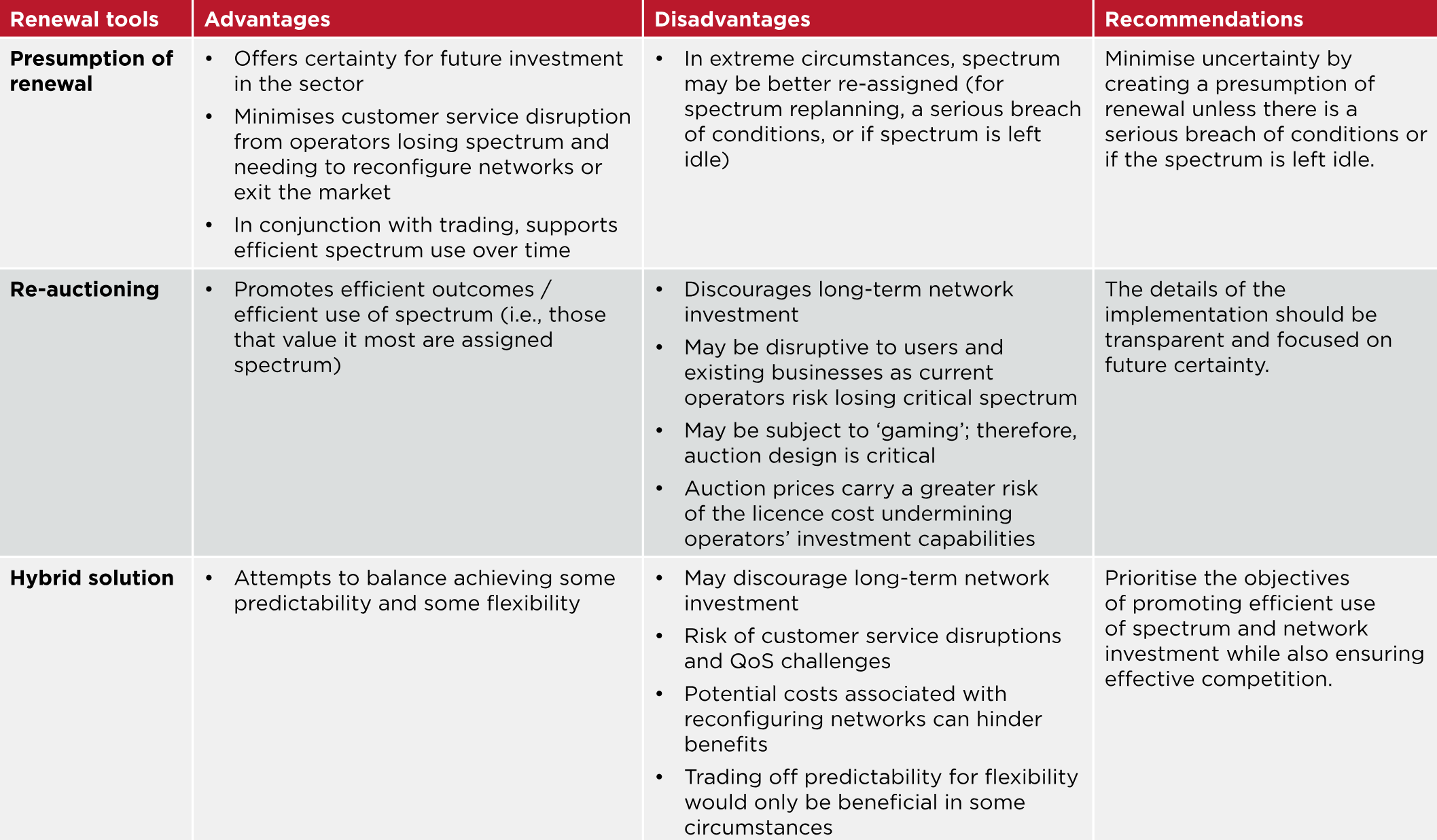
Various renewal approaches are available to regulators when spectrum is already licensed to an operator. Operators may not invest in their networks or compete as much for customers if there is uncertainty over future spectrum rights. Regulators thus serve consumers best by creating that certainty by ensuring licence renewal decisions are made five years ahead of the renewal date. Uncertainty can be further minimised by creating a presumption of renewal unless a breach of licence condition has occurred, a fundamental reallocation of spectrum to a new service is required, or an overriding policy need arises.
What to expect in the year ahead
According to GSMA Intelligence, spectrum assignments in different bands, such as the 900 MHz, 1800 MHz and 2100 MHz, often used for 2G and 3G, are approaching expiry in over 30 countries in 2025. At the same time, 61 network sunsets are planned for 2G and 3G technologies within the same year.
These bands are ideal candidates for migration, in part or fully, via network sunsets to enhance telecom operators’ 4G and 5G connectivity. Renewals should happen on a technology-neutral and affordable basis, considering new methodologies to incentivise investments and allow for migrating these spectrum resources for future connectivity requirements.
Find out more about spectrum licensing best practice here.
| Policy in practice: Brazil implements automatic renewals In 2021, Brazilian regulator ANATEL launched a multi-band spectrum auction for the 700 MHz, 2300 MHz, 3500 MHz, and 26 GHz bands to encourage market interest and incentivise network investment. To achieve this, significant changes to licence terms were introduced based on public-private dialogue, including: • licence terms were increased to 20 years to provide investment certainty. • to further strengthen certainty, licences included clauses for automatic renewal subject to fulfilling coverage and service obligations. • operators could make yearly payments over the licence term, reducing the one-off financial impact of spectrum acquisition. • the cost of compulsory licence obligations was deducted from the spectrum price to promote investment in rural areas. • bids over the reserve price could be converted into voluntary investment obligations. The positive effects of the increased investment certainty and incentives were visible through a vast market interest in the auctioned spectrum and immediate 5G network rollouts by successful bidders beyond licence requirements. |