



India’s Department of Telecommunications (DoT) concluded 2025 by laying out a clear pathway to spectrum access that can help guide the country into the 6G era. The government’s Spectrum Roadmap for 6G services set out how the country plans to build on the success it has achieved over the last two decades. Adequate and timely spectrum access has been essential to this success and the world’s most populous country has built on plans to release 6 GHz spectrum, released earlier in 2025. Its medium-term focus now turns to WRC-27 bands which will allow the country’s mobile operators to develop through the 6G era of the 2030s.
India has its sights set on the next stage of mobile evolution and has committed to making enough spectrum available for its operators to spearhead deployment. The long-term roadmap, which aligns with the next World Radiocommunication Conferences in 2027 (WRC-27) and WRC-31, “aims … to position India as a global hub for 6G innovation.” New spectrum will help build this hub and moving beyond the 6 GHz, into the bands being discussed at WRC-27, such as 4.5 GHz and 7 GHz, will be the next phase that will help build a solid and transparent supply of mid-band spectrum essential for 6G.
India and other global leaders
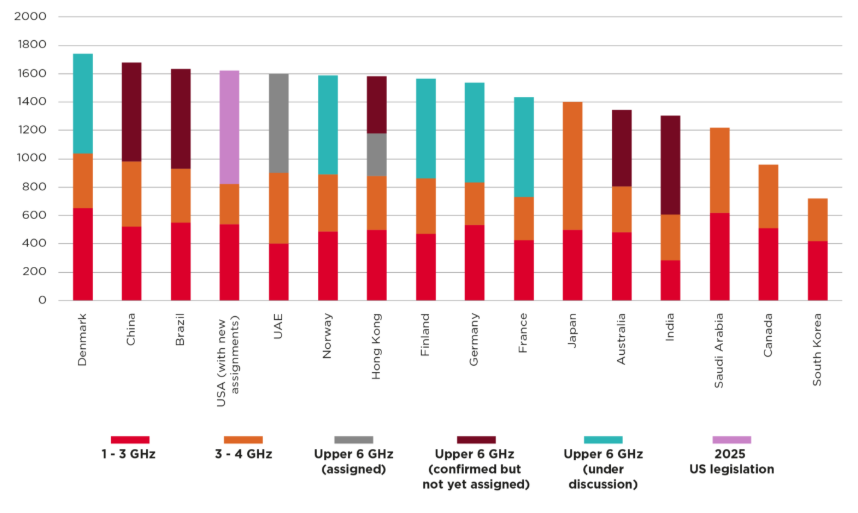
DoT has ensured that India’s spectrum pipeline has developed in the years since WRC-23. Its 6 GHz plans rank it among leading countries for mid-band development, but additional support in the 7 GHz band could elevate it to a global leader in securing spectrum for 6G.
6G is expected to enable new and emerging use cases that could increase demand further in the 2030–2040 period, with much heavier uplink requirements. This includes XR, image- and video-driven generative AI (genAI) and potentially holographic communication. The GSMA’s Vision 2040 study on spectrum needs during the peak 6G era of 2035–2040 provides an assessment of mid-band spectrum needs for mobile networks. The study estimates that South Asia will require 2.1-3.2 GHz of mid-band spectrum on average, whereas for highest-demand populations such as in India, these spectrum requirements will be between 2.4 and 3.7 GHz. India is among the top 25 markets globally in terms of data traffic per connection, with a greater share of broadband traffic delivered over mobile networks than fixed networks. Considering India to be one of the early adopters of 6G (outlined in its Bharat 6G Vision), mobile traffic in the region is forecast to be 115-290 GB/month per connection and 6G connections are anticipated to reach 34% (760 million) market penetration, by 2040.
To cater to these needs in the short- to medium-term, India is making spectrum available in the upper 6 GHz band for IMT. The 4.5 GHz and 7 GHz bands are also being considered following WRC-27 along with 67 MHz in the 1500 MHz band.
India’s 6G spectrum roadmap is guided by sound spectrum policies, including making all spectrum technology-neutral and allowing practices such as sharing and leasing to enhance spectrum efficiency. These policies can enable India to efficiently release additional spectrum within existing frequency bands where opportunities exist.
The roadmap affirms its commitment to be a global 6G leader, along with its peers. In December 2025, the US also published how it will go about ‘Winning the 6G Race’. This includes studying the 2.7 GHz and 4.5 GHz bands while immediately identifying the 7 GHz band for full-power commercial IMT. The decision by the US and India to consider the 7 GHz band for mobile positions it as the next substantial block of spectrum that can facilitate increasing demand.
Similar moves from other countries may follow in the years ahead, as they vie to make the benefits of 6G a reality. India already has a clear and forward-looking strategy for the future. While India is actively participating in global 6G standards development, domestic and international leadership in spectrum policy and alignment will be equally important.
Building consensus with existing users in key bands, alongside forging international partnerships ahead of WRC-27, can help make this new spectrum available as needed for 6G and so India can advance a strong, credible position in preparing for the conference.