


This article is part of the Spectrum Policy Trends 2025 report. Download the full report for a handy compilation of the top five spectrum policy trends for 2025.
Boundless, seamless connectivity. Networks and devices that connect everything and everyone, everywhere. Applications and services delivered with new levels of sustainability that help move the planet towards net zero. This is the vision for 6G.
The strides taken forward on digitalisation and new IoT applications during 5G can become prevalent in the 2030s as the computing power of an enterprise connects automatically with its workforce or integrated technologies enhance the consumer experience. These technologies can enhance productivity, increase competitiveness and, of course, help us have fun.
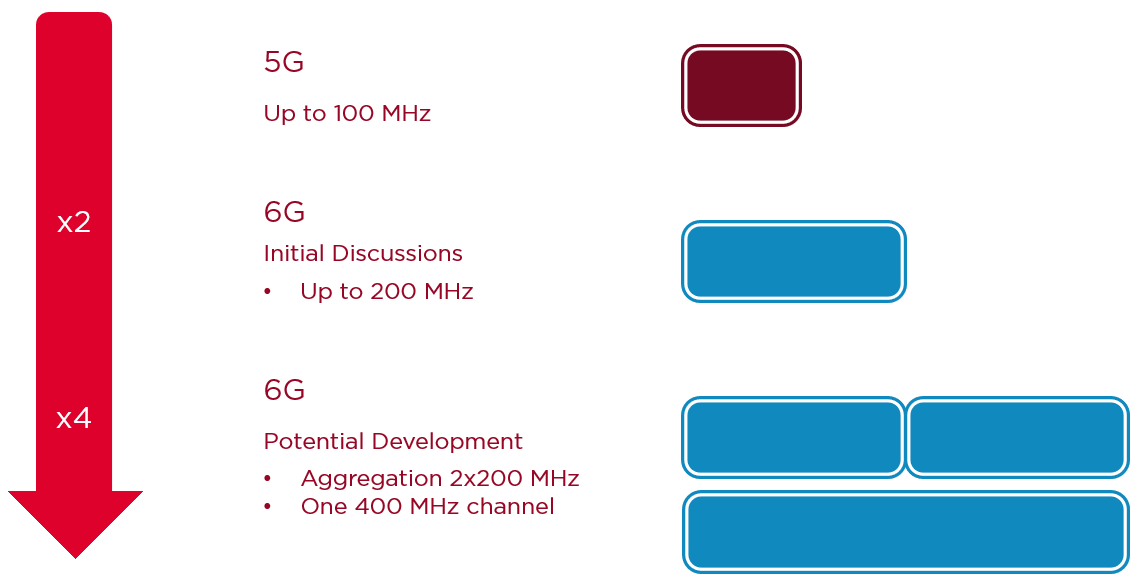
The journey towards 6G is beginning, and as wireless connectivity continues to expand from connecting the phones in our pockets to the machines in our factories and the vehicles on our roads, this potential requires spectrum – delivered in wider 200-400 MHz channels – to cater for demand.
Why is it important?
Mobile connectivity can help provide socio-economic growth. On the economic side, 5G alone can provide nearly US$1 trillion of GDP benefit by 2030. Mobile evolution will have enhanced social benefits, too. Ericsson says of 6G: “By delivering ever-present intelligent communication, 6G will contribute to the creation of a more human-friendly, sustainable and efficient society.”
The need to realise the promise of 6G is attracting global attention, and spectrum plans are an important foundation. mmWave bands will be used for the busiest locations – stadia, train stations, ports and airports, and busy shopping areas. Low bands will be required to deliver crucial digital equality between urban and rural areas. However, a lot of emphasis will be placed on finding the right mid-band assignments to deliver city-wide connectivity. 6 GHz capacity will be brought into play by many governments to carry the next phase of data growth, and this may be used in the short or medium-term depending on the country. Beyond 6 GHz, other bands are considered, including the 7-8 GHz range.
200-400 MHz channels will be required for each operator in mid-bands for mobile evolution going into the 2030s. The mobile ecosystem is working with governments and international bodies to ascertain which bands may be used for the future expansion of mobile.
Figure 1: Channel bandwidth requirements for 6G
What are the policy considerations?
How do regulators and industry solve the challenge of assigning 200-400 MHz mid-band channels for full-power, macro-cell mobile? Delivering this quantum of spectrum for mobile in the congested sweet spot of mid-band spectrum is the subject of global discussion, but some countries have already moved in the right direction. The UAE will add to its 200 MHz channels in 3.5 GHz, used for 5G today, with 350 MHz per operator in 6 GHz in 2025. Specific country demand will dictate whether the 6 GHz band remains congested with 5G traffic in future or can be used for 6G, which is why international discussions are looking at other bands.
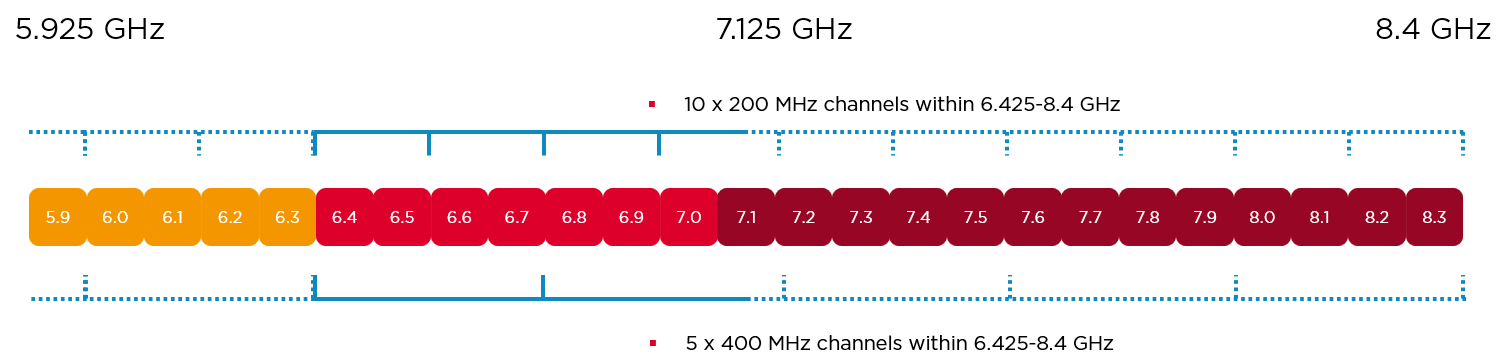
The World Radiocommunication Conference in 2027 (WRC-27) will consider bands in the 4.5 GHz, 7-8 GHz and 14 GHz bands. Particular attention is being given to the 7-8 GHz range as this sits closely above existing 6 GHz assignments and may provide a wider mobile tuning range.
Figure 2: 6-8 GHz bandwidth options
The 7-8 GHz band has existing users, as do most spectrum bands. In this case, incumbent government and military use, especially for satellite connectivity, makes coexistence discussions extremely important. Some countries see military presence in the bands as an insurmountable obstacle, but others see potential. Can we develop a means of sharing between military use and commercial broadband in urban areas while maintaining full-power mobile networks? Is the commercial development of chipsets, produced at scale, in the government spectrum ultimately beneficial for government applications and users?
What to expect in the year ahead
2025 is the second of a four-year cycle of discussions at the International Telecommunication Union (ITU) in the build-up to WRC-27. From early technical work, the debate will move further into certain bands’ feasibility.
Crucially some blocs will develop their own vision for the spectrum needs of 6G. Europe is doing so through its Radio Spectrum Policy Group. India is developing its 6G programme through the Bharat 6G Alliance. In the UAE, the regulator TDRA has published its own ‘6G Roadmap.’ In Saudi Arabia, research and development on 6G is happening through the government and universities.
More governments will assign the next portion of mobile spectrum – the upper 6 GHz band – in 2025. Those that do it in the next year are more likely to see this as a short-term requirement for use in the development of 5G, but others may place this band into their long-term roadmaps to bring into use with new 6G technologies around the end of the decade.
| Policy in practice: The EU’s Radio Spectrum Policy Group to develop 6G spectrum roadmap How can government and industry understand the future needs of 6G and develop a clear vision of the demand for services and applications? Many in the mobile ecosystem see the biggest challenge not being the need to provide more speed, but in delivering consistency across a huge number of devices which require fast, stable connections. Spectrum calculations will consider all elements of likely demand. Industry and governments will provide their vision for supporting this demand over the coming years. Understanding the requirements related to each country, and importantly the peak-time use in busy areas within them can help regulators produce robust spectrum roadmaps. One example is the EU’s Radio Spectrum Policy Group, which has created a specific sub-group to provide its ‘6G Strategic Vision.’ It proposes, among other things, to develop a 6G spectrum roadmap over the coming years, for delivery by 2027, which will discuss which bands will be the most appropriate for use in the 6G era. Such processes, providing they ensure a period of collaborative consultation between government and industry, will ensure that 6G’s promise of connecting everything, everywhere, is realised. |