


Monday 16 November, 2026
In July 2024 a surgeon in Shanghai removed the upper right lobe of a patient’s lung in Kashgar, more than 5,000 kilometres away, using a Chinese-built surgical robot. The operation ran over a China Telecom dedicated network with 5G inside the Kashgar operating theatre. The treating team published the case, including what the network actually did: 100 milliseconds average delay, a 121 millisecond peak, and 0.012 per cent packet loss. [1]
At a glance
| Location | Shanghai Chest Hospital to Kashgar Second People’s Hospital, Xinjiang, China |
| Health system | Shanghai Chest Hospital and Kashgar Second People’s Hospital |
| Partners | China Telecom, MicroPort MedBot |
| Connectivity | China Telecom dedicated network for the long-haul link, with 5G providing wireless access in the Kashgar theatre, plus redundant connections |
| Robot | Toumai endoscopic surgical system |
| Status | Single procedure completed |
| Year | July 2024 |
What was the healthcare challenge?
Kashgar had no surgical robot. Chen Tianxiang, a Shanghai Chest Hospital doctor seconded to Xinjiang as vice president of Kashgar Second People’s Hospital, put it plainly: at the time there was not a single surgical robot in Kashgar. [2]
The gap was access to robotic surgery and senior expertise rather than access to surgery itself. This patient could have had a conventional operation locally. What the project offered her was a minimally invasive robotic procedure performed by a leading thoracic surgeon, which would otherwise have meant travelling to Shanghai or Beijing. [2]
The treating team frame the wider problem as medical resources in China being scarce and unevenly distributed, with remote surgery one way of supporting border regions. [1]
How is connectivity being used?
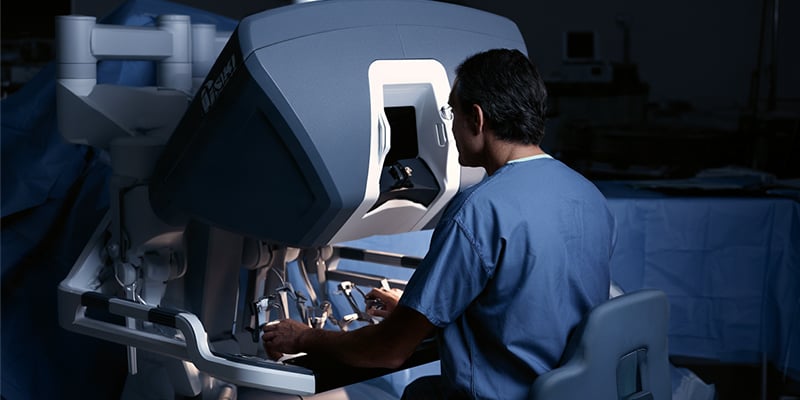
The surgeon’s console was in Shanghai and the Toumai robot was in Kashgar, with the two linked over what the clinical team describe as China Telecom’s dedicated network and 5G technology. China Telecom describes its own build as a wired dedicated line plus a wireless private network, and the only latency figure it gives covers the 5G air interface inside the theatre, which it reports at millisecond level. [1][3]
Read together, that means the long-haul link was terrestrial and 5G carried the last hop at the patient’s end, with multiple redundant connections used specifically to guard against signal loss. The team’s own conclusion credits 5G technology, and hospital-side coverage described the operation as 5G-guided; what the sources do not support is the shorthand that the 5,000 kilometre control link itself ran over 5G. [1][3]
A good deal sat around the network. The robot was shipped overland from Shanghai and the manufacturer sent engineers to train the local team. A second surgeon console was installed in the Kashgar theatre so a local surgeon could take over if the link failed, and a local thoracic team stood by for bleeding or conversion to open surgery. Engineering teams at both ends monitored latency and packet loss throughout. The procedure followed more than a year of preparation, including animal experiments within Shanghai and then between Shanghai and Kashgar, and ethics approval from both hospitals. [1][2]
What has been the impact so far?
The operation took one hour and fifty minutes in total, with around eighty minutes of core surgical work. Blood loss was under ten millilitres, the chest drain came out on day five, and final pathology showed an invasive mucinous adenocarcinoma staged T1aN0M0 with clear sampled lymph nodes. The second console was never needed and the connection did not drop. [1]
On the network: average delay 100 milliseconds, peak 121 milliseconds, packet loss 0.012 per cent, no interruptions. [1]
The team’s own reading of those numbers is the most useful thing here. At 100 milliseconds the delay was not noticeable for most of the procedure, but the 121 millisecond peak was enough to make the surgeon slow down during vascular dissection and stapler placement. They propose that latency should stay under 100 milliseconds for remote thoracic surgery, stricter than the 200 milliseconds often cited from urology and simulator work, and argue that network quality matters more than geographic distance. [1]
This is a single patient, written up by the surgeons who treated her, and the paper calls for larger studies to follow. The route has been used again since: in February 2025 a Shanghai specialist operated remotely on a patient at the same Kashgar hospital, in a different procedure, over China Telecom 5G and long-haul wired links.
Disclaimer: This page is based on publicly available information and has not been reviewed by the organisations named in it. Details were accurate at the time of writing and deployments may since have changed. If you were involved in this work and would like to correct or update anything here, please contact us at connectedhealth@gsma.com.
Contributing operators
Sources
[1] Tian Y, Lv H, Jumai A, et al. Ultra-remote robot-assisted right upper lobectomy between the Shanghai and Kashi Prefectures: a case report. Journal of Thoracic Disease 2024;16(12):8823-8830. https://jtd.amegroups.org/article/view/94538/html
[2] China National Radio, First ultra-remote domestically produced robot-assisted lung tumour operation completed, 15 July 2024. https://china.cnr.cn/gdgg/20240715/t20240715_526793538.shtml
[3] China Telecom, official account on The Paper, 22 December 2024. https://m.thepaper.cn/newsDetail_forward_29703735
[4] Jiefang Daily, 5G, 5,000 kilometres, the doctor in Shanghai, 14 July 2024. https://www.jfdaily.com/wx/detail.do?id=772176
