


Monday 2 November, 2026

Tools to Assess Roaming in Latin America and Elsewhere
As in many other areas of the world, post-pandemic travel into, out of and throughout Latin America is on the rise. And that’s no surprise: Whether the destination is Rio de Janeiro, Cancún, Iguazu Falls or the inside of an important client’s office, many of the 20 countries that make up Latin America are reporting major increases in tourism and travel.
And – as in many other areas of the world – this is paramount to the mobile network operators that cover Latin America. That’s because more travel means more possible revenues from roaming. After all, wireless connectivity is quickly shifting from a travel convenience to a travel necessity.
Here’s a look at how Ookla data can help operators navigate their roaming businesses through these changes.
Key Takeaways:
- Plenty of new trends are poised to cut into operators’ roaming revenues such as increasingly capable and available Wi-Fi options. Beyond that, eSIM operators are threatening to upend traditional competitive dynamics. Some regulators are pushing for cheaper and simpler roaming agreements. And some bigger operators are using their competitive weight to push for unlimited international roaming options.
- Amid these threats, Ookla Speedtest® data can help operators ascertain their customers’ top travel destinations. Knowing that Canada is one of the top stops for travelers from Mexico, for example, can help guide operators in their pursuit of international roaming agreements.
- Ookla data can also help illuminate some operator’s existing roaming strategies. For example, it seems some providers, like America Movil, have kept their customers’ connections inside their own network footprints, or those of select partners. Meanwhile, other operators have been more willing to let their traveling customers roam onto a variety of competing networks.
- Finally, it’s clear that Latin American travelers can have a wide variety of roaming experiences. In some cases, customers’ travel connections have been faster than the speeds they receive in their home country – for example, users with Telefonica service from Mexico recorded 34.4 Mbps median download speeds in Mexico, but 55.8 Mbps median download speeds when they traveled internationally.
Travel Destinations
Mexico has a population of 131 million, putting it second to the region’s biggest country, Brazil, which counts 212 million residents. But Mexico is the undisputed tourism leader in Latin America. The country attracted 45 million international visitors in 2024, up 7.4% from the previous year. Brazil, for its part, hosted 6.8 million international tourists in 2024, up 14.6% year over year.
Those figures are undoubtedly a boon to the two countries’ mobile network operators, which can profit from the sale of roaming connections to all those inbound travelers.
However, those same operators also must address outbound roaming fees if they want to keep their customers connected when they travel abroad. This is where Ookla data comes in handy.
Over the past 12 months, customers with service from a Mexican mobile network operator often traveled to the US or Canada, according to Ookla Speedtest data. Other top destinations for travelers from Mexico included Colombia, Spain and Guatemala.
Similarly, the US was a top destination for customers who purchased their mobile services from a Brazilian operator. Other top destinations for such customers included Argentina, Portugal, Paraguay and Italy.
Latin American travelers’ top roaming destinations
This is a chart that shows the types of connections mobile customers use when they travel from Brazil to the US, divided up by Wi-Fi, 4G and 5G. They mostly use Wi-Fi.
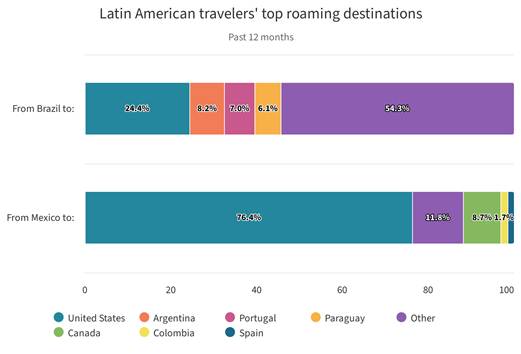
The US was also a popular destination for travelers from other Latin American countries, such as Argentina and Chile, though not to the same degree as for travelers from Mexico (which of course sits on the southern border of the US).
Regardless, this kind of information can help guide Latin American operators as they sign roaming agreements with their international operator peers – and those decisions will ultimately impact the experiences their roaming customers will receive. After all, customers who use the Speedtest app to check their connections are probably the ones who care about the quality of those connections.
Within this data, it’s also worth noting that almost all of these countries are enjoying a general rise in their overall mobile Internet speeds. That’s important given the concurrent increase in the number of people traveling across Latin America’s borders.
Median mobile download speeds at top destinations for Latin American travelers
This chart shows median mobile download speeds across several different countries from 2020 to 2024, with the US showing the greatest growth.
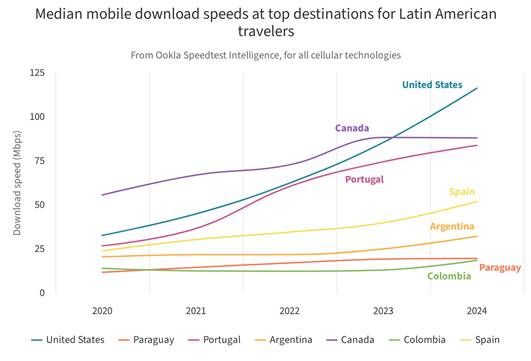
This rise in speeds spans much of the region – except for outlying locations such as Paraguay, where 5G is still in its infancy.
This kind of network performance information can also help assuage travelers who are increasingly relying on their phones for travel necessities like maps, translation apps and, of course, sun-drenched Instagram posts – as long as their roaming plans provide access to these speedy networks.
Picking the right connection
Like all modern travelers, Latin American globetrotters must decide: Cellular or Wi-Fi? Is it possible to use local Wi-Fi connections in order to avoid a mobile operator’s international roaming fees?
Over the past 12 months, it appears that travelers who hail from Mexico were keen to employ the Wi-Fi option. For example, more than half of all travelers from Mexico to the US relied on Wi-Fi connections instead of 4G LTE or 5G when they arrived in the US. In contrast, travelers who bought service from an operator in Brazil and then traveled to the US didn’t show nearly as much interest in Wi-Fi as their Mexican peers.
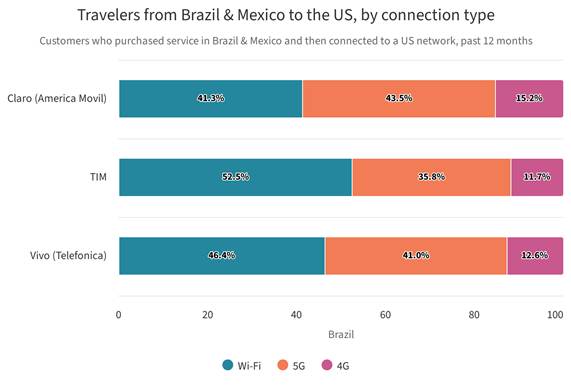
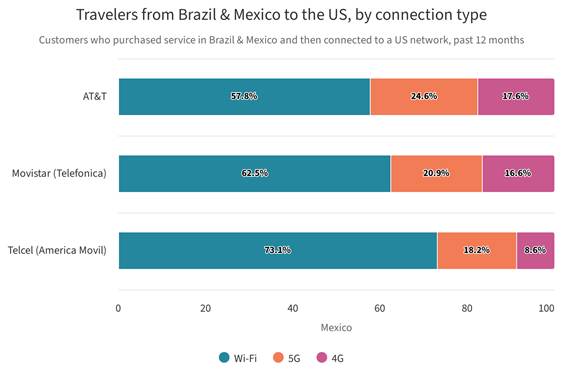
Travelers originating in Argentina, Colombia and Chile showed this same proclivity for Wi-Fi. Indeed, roughly 80% of the mobile customers over the past 12 months who purchased service in Argentina and then traveled to Brazil (the top destination for these kinds of Argentinian travelers) connected to Wi-Fi when they arrived in Brazil.
However, this could be due to a variety of factors beyond the price of international cellular data. For example, Mexico City’s “Internet for All” initiative, aimed at bridging the digital divide, now spans tens of thousands of free Wi-Fi hotspots, earning the effort a nod from the Guinness World Records in 2021. Since 17% of Mexico’s total population lives in the larger Mexico City metropolitan area, travelers from Mexico may have a higher affinity for public Wi-Fi connections.
But Wi-Fi isn’t the only technology affecting the roaming equation for mobile customers and network operators in Latin America and elsewhere. For example, eSIM technology allows travelers to bypass their home operator’s roaming packages in favor of local or regional data plans that may be less expensive. This trend could help erode operators’ legacy roaming revenues – the GSMA projects that a remarkable 75% of smartphone connections in Latin America will use eSIM by 2030.
A final, critical factor that may affect the Latin American market stems from unlimited roaming offerings. For example, T-Mobile and AT&T are selling premium plans in the US that include roaming across Latin American at no extra cost. This reframes international connectivity as an included feature rather than a costly add-on – another competitive lever against the traditional roaming business model.
Roaming costs and roaming partners
A central question in any analysis of the Latin American roaming market is the financial impact of such services on operators, whether through fees paid to their international roaming partners or through revenues gained from inbound connections. However, obtaining precise figures in this area is difficult since operators generally do not disclose roaming revenues in their public financial statements.
An anecdotal view of the situation comes from Telecom Argentina’s 2024 financial results, which list “roaming, international settlement charges and lease of circuits” among expenses totalling $118.5 billion Argentine pesos, or around $90 million US dollars. That’s roughly 2.8% of the telecom operator’s total consolidated operating costs.
These expenses can be affected by a variety of factors. Variations in exchange rates – such as the appreciation of the Mexican peso and the Brazilian real against the US dollar – can substantially influence the profitability of operators’ roaming agreements. And local regulations can have a major impact as well. For example, the telecom regulator in Mexico, IFT, recently renewed rules governing the rates America Movil can charge other operators for roaming onto its network in Mexico, in a bid to expand telecom competition in the country.
Although roaming revenues might be difficult to assess, operators’ roaming partners are a bit clearer. Here too Ookla data can offer some insights. For example, over the past 12 months it appears that America Movil strongly favored one roaming partner per country. In the US, that was mostly T-Mobile.
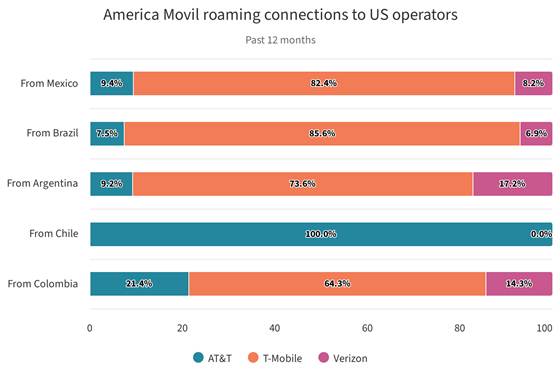
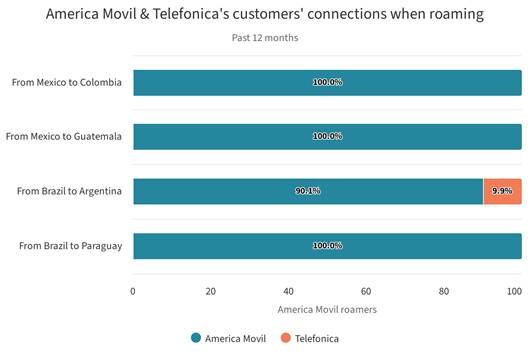
Further, in many markets where the company operates its own network, Ookla data showed that America Movil was reluctant to push its customers onto any other operator’s network except its own. Other big operators, like Telefonica, appeared more open to maintaining multiple roaming relationships.

AT&T, meantime, appeared to take an egalitarian approach to roaming in Canada by spreading its mobile customers – those with service from Mexico – evenly across Canada’s top mobile network operators: Telus, Bell, Rogers and Videotron. But, like other operators, AT&T pushed most of its customers in the US and in Mexico onto its own network in those countries.
So, what to make of these approaches to roaming? First, it’s worth noting that Ookla data showed the median mobile download speeds that customers received in the locations where they traveled as well as in the market where they initially purchased their mobile services:
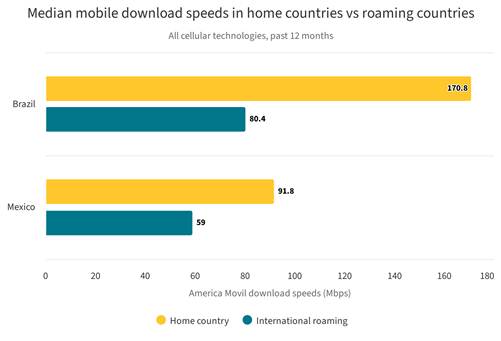
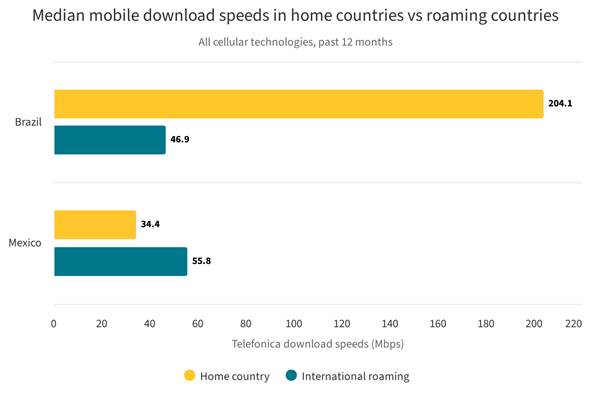
Thus, mobile users who purchased America Movil’s services in Brazil, for example, saw a clear decline in speeds when they were roaming vs. when they were in Brazil. But in other cases the reverse was true. As shown in the above chart, when a customer purchased their service in Mexico and then traveled abroad, they tended to find faster speeds at their destination if they were a Telefonica customer.
To be clear, network quality can vary by destination. Latin American customers who travel to the US, for example, will probably receive higher overall speeds than if they travel to Paraguay. That’s because US operators are roughly five years into their 5G buildouts whereas operators in Paraguay are just getting started.
Nonetheless, this data can help operators understand their customers’ roaming experiences, and then adjust as necessary.
Conclusions and recommendations
The roaming market globally, as well as in Latin America, is undergoing significant change. Some of that change is obvious – for example, Telefonica is offloading its mobile businesses in Argentina (to Telecom Argentina), Colombia (to Millicom), Peru (to Integra Tec), Uruguay (to Millicom) and Ecuador (again to Millicom). AT&T too is reportedly considering a sale of its business in Mexico. All these ownership changes could affect the region’s roaming agreements.
Other changes may be less clear, given the opaque nature of roaming revenues in general and the quiet rise of independent eSIM providers like Airalo and Holafly.
But there are a few things that operators in Latin America and elsewhere can focus on amid these changes:
- Network performance. As 5G expands throughout Latin America, mobile customers in the region will likely begin to focus more closely on the quality and coverage of their 5G connections while they’re traveling. Similarly, big mobile network operators outside the region will be watching the construction of 5G networks in Latin America carefully as they decide how to keep their own roaming customers connected. Latin American operators that can offer a reliable, high-speed 5G experience may have a better chance at winning these roaming deals.
- Digital experience. Operators that make international travel easy and seamless may be a step ahead of startup eSIM operators or Wi-Fi providers. For example, they may want to consider no-extra-charge roaming plans if such services can profitably attract high-value customers. Alternatively, operators could consider simplified purchasing and management systems for roaming, to prevent their customers from seeking eSIM alternatives.
- Efficiency. Roaming-focused infrastructure may improve operators’ traffic management. For example, local breakouts can route mobile customers’ Internet traffic directly into the nearest local Internet exchange in the country they’re visiting, rather than all the way back to their home country’s network. This reduces customers’ overall latency and improves their experience (this too is recorded in Ookla data). Operators may also consider using blockchain technology, such as the GSMA’s eBusiness Network, to speed up roaming settlements.
We will continue to track roaming services and user experiences across major markets like Latin America for the foreseeable future. For more insights into Ookla’s network intelligence and experience benchmarking solutions, please contact us.
Ookla Senior Network Data Scientist Cristhian Castro contributed to this report.
Ookla retains ownership of this article including all of the intellectual property rights, data, content graphs and analysis. This article may not be quoted, reproduced, distributed or published for any commercial purpose without prior consent. Members of the press and others using the findings in this article for non-commercial purposes are welcome to publicly share and link to report information with attribution to Ookla.
