


Friday 12 June, 2026
Variation in outage scale and duration across mobile operators during the April 28th event reinforces the case that robust power resilience is now the single most decisive factor in preserving service continuity in mobile networks
The Iberian grid collapse stands as the starkest demonstration yet of the fragility of mobile network infrastructure precisely when it is needed most. Public scrutiny following the historic event has centred on understanding and ultimately mitigating the societal vulnerabilities stemming from mobile networks’ inherent reliance on a constant grid power supply, which is increasingly difficult to guarantee as severe events become more frequent.
For the first time, and with the goal of fostering deeper understanding of the interdependence between mobile and power infrastructure in Europe, Ookla is publishing detailed data exposing the scale and geographic distribution of mobile network disruptions caused by the April 28th event. Building on our earlier analysis, this research reveals that the impact of the power outage on mobile network infrastructure varied significantly across operators, with differing levels of power backup penetration likely a critical factor shaping the severity experienced by end users.
Key Takeaways:
- At the peak of the April 28th blackout, more than half of all mobile network users across large parts of Spain were left completely without mobile signal. The proportion of mobile network users experiencing complete service loss (unable to call, text, or use data due to sites going dark) surged from a pre-blackout baseline of under 0.5% to more than 50% across extensive areas of Spain at the peak late on April 28th. This indicates a severe, widespread, and historic collapse of the mobile site grid that deepened throughout the afternoon and evening on the day of the blackout as available power backups were progressively depleted.
- The timing and distribution of mobile network outages closely tracked the pattern of power grid events, underlining the telecom infrastructure’s vulnerability to even brief interruptions in power supply. Within 30 minutes of the grid failure (by 13:00 CET), the proportion of users with no service surged as small cells and sites with minimal power backup and battery autonomy went offline. After two hours, about 12% of users on the most affected operator had no service. Outage growth then slowed, suggesting that remaining macro sites, likely equipped with four-to-six hour battery banks, kept operating until their reserves ran out, leading to a final sharp wave of service loss in the late evening. The restoration of mobile services tracked the geographically-phased re-energisation of the power grid, with network disruptions persisted longer into the night in parts of Andalusia and Galicia.
- While severe network outages were observed across all Spanish operators during the blackout, mobile users on the Vodafone network were less likely to experience a complete service loss. Four-to-eight hours after the grid collapse, the interval in which every operator hit its worst point in terms of service loss, Vodafone’s subscribers were, on average, less than half as likely to be left without service as subscribers on Orange’s network and notably less likely than subscribers on Movistar or Yoigo as well.
- Morocco’s mobile site footprint remained operational throughout April 28th since domestic grid supply was unaffected. However, the country’s reliance on Spain for international connectivity in deeper network layers resulted in cascading failures and severe service degradation. The proportion of mobile users experiencing no service on the Orange Maroc and Maroc Telecom networks remained consistent with the pre-blackout baseline on April 28th, confirming there were no sustained network disruptions at the mobile site level due to grid failure, unlike in Spain and Portugal. However, analysis of Speedtest Intelligence data reveals significant performance degradation still occurred in Morocco, with the median load time for popular websites increasing by more than 20% compared to the same day in the previous week. The quality of experience (QoE) for Orange Maroc subscribers was particularly impacted during the blackout, reportedly due to disruptions in upstream subsea connectivity between Morocco and mainland Spain.
Power Resilience and Energy Management Strategies Shape the Anatomy of Network Outages
The Iberian grid collapse exemplifies a type of stress test becoming increasingly common in Europe—the ability of mobile network infrastructure to withstand prolonged, severe external shocks beyond direct operator, ensuring continuity of service precisely when it is most critical for public safety and societal functioning.
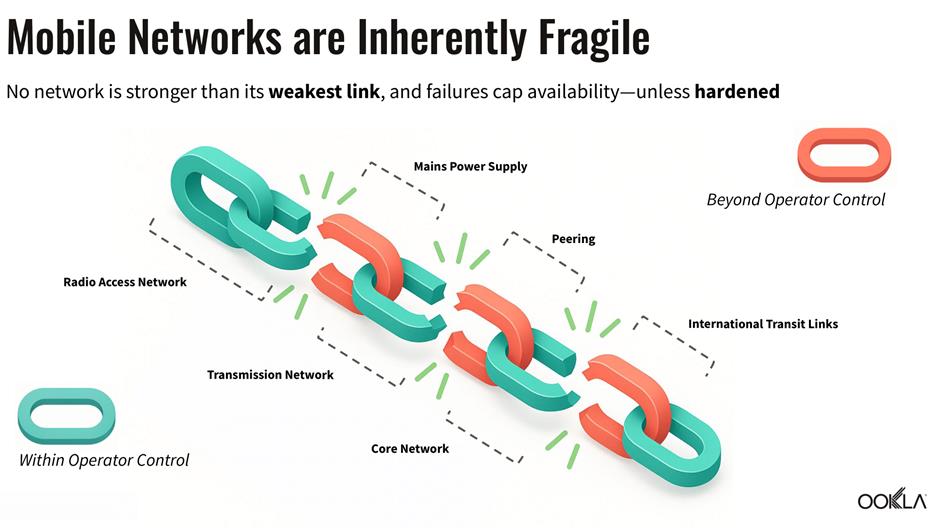
Beyond the April 28th blackout, recent events in the UK and Ireland, where winter storms (especially Storm Éowyn) caused extensive localized damage to electricity distribution networks, and in France, where substation vandalism resulted in brief but severe blackouts in Cannes and Nice, highlight electricity supply disruptions as a principal vulnerability for mobile networks reliant entirely on grid power. These disruptions add to other external vulnerabilities faced by operators, such as terrestrial or subsea fiber connectivity, upstream cloud links, and third-party peering connections.
Power resilience, particularly through battery and generator backup systems at mobile sites, has emerged as a key proactive measure to mitigate network outages resulting from electricity grid disruptions. Simply put, backup power serves a role analogous to public health measures in a pandemic: it strategically delays the onset of outages (extending the operational hours before sites lose power) and reduces the peak severity (limiting the total number of sites simultaneously affected).
Capital investments in network hardening tools like power redundancy can therefore “flatten” the service-impact curve during an outage event in the same way public health measures flattened the infection curve during the coronavirus pandemic. Prolonged and wide-area grid disruptions like the one on April 28th, however, demonstrate that no single measure is a silver bullet and long-term power autonomy is often not economically viable across a large proportion of the site footprint.
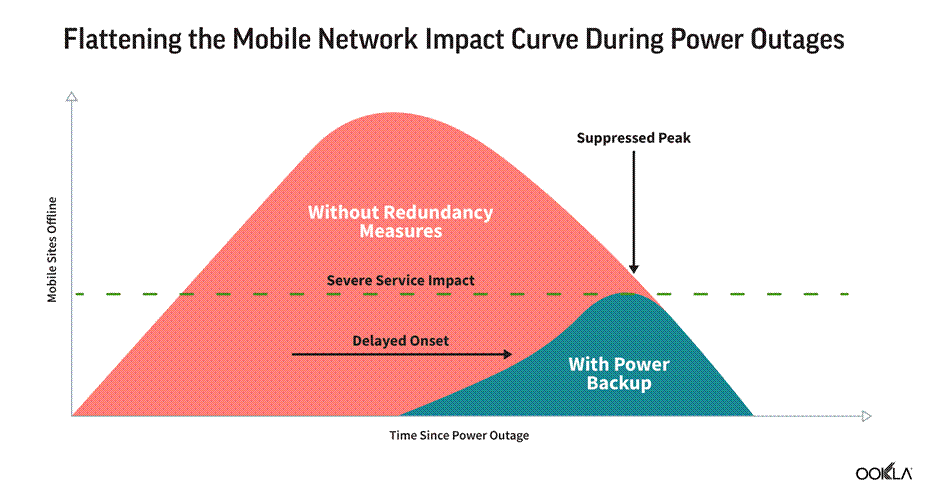
Recognizing this, mobile operators typically implement aggressive energy management measures during power disruptions to maximize site uptime and strategically allocate network resources based on user priority. These measures may include throttling site transmit power to reduce coverage footprints, limiting spectrum diversity to limit carrier aggregation and overall capacity, and temporarily disabling newer technologies such as 5G and Massive MIMO to extend battery and generator runtime.
Differences in the extent of power backup deployment and the strategic use of energy conservation and load-shedding measures shape the anatomy of network outages. Such variations among operators may arise from a diversity of fuel choices for backup power (e.g., batteries might offer long-term monetization potential, including opportunities for resale to the grid, but typically have shorter runtimes), network configurations (such as RAN sharing arrangements and site types, with dense urban small cells facing greater physical constraints for power backup deployments), and subscriber base characteristics (e.g., operators serving a larger rural subscriber base face more complex and costly challenges in enhancing network resilience).
Iberian Grid Collapse Cascaded through Mobile Networks in Spain, Moving in Lockstep with Power Disruptions
Analysis of Ookla® background signal scan data reveals that the April 28th event placed unprecedented stress on mobile networks in Spain, triggering a rapid collapse in site grid density. The historic scale of this collapse severely curtailed the coverage footprint of operator infrastructure, pushing a significant share of Spanish mobile subscribers into a ‘no service’ state, unable to connect to a nearby mobile site and thus temporarily unable to make calls, send texts, or use data.
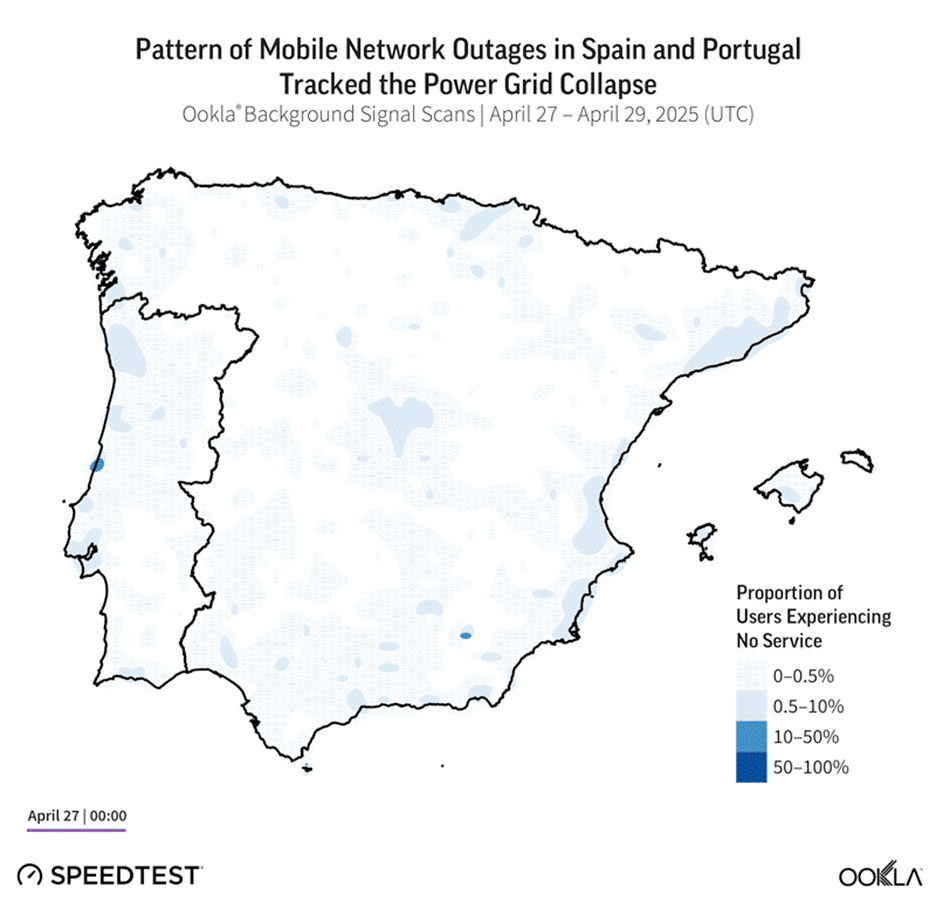
Geospatial sequencing of the ‘no service’ data calculates the average probability that a mobile network user was left without signal during any given time window and serves as a proxy for the overall proportion of subscribers left with no network access. This methodology illustrates that the impact of the power blackout quickly cascaded through Spain’s mobile networks (closely mirroring the infection curve analogy described earlier):
- Baseline (Pre-Blackout): Mobile sites were operating as normal. The average proportion of subscribers without service was less than 0.5%, reflecting the very high levels of network availability typical of Spain.
- Initial Impact (Immediate Aftermath of Blackout): The grid collapsed at ~12:33 CET across the Iberian Peninsula, triggering rectifiers or uninterruptible power supply (UPS) devices at mobile sites to switch over to backup batteries or generators (where these were installed and adequately charged or fueled).
Within 30 minutes of the voltage drop, the proportion of subscribers without service had climbed well above the pre-event baseline across Spain and the outage curve entered a phase of runaway growth. This limited initial outage impact likely reflected the immediate loss of a small portion of the overall site footprint in areas where power backup was either absent or severely limited in capacity—most commonly at small cell sites in dense urban environments, where physical space restricts battery or generator installations, or at remote rural sites lacking redundancy (or featuring generators that took longer to switch over and come online).
Notably, the balanced geographical spread of subscribers beginning to experience no service on their devices (i.e. losing network access) at the start of the network outages suggests that the timing of impacts was broadly consistent across Spain, affecting both rural and urban regions. However, the initial severity was more pronounced in areas along the east and south coasts, as well as in the interior of the country, potentially indicating a lower level of power autonomy at sites in these areas.

Control how much of each overlapping image is shown. 0 means the first image is completely hidden and the second image is fully visible. 100 means the first image is fully visible and the second image is completely hidden. 50 means both images are half-shown, half-hidden.
- Ramp-Up (2-8 Hours After Blackout): Within two hours of the blackout, the most affected operator had already seen ~12% of users left with no service. After this point, the rate of outage growth slowed temporarily for several hours. This pattern suggests that the power backup profile of Spanish mobile sites was bi- or tri-modal, with a tiered approach to backup capacity employed by operators (i.e., site autonomy was clustered into configurations like two, four or six-hour power resilience, with battery discharge rates determined by amp-hour capacity and site load at each location).
As a result of this tiered approach to power autonomy and site load variability, a portion of sites continued operating, likely in a reduced state with aggressive energy conservation measures in place (reflected in marked performance degradation observed in Speedtest Intelligence® data), throughout the afternoon and evening of April 28th.
The eventual depletion of larger power reserves, typically found at major macro sites on lattice or monopole towers, triggered a final sharp wave of network outages four to eight hours after the blackout began. The loss of these wide-area ‘umbrella’ sites in the evening resulted in a substantial share of Spanish mobile subscribers experiencing no service by 21:00 CET, with severe network outages geographically distributed across all of Spain. - Peak (8-10 Hours After Blackout): The impact of the blackout on mobile network infrastructure in Spain peaked between 21:00 and 22:00 CET, with more than half of all mobile subscribers left without service across many regions by late evening, just before power began to return. By this stage (about ten hours after the initial power loss), even the most capable battery backups were likely exhausted, leaving only those sites powered by mobile or stationary generators still operational (especially where strategic fuel deliveries could extend uptime).

- Recovery (Remainder of April 28th and 29th): Cross-analysis of geospatial sequencing of the no service data with nighttime light emissions detailed in NASA satellite imagery reveals that the recovery of mobile services and the site grid footprint in Spain closely tracked the pattern of grid re-energization. The proportion of users without service began to decline in the mid-afternoon and early evening in the areas where power was first restored, as the grid operator carried out a phased nationwide black-start. This early network recovery was most evident in regions such as the Basque Country, Catalonia, and Castile and León.
Significant network outages continued into the night in parts of Andalusia and Galicia, meanwhile, mirroring the slower pace of power restoration in these regions. In some parts of Andalusia, for example, more than half of subscribers remained without service by 6:00 a.m. the following morning, only regaining connectivity once power was restored shortly afterwards. The direct relationship between the timing of power restoration and mobile network recovery highlights that operators are wholly dependent on the grid for service continuity once backup systems are inevitably depleted.
Breadth and Depth of Power Autonomy Drives Differences in Network Resilience Outcomes
The infection curve analogy provides a potent mechanism to visualize and compare network outage profiles and site resilience among Spain’s mobile operators during the blackout. The shape of these outage curves transforms the ‘no service’ data into a story about both network topology and the breadth and depth of power backup deployed across different operators.
In the context of the outage curves, the point where each curve rises from the baseline reflects the level of power autonomy or battery/generator depth. The height of the peak shows how evenly that autonomy is distributed across the site footprint, while the length of the tail can reveal the geographical skew of subscribers within each operator’s network.
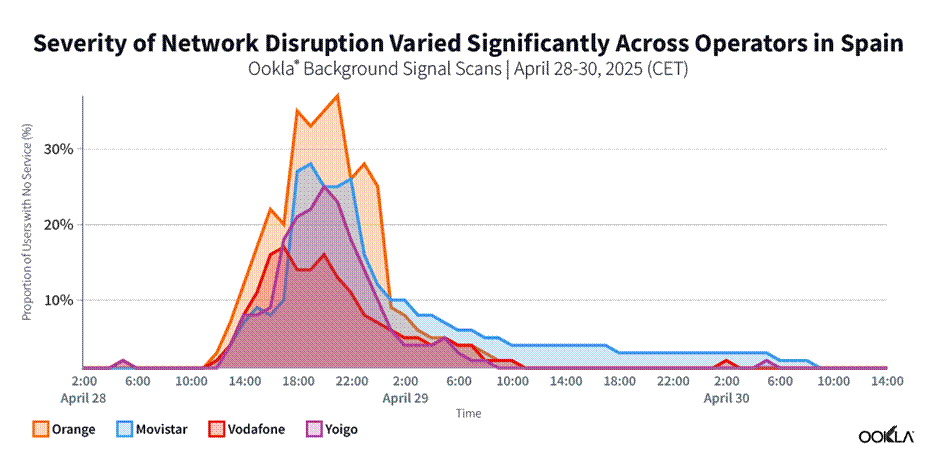
On April 28th, Vodafone exhibited the earliest and lowest outage peak in Spain. The probability that a subscriber on its network was left without service peaked at about half that of Orange and notably below other operators. This early yet suppressed peak indicates a thin but widely deployed power autonomy layer in its network, with small cells (featuring short UPS reserves) dropping out quickly, while most large macro sites carrying modest batteries or generators with different configurations likely kept at least one carrier alive for several hours. This approach of spreading shallow reserves across most sites flattened Vodafone’s outage peak but also pulled it forward in time.
While Orange’s outage curve did not reach its peak until several hours after Vodafone, it is indicative of a strategy that concentrated on thick battery or generator backup at key sites but left a broad swath of sites vulnerable to synchronized collapse (as reflected in the sharp no service spikes), the higher peak suggests a larger share of its subscriber base was likely left with no service during the blackout.
Movistar’s outage profile fell between Vodafone and Orange in both the timing and height of its peak during the blackout, but the recovery of its site footprint was significantly more protracted—taking nearly twice as long (almost a day and a half) as the other operators for the proportion of subscribers with no service to drop below 2%. This is likely an artifact of the unique scale of its rural site and subscriber footprint in Spain, where power backup is often more reliant on generators that require manual intervention and are more limited in deployment due to the economic challenges posed by installation in remote areas.
Network Resilience is about more than Power Redundancy
While the Iberian blackout may have been a black swan event, the wider global trend of escalating climate, energy, and security-driven shocks impacting multiple layers of telecom infrastructure—often beyond the direct control of mobile operators—has elevated network resilience from a secondary consideration to a core design principle. This shift is reflected in more robust policy oversight (as exemplified in countries like Norway and Finland) and is likely to be underpinned by fiscal subsidies that seek to support the deployment of more power resilience solutions at mobile sites.
Network resilience is, however, more than keeping the lights on; it also depends on other important factors like having diverse, independent paths to the wider internet. On the day of the blackout, Moroccan operators that funnel most of their international traffic through Spanish landing stations lost those paths when the grid collapse knocked Spanish routers and data centers offline.
Since the subsea capacity and routing of some Moroccan operators was dependent on a highly concentrated upstream Spain-centered corridor, there was limited immediate fail-over and users experienced sharp service degradation, even though power and equipment inside Morocco never went down. By contrast, operators that had additional fibers to France or Italy suffered more minor disruptions, highlighting how geographic and upstream diversity are just as critical to mobile network resilience as local power autonomy.
Ookla retains ownership of this article including all of the intellectual property rights, data, content graphs and analysis. This article may not be quoted, reproduced, distributed or published for any commercial purpose without prior consent. Members of the press and others using the findings in this article for non-commercial purposes are welcome to publicly share and link to report information with attribution to Ookla.
