


Sapphire Lally, Quantum Technologies Business Developer, outlines how the GSMA is helping telcos assess the potentially profound impact of quantum technologies.
Quantum is looming large on the tech horizon. While engineering hurdles remain, quantum computing, quantum communications and quantum sensing have already begun to impact telecoms, finance and healthcare, and world-changing capabilities are likely to emerge in the next five years.
In a recent interview with the WSJ, Dan Schulman, the CEO of Verizon Communications, predicted that there will soon be huge demand for quantum computing capacity. “If you are not using quantum as your underlying basis for your algorithms, you lose. It’s as simple as that,” he said. As awareness grows, leaders in the telecoms industry are engaging with the emerging quantum computing ecosystem via the GSMA and other channels.
Quantum technologies could deliver unprecedented optimisation power, enhanced network sensing, energy-efficient machine learning, ultra-precise timing and other sophisticated capabilities. In an increasingly unstable world, the inherent security principles of quantum computing and quantum communications (a product of the laws of physics) is likely to appeal to business leaders and policymakers alike.
The GSMA – through its Quantum Networks and Services (QNS) Working Group and the GSMA Foundry – is investigating the potential benefits of quantum technologies for the telecoms sector. Will they simply yield incremental gains or will they revolutionise our industry?
How will quantum technologies enhance telecoms?
For telcos, quantum technologies could yield benefits for both their internal operations and the connectivity and security propositions they provide to other enterprises. For example, early pilots suggest quantum computing can solve complex network optimisation poblems, such as traffic routing, antenna placement, spectrum allocation, and energy-efficient network design. Increasingly, telcos are piloting quantum key distribution (QKD), which enables ultra-secure key exchange based on quantum mechanics, in metropolitan networks and for safeguarding data in sensitive industries, including healthcare and finance. Some European telcos are involved in the EU’s EuroQCI project, which is developing pan-European wide scale quantum communications infrastructure.
More broadly, quantum technologies could propel further advances in artificial intelligence (AI). Quantum-inspired techniques have been used to compress large language models, for example, delivering significant savings on energy and data imputation – and AI processors and quantum computers are set to be co-deployed in data centres and computing clusters for easy access. However, fully quantum-native solutions remain in the research and pilot phases, with scalability and benchmarking as key challenges.
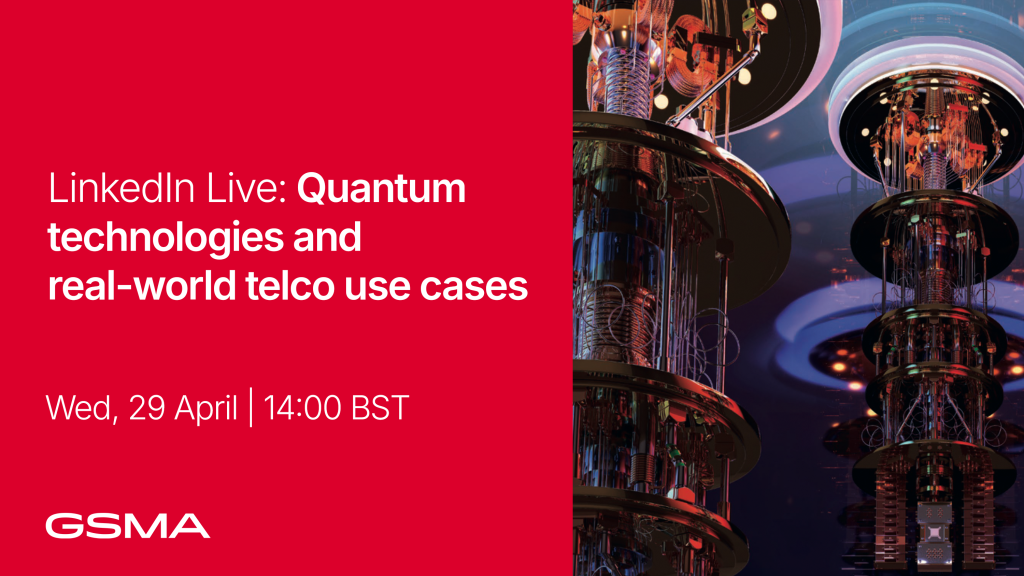
Further important applications are detailed in the GSMA’s latest whitepaper, Quantum Technologies – Telecom Use Cases. That paper was the basis for a recent LinkedIn Live webinar, available to watch below, in which members of the GSMA Quantum Networks and Services (QNS) Working Group shared an overview of their work. The chair of the group Dr Simon C. Müller, Senior Technology Strategy Manager at Telefónica, Yolanda Sanz, Head of the Working Groups and Cathy White, Research Technical Manager at BT, discussed early opportunities for network optimisation, quantum communication protocols, and advanced sensing, alongside the importance of industry collaboration in accelerating adoption.
In the webinar, Cathy White outlined BT’s history of innovation in developing and deploying QKD networks – leading to the BT-Toshiba Quantum Secure Metro Network, which connects sites across the City of London and the London Dockyards. BT’s expertise has also driven the QAssure project – a key milestone for assurance and evaluation of QKD systems – which deepens trust and further supports commercial deployments.
Telefónica is also learning by doing. It is experimenting with a range of quantum technologies, including quantum computing and QKD deployments in a variety of different contexts, such as data centres and healthcare environments. As well as using quantum computers to trial optimisation strategies for parts of its network, Telefónica is exploring how to utilise its existing infrastructure in Spain to provide quantum computing-as-a-service to other enterprises.
In addition to showcasing initial deployments, the GSMA is building a sector-wide understanding of the realistic benefits of quantum technologies. To that end, we are defining telecom use cases and driving trials, building ecosystems and partnerships, and creating structured industry roadmaps and adoption guidance. We are also helping operators to identify quantum applications with the greatest technical and economic potential for the telecoms industry. Major telecoms operators, leading equipment vendors, specialist quantum companies and cloud and technology providers are all involved in the QNS Working Group.
Sharing learnings across the ecosystem
Through quantum knowledge transfer and skills development, the GSMA is strengthening overall ecosystem readiness and informing strategy development, reducing the inefficiencies that often characterise the development of entirely new technologies.
Another key goal is to ensure that quantum technologies serve the needs of telcos and their customers, and vice versa. As well as helping telcos understand how quantum computers could help them optimise their network operations and other processes, the GSMA is exploring new service opportunities for telcos in the emerging quantum landscape – including the connectivity requirements for data centres equipped with quantum computers. Can pre-existing dark fibre carry both quantum and classical traffic, for example?
One of our near-term priorities is to identify enablers for the quantum internet – the creation of entanglement-based links between nodes. The benefits could include quantum sensor networks, distributed quantum computing, and new business models around “quantum-as-a-service”. While challenges remain, such as maintaining entanglement over long distances and integrating quantum repeaters, global initiatives and standardisation efforts are accelerating progress. Early adoption would position telcos at the forefront of next-generation connectivity.
While the QNS Working Group is building understanding and fostering technical alignment of quantum technologies, the GSMA Foundry is exploring their commercial potential. As well as helping to clarify the economic benefits for telcos and their partners, the Foundry is making it easier for our members to work with technology vendors on low-risk experimentation and innovation. For example, emerging quantum-computing-as-a-service (QCaaS) propositions can enable telcos to access quantum capabilities via cloud platforms. This model allows businesses to experiment with quantum algorithms for optimisation and efficiency, and AI applications without large upfront investments in specialised hardware.
While quantum technologies are evolving quickly, significant challenges remain. These include hardware fragility and scalability, improved error correction, algorithm and software readiness, integration into existing systems, cost and accessibility, regulatory and security concerns, and skills and workforce gaps.
If and when these challenges are resolved, quantum technologies could enable more secure, efficient and innovative telecoms services, creating enormous value for end-users. Telcos that invest time and resources today could reap major rewards in future.
To learn more about the GSMA’s work on quantum technologies visit our dedicated hub.
Get Involved
If you’re a GSMA Member and interested in collaborating on this topic, please join the Quantum Networks and Services Working Group.
Find out more about GSMA Working Groups and how their role in driving industry collaboration.
Become a GSMA Member
Join a global community of like-minded professionals and organisations who share a common goal of advancing the mobile ecosystem. Find out more.