


Barbara Pareglio, Senior Technical Director explains how the GSMA’s Working Groups are helping the mobile industry harness the full potential of non-terrestrial networks.
When you’re travelling, your handset can connect to many different mobile networks (thanks to standardisation and roaming agreements between operators). Ideally, in the absence of mobile connectivity, your handset would also be able to connect to any satellite network.
That’s not the case today, but that is where the mobile and satellite industries are heading. Cellular standards body 3GPP is paving the way, by integrating non-terrestrial networks (NTN) into its latest releases. At the same time, the GSMA’s NTN Community and working groups are helping operators to translate the standards into real services by developing guidelines to enable interworking and roaming across terrestrial and satellite networks.
Fully integrating satellite networks into the broader telecoms sector is important because there is never realistically going to be cellular coverage across most of the Earth’s surface. While mobile broadband networks (3G, 4G or 5G) reach more than 95% of the world’s population, the majority of the Earth’s landmass lacks cellular coverage. And, most of the seas, which account for 70% of the earth’s area, are not covered by cellular networks.
By contrast, NTN can provide coverage to buildings, boats, aircraft, vehicles, cyclists and hikers, no matter where they are. At the same time, satellites are becoming increasingly capable of supporting the services and applications we associate with mobile networks, including voice calls, messages, navigation and internet access. Some NTNs now have direct-to-device (D2D) capabilities, which enable mobile handsets to communicate directly with a satellite, removing the need for end-users to purchase and carry specialist terminals.
The satellite industry – diverse and dynamic
While satellite operators are forging partnerships with mobile network operators, bringing these two industries together is far from straightforward. That’s because satellite constellations are both diverse and expanding rapidly. Whereas low earth orbit (LEO) constellations are set to consist of thousands of satellites, their geostationary (GEO) counterparts might only need a few dozen. Even within the LEO sector, constellations vary enormously. For example, Starlink, which is offering broadband to homes and businesses, already has more than 7,800 LEO satellites in orbit, and is planning to have 12,000, while Globalstar is providing D2D connectivity to iPhones using just 32 LEO satellites.
While some constellations are designed to support 3GPP standards, others are not. Where satellite services are fully compatible with 3GPP, they can be fully interfaced with terrestrial connectivity through the mobile operator’s core network or even the radio access network (RAN). As with terrestrial networks, interworking can occur at different levels. For example, interworking could be achieved via core interconnections, RAN interconnections or slicing scenarios.
However, some of today’s D2D services are either proprietary (such as Apple’s Emergency SOS via satellite) or are only partially compliant with 3GPP standards. To support interworking between terrestrial networks and partially compliant services, a first level of service interworking can be realised at a core network level.
Refining devices, networks and roaming agreements
Within this complex and dynamic environment, the GSMA has begun developing guidelines that cover everything from device compatibility to the commercial aspects of roaming. The GSMA Terminal Steering Group (TSG), the GSMA Networks Group (NG) and the GSMA Wholesale Agreements and Solutions Group (WAS) are all busy tightening the integration of NTNs into the mobile ecosystem. This work is focused on supporting the rollout of both D2D services and 5G-based broadband by NTNs.
The TSG, for example, is building on the work of 3GPP RAN5, which is responsible for creating conformance test specifications at the radio interface, encompassing IoT-NTN technologies and, in future, NR-NTN. To provide additional layers of validation for NTN components in live networks, the TSG is ensuring that NTN deployments meet the expected performance levels in real-world environments. Most of the conformance and field test cases defined in TSG form part of the GCF and PTCRB certification criteria, as well as being used by mobile operators for their own device approval processes.
The TSG is also looking to optimise how devices select satellite networks, while ensuring consistency with the existing mechanisms used to select terrestrial networks. Meanwhile, the Networks Group is adapting the GSMA’s R21 permanent reference document (PRD), which is used by mobile operators to underpin commercial roaming agreements, to support roaming across NTN and terrestrial networks. At the same time, the WAS is exploring potential charging models and related business models.
In each and every case, our working groups are looking to ensure that their output fully reflects the technical and commercial realities on the ground (and in the skies). If you are working in this space, please get involved. With so much happening in this sector, we are keen to benefit from a broad spectrum of expertise from across the NTN and terrestrial ecosystems.
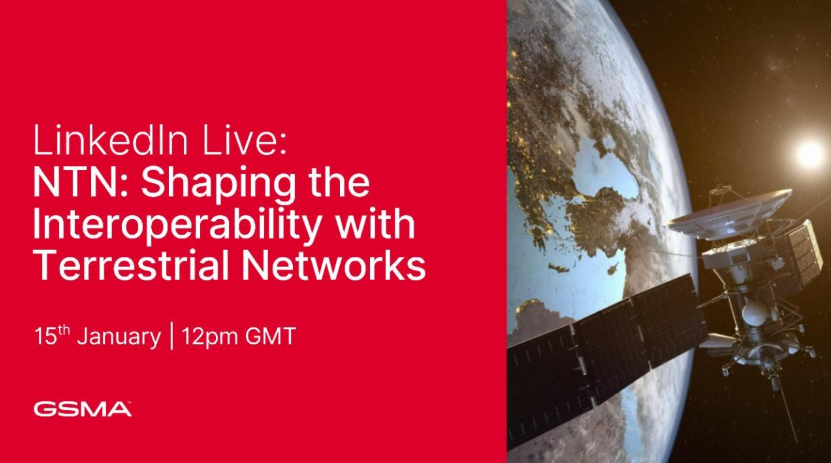
For more on this topic, see a recent LinkedIn Live webinar, in which I outlined how the GSMA’s NTN Community is supporting the GSMA’s working groups. In that discussion, Shahbaz Ali, VP of Product and Standards at Sateliot and Michele Zarri, Senior 3PP Expert at Huawei, highlighted the key activities within each working group and discussed how these initiatives benefit the wider ecosystem and their organisations.
Get involved
If you’re a GSMA Member and interested in collaborating on this topic, find out more about the NTN Community.
Download our latest whitepaper on NTN – Opportunities and Challenges.
Become a GSMA Member
Join a global community of like-minded professionals and organisations who share a common goal of advancing the mobile ecosystem. Find out more.