


GSMA Technology Summit: Australasia
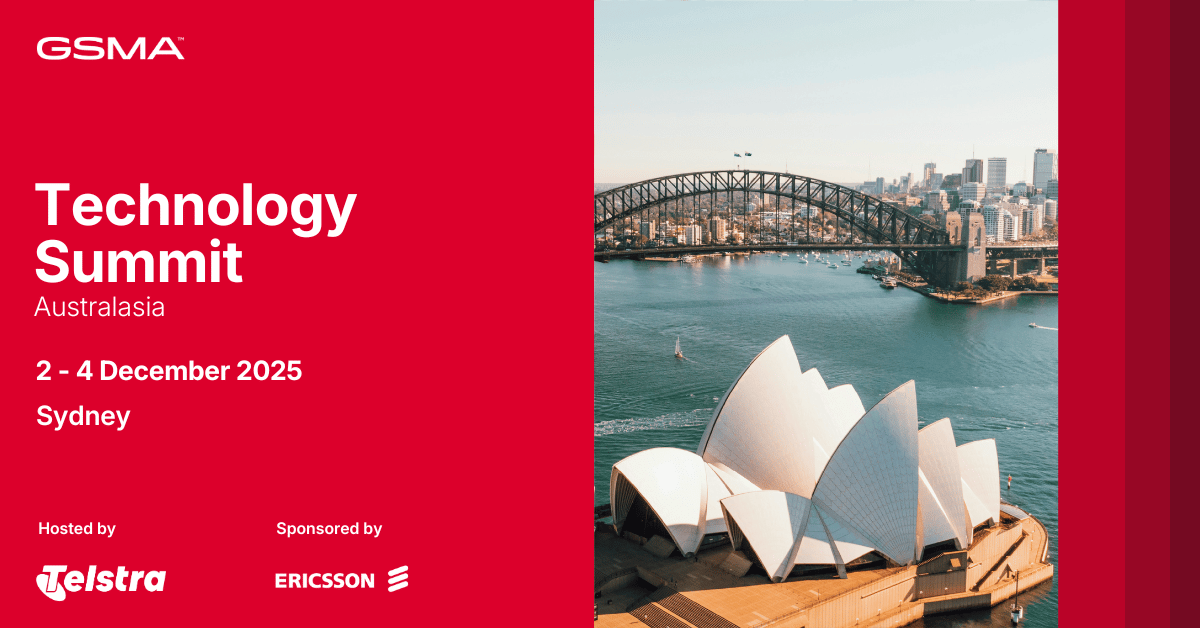
Start: Tuesday 2 December 2025
End: Thursday 4 December 2025
Venue: Telstra's Customer Insights Centre, Sydney
Location: Sydney, Australia
About the summit
GSMA Technology Summit: Australasia, 2-4 December 2025
GSMA will hold a three-day Technology Summit for companies to present on common themes currently impacting the mobile telecommunications market within the Australasian region. The summit will facilitate discussions on key topics, identifying how these fit into the broader GSMA Technology activities. The outcomes gained from this event will be invaluable to industry leaders, practitioners, and policymakers, enabling a better understanding of the local and global telco ecosystem. It will also provide insight into how GSMA Technology activities support informed decision making and influence the GSMA technological landscape.
The full agenda for the summit is outlined below, with topics suitable for a wide audience, including mobile operators, mobile technology manufacturers and adjacent enterprises looking to work more closely with mobile technology. It covers a breadth of key areas related to mobile telecommunications, from the deployment of 5G networks and services, to the integration of Private Networks and Non-Terrestrial Networks, alongside more forward-looking technologies such as Quantum, AI and 6G, including security and spectrum considerations.
With a blend of education, networking, and innovation, this summit will provide a collaborative framework for attendees to share ideas, identify challenges to be addressed in the Australasian region, and highlight problems that could be addressed globally within the GSMA Technology working groups.
GSMA Technology Summit presentations
Find out more about the GSMA Working Groups here.
Agenda
Day 1 – 5G Networks
| Time / Topic | Session information | Speakers and panellists |
| 09:30 – 10:30 State of the Industry / Market Insights | The global mobile industry is undergoing rapid transformation, shaped by economic shifts, regulatory pressures, and accelerating digital adoption. With an emphasis on the Australasian markets, this opening session will provide critical insights into the big-picture emerging technology trends and challenges that are impacting the mobile sector. | Julian Gorman, Head of Asia Pacific, GSMA Shailin Sehgal, Group Executive, Global Networks and Technology, Telstra Ludvig Landgren, President & CEO of Ericsson Australia & New Zealand, Ericsson Louise Hyland, CEO, AMTA Samantha Kight, Head of Industry Security, GSMA |
| 11:00 – 12:15 5G Advanced | 5G Advanced is the most recent evolution in network technology, it features integrated AI/ML for network optimisation, enhanced uplink and downlink capabilities for higher speeds and improved user experience, advanced mobility and positioning services, improved network slicing, and specialised solutions for device efficiency and power saving. It builds on 5G’s Service-Based Architecture (SBA) core network enabling operators to leverage the flexibility of SBA to deliver new services and automate network operations. This session will examine the technical breakthroughs of 5G Advanced, its commercial implications, and how it serves as a bridge towards next-generation networks. | Ian Pannell, Chief Engineer, GSMA Morteza Kheirkhah, Technical Director in Networks, GSMA Do Young Kwak, Director AI Analytics, Network AI and Future Network Lab, KT Christopher Price, Director of Advanced Technology, Ericsson |
| 13:15 – 14:15 5G Slicing | Recent improvements to network slicing include enhanced application awareness, AI-powered automation, and flexible device management for more tailored and efficient services. These advancements have made key use cases possible, such as immersive AR/VR, real-time industrial automation, enhanced autonomous vehicle communication (V2X), and more resilient services for public safety, media, and critical infrastructure. This session will explore the transformative impact of 5G slicing, highlighting deployment use cases, business opportunities, and what it means for the broader mobile ecosystem. | Ian Pannell, Chief Engineer, GSMA Luke Coleman, CEO, Australian Telecommunications Alliance Palash Gupta, Solution Architect (Assurance, Fulfilment, ICT, Big Data), Nokia Dhana Ponnamperuma, CTO & Wireless Solutions Lead, Ericsson David Aders, Telstra |
| 14:15 – 15:00 5G Roaming | 5G significantly improves roaming by introducing features like enhanced user plane integrity through Security Edge Protection Proxies (SEPPs) and stronger, mutual authentication, preventing unauthorized access and securing traffic between networks. 5G Advanced builds on these by integrating AI/ML-driven security features, improving NTN integration, improving network slicing security for dedicated services, and enhancing user experience through higher performance and better mobility for seamless, high-quality roaming experiences. This session will investigate the future of roaming in a 5G world, covering technical, security, and commercial considerations needed to ensure ubiquitous global connectivity. | Ian Panell, Chief Engineer, GSMA Jehad Matar, IoT Technical Sales, Vodafone Simon Fraser, CEO, PNCC |
| 15:30 – 17:00 Private Networks | Private mobile networks and massive IoT are central to driving productivity and unlocking new value in the 5G era. Each release of 5G improves the features critical for Private Networks including network slicing for dedicated resources, ultra-low latency for real-time applications, improved security for data privacy, and massive capacity for IoT. However, nearly six years after the first launch of 5G, private networks still represent new ground in terms of regulatory best practice. This session will focus on how to accelerate private network deployment, address regulatory challenges, and ensure these technologies deliver their full economic and societal potential. | David Turkington, GSMA Ian Ross, Ericsson Edward Ting, Askey David Montillet, Airbus Paul Johnson, Nokia |
| 17:00-19:00 Networking Event | Drinks reception sponsored by Ericsson |
Day 2 – GSMA Open Gateway and Security
| Time / Topic | Session information | Speakers and panellists |
| 10:00 – 11:00 Telco APIs: Powering the Next Wave of Security and Growth | As digital ecosystems evolve, legacy mechanisms like SMS OTPs are becoming increasingly obsolete. New approaches powered by telco-enabled APIs can offer frictionless user authentication, enhanced security, and smarter service delivery. This event explores how mobile network operators and channel partners can power the digital economy by exposing network capabilities through APIs and how Fintech’s can enable a more secure means of transacting on top of easing the customer’s digital journey, starting with silent number verification and moving into more advanced use cases. | Julian Gorman, Head of APAC, GSMA Kevin Henry, GSMA Simon Osmond, Product Executive & Group Owner, Telstra Harry Cheung, Founder, IPification Alon Cohen, Strategic Carrier Relations, Twilio Matthew Horton, Director of Customer Marketing & Product Strategy, Optus Wholesale David Livermore, Business Lead ANZ, Infobip Vaibhav Mehta, CEO, Nabstract |
| 11:30 – 12:15 Fraud and Scams | Consumers globally are facing an unprecedented increase in fraud and scams, many of which exploit cross-industry vulnerabilities within the mobile sector and erode consumer trust. Combating this challenge requires collaboration on a global basis between financial institutions, technology platforms, operators and service providers, and regulators. This session will examine how knowledge sharing and coordinated action across industries can enhance the detection, prevention, and response to the increasing threat and hardship due to Scams and resulting Fraud. | Samantha Kight, Head of Industry Security, GSMA Sandy Cameron, CEO, Telstra Quantium Brad Joffe, Apate.ai Samuel Stuart, Mastercard Rob Hall, Entrepreneur |
| 13:15 – 14:15 Security for Telecoms | The mobile threat landscape is evolving rapidly. Current threats are shifting from simple malware to sophisticated, AI-driven social engineering, nation-state attacks, and supply chain compromises that exploit the human element. To stay ahead at a global level, organisations must adopt a proactive, multi-layered approach that includes advanced technology, strong policies, and international collaboration. This session will provide insight into current and emerging threats, while highlighting collective approaches to safeguarding telecom networks against evolving risks. | Samantha Kight, Head of Industry Security, GSMA Clive Rees, Deputy CISO, Telstra Nick Jones, Omnitouch |
| 14:15 – 15:30 Post Quantum Cryptography | Australia’s formal embrace of post quantum cryptography took a major step when in December 2024, Australia took the significant step of formally recognising the need to transition to Post Quantum Cryptography (PQC) within its updated National Cyber Security Strategy. Under these new guidelines, all legacy cryptographic methods must be phased out in favour of PQC solutions by 2030, in line with the NIST timelines. Although 5 years in the future, this is a relatively short window for a complex and far-reaching shift across all technology platforms including mobile. This session will explore what GSMA is doing in this space to help the operators with the PQC transition, the deprecation timelines, and readiness strategies | Yolanda Sanz, Head of GSMA Working Groups, GSMA Umut Cikla, IBM Jonathan Jackson, Senior Director, Strategic Technical Sales APAC, Blackberry James Mabbott, KPMG Futures Matt Henricksen, Cryptographer, Huawei Clive Rees, Telstra |
| 16:00 – 17:00 Securing Connected Devices | As device formats diversify, embedding secure and flexible connectivity has become a priority. eSIM was developed to provide this flexibility in a trusted and secure way. In Australia, the major mobile operators all offer eSIM support for their customers. eSIM technology, defined and supported by the GSMA, enables telco operator profiles to be securely downloaded and managed over-the-air, offering the same trust and protection as traditional SIMs. Evolution of the technology is leading to simplified user adoption and the ability to transfer eSIM based subscriptions between devices. This session will look at the progress of the eSIM ecosystem, new features required by the ecosystem, and how eSIM has the potential to underpin a new era of connected devices with more flexible connectivity features and management of device personas. | Yolanda Sanz, Head of GSMA Working Groups, GSMA David Williams, Managing Director, G+D Mobile Security Australia David Yuwono, CEO, All things Junaid Afzal, Business Development Manager, Acceleronix |
Day 3 – New Tech Frontiers
| Time / Topic | Session information | Speakers and panellists |
| 10:00 – 11:00 Quantum Technologies for Telco | According to some researchers, Australia is recognised as a global quantum leader, with some of the best minds in quantum research and applied technology Quantum technologies are progressing rapidly, with applications ranging from ultra-secure communications to breakthroughs in computing and sensing. Alongside the known cryptographic security challenges, Quantum Technologies presents opportunities in areas such as optimisation, planning and resource allocation and improved timing without relying on GPS. This session will provide an overview of the Quantum Technology use cases for the telco industry, with GSMA bridging the gap between the world class research and the commercial success for quantum technology applied on the telco side. | Yolanda Sanz, Head of GSMA Working Groups, GSMA Jared Smith, Vice President, Business Development, Silicon Quantum Computing Pty Ltd Vikram Sharma, CEO and Founder, QuintessenceLabs |
| 11:30 – 12:30 AI for Networks / 6G | The evolution of AI in networks into the 6G era includes the development of AI-native networks for autonomous operations, AI-accelerated services for faster innovation, and integrated intelligence that enhances network efficiency through real-time data processing. Key areas of focus are dynamic spectrum management, the use of deep learning and reinforcement learning at all network layers, and the development of explainable and adaptable AI architectures to manage complex networks and ensure trustworthiness. Additionally, 6G networks will integrate AI with communication, sensing, and computing, leading to new capabilities like sensing, computing, and AI as foundational network functions. This session will examine how telcos are deploying AI today, the barriers to adoption, and the role AI will play in shaping the path towards 6G. | John Kim, GSMA Morteza Kheirkhah, Technical Director in Networks, GSMA David Soldani, SVP Innovation and Advanced Research, Rakuten Basem Al-Sabri, Founder, Netomate Giuseppe Porcelli, CEO, Lakeba Mark Sanders, Chief Architect, Telstra |
| 13:30 – 14:30 NTN & IoT | In Australia, Non-Terrestrial Networks (NTNs) primarily serve to provide ubiquitous mobile and IoT connectivity to remote areas, support critical services, and enhance network resilience by supplementing existing terrestrial infrastructure. This session will explore how NTN integration with cellular networks can drive universal connectivity. | John Kim, GSMA Michael Swadling, GM Networks & Service Evolution, Telstra James Alderdice, VP Asia Pacific, Lynk Global David Montillet, Senior Solutions Architect, Airbus Paul Tremlett, GM, Technology Strategy & Innovation, TPG Telecom Stephen Oh, CEO, XM2 Group |
| 14:30 – 15:45 Spectrum for 6G | As the industry looks beyond 5G, spectrum allocation and management for 6G will be fundamental to enabling 6G based innovation. Securing adequate spectrum resources early will ensure networks can meet future performance demands and societal expectations. This session will explore spectrum priorities for 6G, examining allocation strategies, regulatory considerations, and how to balance industry growth with sustainable connectivity goals. | Luciana Carmagos, Head of Spectrum, GSMA Yishen Chan, Director, Spectrum Policy & Regulatory Affairs (APAC), GSMA Christopher Worley, Executive Manager, Spectrum Planning and Engineering, ACMA David Everingham, Lead, Standards and Industry Initiatives, APAC, Ericsson Golnar Khomami, Senior Network Engineering Specialist, Telstra Nies Purwati, Senior Director of Government Affairs for Southeast Asia & Pacific, Qualcomm Amanda Hu, Global 6G Technology Marketing & Content, Nokia |
| 15:45 – 16:00 Wrap up | The closing session will summarise the Summit’s key insights and identify takeaways for consideration in the workplans for GSMA’s Technological Working Groups. |
Get in touch
To find out more about how you can participate in this summit, please contact us.