



Thursday 7 August, 2025
Airtel recognises the importance of renewable energy in mitigating its environmental impact and achieving increased sustainability. With ambitious targets set for March 2031, Airtel aims to reduce emissions from its operations by 50.2% and from its value chain by 42%.
Airtel faced major challenges due to its network sites being spread across over 300,000 locations, with most sites being small-scale (2 kW to 10 kW), complicating large-scale Power Purchase Agreements (PPAs). Integrating solar power into the existing infrastructure required seamless compatibility with current power equipment, minimising energy conversion losses, and ensuring modular and scalable solutions. Additionally, the presence of multiple power sources, such as grid, generator, and solar, complicated source prioritisation, especially with the variability in per unit energy costs.
The variability in site loads further challenged the optimisation of solar capacity utilisation. Moreover, the feasibility of solar installations depended on the availability of shadow-free, south-facing areas at each site. Building a robust partner and supply chain ecosystem for small-scale solar capacity installations across such a vast and scattered network was another significant challenge.
To address these challenges, Airtel collaborated with Original Equipment Manufacturers (OEMs) to develop high-efficiency Maximum Power Point Tracking (MPPT) solar charge converters that integrate seamlessly with existing power equipment and minimise energy conversion losses. An intelligent decision tree logic was incorporated into power plant controllers, enabling dynamic management of solar energy consumption using existing battery banks and efficiently managing source prioritisation to minimise energy costs.
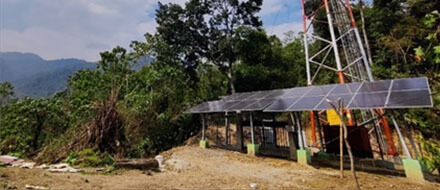
This optimisation ensured the efficient use of installed solar capacity. Airtel customised the solar capacity to meet the specific load requirements of each site, ensuring both scalability and cost-effectiveness. Custom solar module mounting structures were designed to fit the diverse shapes and plots of available space at network tower locations.
The results of this initiative have been exceptional. In FY 2023-24, Airtel successfully installed solar rooftop panels at 15,045 owned and third-party network sites, adding over 82 MWp of additional solar capacity and generating 1,497,939 kW of renewable energy. Additionally, rooftop solar plants have been established at 30 different locations in Airtel’s data centres and MSCs, producing 5,659 MWh of renewable energy. Through energy conservation measures (ECM), Airtel has also achieved diesel savings of 1,614 KL.
As of FY25 Q3, Airtel leads the country in the deployment of solar-powered mobility sites, with over 28,000 solarised network site locations. Airtel has been actively coordinating with State Electricity Regulatory Commissions (SERCs) in various states to adopt green energy open access (GEOA) policies and address operational challenges. As of March 2024, 12 states/UTs have adopted the new green energy open access regulations. A pilot project has been launched with the support of Indus Towers in Karnataka to utilise GEOA under the new regulations. These initiatives reduce Airtel’s reliance on conventional power sources and significantly cut down carbon emissions, highlighting Airtel’s unwavering commitment to sustainability and showcasing its leadership in the renewable energy sector.
