



Tuesday 8 September, 2026
Airtel aims to achieve the SBTi validated climate targets through energy-efficient initiatives such as setting up green data centers, adopting advanced technologies, and using renewable energy extensively. Energy efficiency is a core aspect of Airtel’s commitment to environmental conservation, decarbonising operations, and meeting stakeholder expectations. It also enhances the company’s reputation and ensures reliable services for customers. The expansion of 5G, with its low latency, high capacity, and fast connectivity, promises to be more energy-efficient than its predecessor.
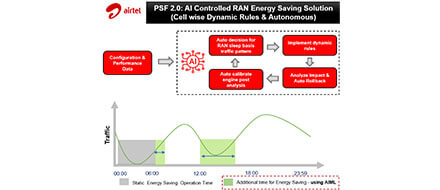
Energy costs account for about 29% of annual Network OPEX, with approximately 80% attributed to RAN network elements. Therefore, improving energy efficiency in the RAN is crucial, as even small improvements can lead to significant reductions in energy OPEX. Airtel has partnered with solution providers to develop an Artificial Intelligence and Machine Learning (AI/ML) energy-saving solution aimed at conserving energy by dynamically extending cell sleep windows during low-traffic periods.

In traditional networks, RAN Power Saving features (PSF) are deployed at Sites in static time windows which essentially limit the Energy saving opportunity. This solution leverages AI and machine learning algorithms to analyse cell-level traffic patterns using Performance data, identify optimal time windows for energy-saving, dynamically implement the energy saving measures, all while preserving the user experience.
Last year, Airtel collaborated with multiple solution providers to develop an AI-driven, vendor-agnostic solution that supports both 4G and 5G technologies. Extensive trials were conducted across diverse geographies, encompassing urban and rural markets as well as various spectrum scenarios. These trials played a crucial role in modeling potential savings and generating fair estimates for expected energy efficiency. Additionally, insights gained from these trials enabled the effective implementation of the solution across India
The solution has been recently rolled out across India, and initial results indicate its potential to unlock substantial RAN OPEX savings in the future. This marks a significant step towards achieving the Climate Mitigation Targets.
