


This year marked the first time the GSMA Climate Action team travelled to MWC Shanghai and the experience was nothing short of energising. Read on to discover:
- Climate action at MWC Shanghai
- Inside ZTE’s 5G Smart Factory
- Climate leadership takes the stage
- Accelerating China’s progress
- A circular opportunity for mobile
- What’s next for China?
Climate action at MWC Shanghai
Across the exhibition halls, stages and site visits, one message came through clearly: China’s mobile industry is accelerating towards net zero — and fast. From major emissions reductions to the future of circular devices, companies across the Greater China region are shifting gears and driving meaningful change.
We were there to launch something special — alongside our global State of the Industry on Climate Action report we launched our first Mobile Net Zero regional report focused on Greater China.

The findings are compelling. Operators are starting to bend the emissions curve, showing measurable progress in energy efficiency and renewable energy uptake. But beyond the data, what struck us most was the momentum. Climate ambition isn’t confined to the page — it’s visible in the leadership, the innovation, and the strategic choices being made today.
Inside ZTE’s 5G Smart Factory
During our visit to ZTE’s 5G Smart Factory in Nanjing, we saw first-hand the advancements being made, providing a compelling view of emerging tech developments.
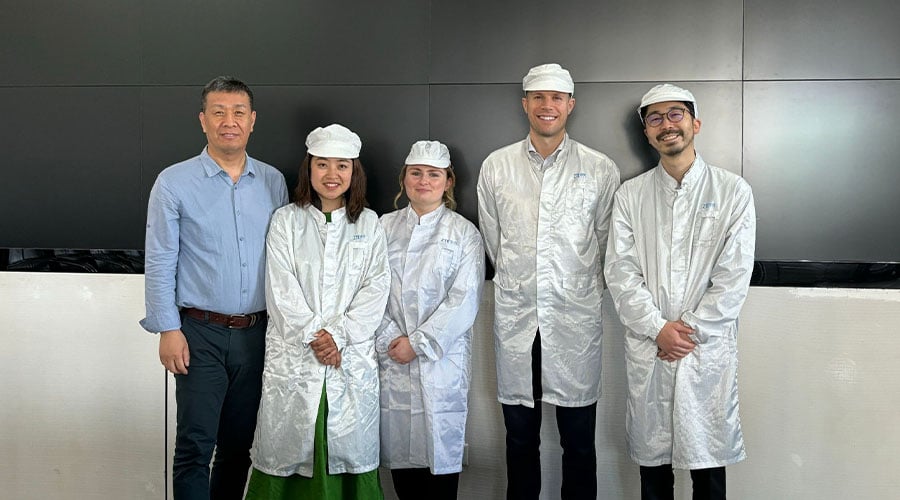
Robots glide along factory corridors, handling everything from logistics to intricate assembly tasks. Robotic arms, guided by AI-powered vision systems, carry out delicate procedures with astonishing precision. Thousands of sensors feed data into a central AI platform that monitors, adjusts, and continuously learns — keeping everything running smoothly. This is manufacturing at its most advanced. But also, increasingly, at its most sustainable.
The GSMA is working on several AI projects across the organisation. For more information on what we are up to and how you can get involved, please visit the GSMA AI page.
ZTE’s factory is powered by a growing share of on-site renewable energy, now covering 12% of its total energy use — the equivalent of 6% of ZTE’s total emissions. Since setting near term and net zero science-based targets (validated by SBTi in 2024), the company has made measurable reductions in its operational footprint, all while continuing to scale up innovation.
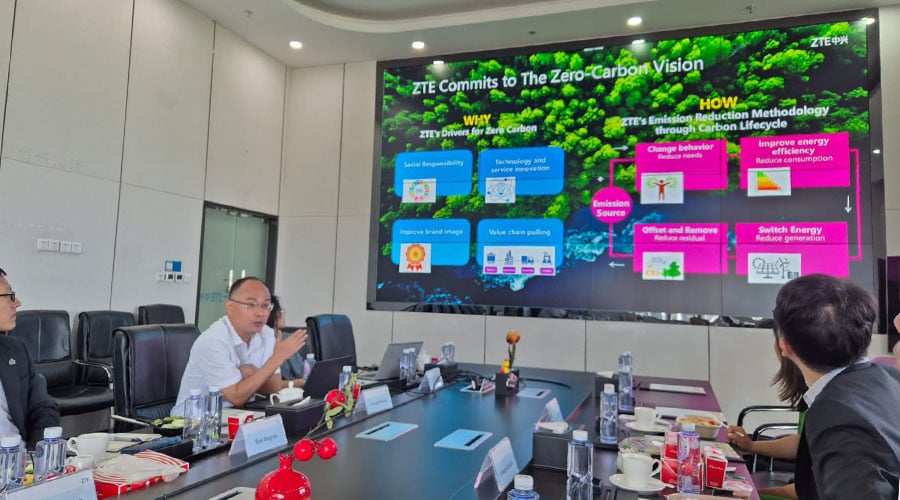
What’s driving this transformation? It’s not just technology. It’s leadership. More than half the staff at the factory are dedicated to research and development, rather than routine operations. That shift in focus — investing in innovation instead of traditional labour — is helping unlock big gains in both efficiency and impact.
Climate leadership takes the stage
Back at MWC, climate leadership was a recurring theme — not just as part of side conversations, but on the main stages and in boardrooms.
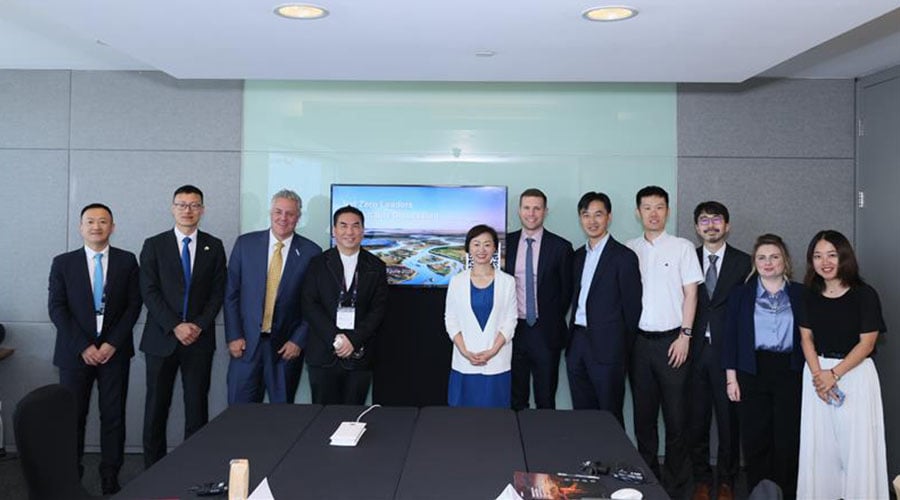
We brought together senior executives from China Telecom, China Unicom, Hutchison Telecom Hong Kong, ZTE, Huawei and HONOR for a Net Zero Leaders Roundtable, hosted by our Chief Regulatory Officer, John Giusti and Head of Climate Action, Steven Moore. These are companies responsible for hundreds of millions of mobile connections — and their decisions have major implications for the climate transition across Asia.
Are you ready supercharge your climate action journey? Join 77 mobile operators representing more than 80% of global mobile connections in the GSMA’s Climate Action Task Force.
The message from leaders was clear: net zero is no longer a distant ambition — it’s a strategic priority. There was real appetite to share best practices, align on action, and strengthen the relationships needed to move forward together.
Accelerating China’s progress
To explore this further, we hosted our first Climate and Sustainability Summit in China, hearing directly from operators, finance experts and device manufacturers about what’s working — and what still needs to change.
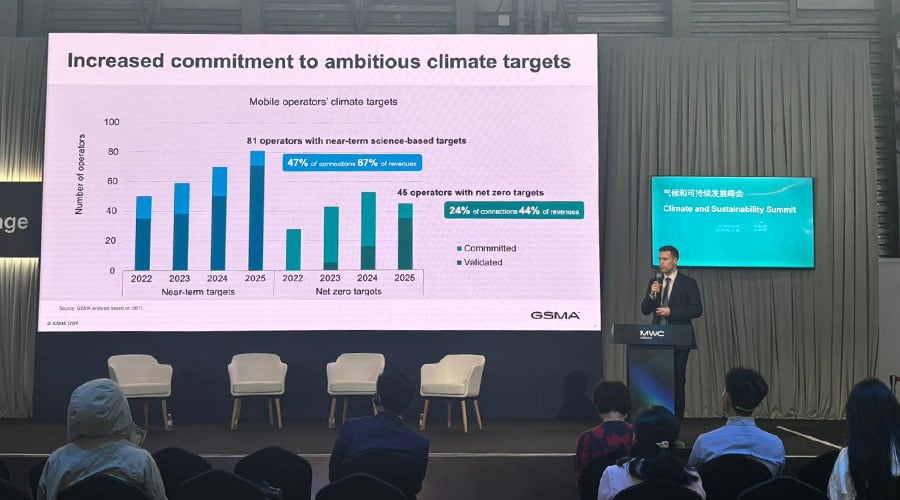
From Ying Shi, Director at China Telecom, we learned how green data centres and targeted network upgrades are already cutting energy use and emissions — including a 10% reduction in Scope 1 and 2 emissions in just one year. More than a million kilowatt-hours have been saved at data centres alone.
At the same time, financial institutions are watching closely. As Li Tao, EGS Ratings Director from Sina Finance explained, companies with strong ESG performance — like China Telecom — enjoy greater transparency, investor confidence, and ultimately, better access to capital to fund the transition to net zero.
Liu Ziyi from Climate Bridge China shared the latest data showing the rapid growth in renewable energy in China. However, only a fraction of the 3.4 billion ‘green certificates’ issued by China’s Energy Bureau have been traded — a signal that stronger incentives and policy frameworks could unlock even more private-sector demand.
A circular opportunity for mobile
One of the most forward-looking discussions we hosted focused on the circular economy — and the untapped commercial potential in second-hand mobile phones and repair services.
According to GSMA research, the global market for circular devices and services could soon reach $150 billion annually — yet many phones still end up in drawers or landfill, rather than being refurbished, reused or recycled.

In a fireside chat with George Kamiya our Director of Climate Insights, Irene Zhang, Director of Public Affairs at HONOR shared how they’re turning circularity into competitive advantage. The company has committed to carbon neutrality targets for 2040 (operations) and 2050 (value chain) and is embedding sustainability across hardware and software.
Interested in learning more? You can discover the business case for why and the mobile industry can – and should – move towards circularity in our recent report.
Their latest devices now include 23 components made from recycled or bio-based materials, and AI tools help optimise battery life and performance in different environments. Inspired by new European regulations and customer demand, HONOR has committed to seven years of software updates for its flagship Magic series. They are also collaborating with operators to expand their refurbished phone programme. All major steps toward increasing device longevity and reducing waste.
What’s next for China?
The momentum we witnessed in Shanghai was real but we know that acceleration can’t be taken for granted.
To keep moving forward:
- Senior leadership must continue to drive climate ambition from the top.
- Collaboration must deepen between manufacturers, operators, investors, and regulators.
- And we need to keep asking big questions — like how AI is reshaping energy use across the telecoms sector, and how we can steer that innovation in a sustainable direction.

As one leader put it, “Net zero isn’t an isolated mission — it’s a mission for the whole value chain.”
That’s why we’re here. To connect those voices, share those insights, and make sure that as digital transformation advances, so does climate action. China is accelerating. Let’s keep the momentum going.
