



What do refurbished phones, AI energy demand, power for towers, and resilient networks have in common? At first glance, not much. Walking through the halls at MWC Barcelona 2026, it wasn’t immediately obvious either. AI dominated the stands, much like sustainability did a few years ago.
But after a week of attending sessions and conversations with leaders across the ecosystem, a clear pattern emerged. The mobile industry is undergoing a quiet but significant shift. The focus is no longer just on faster speeds, new devices, or the next generation of connectivity.
Instead, the sector is grappling with deeper structural questions:
- – How do we build trust in the used device market?
- – What does the energy transition mean for tower infrastructure?
- – How do we power AI, and do it responsibly?
- – And how do we ensure networks remain resilient in an unpredictable world?
These are no longer side conversations. They’re the 2026 telecom industry trends shaping the future of mobile.
The Circular Economy Is No Longer Niche
Refurbished phones were once viewed as a budget alternative – an afterthought in the device market. That perception is rapidly changing.
Why refurbished phone sales are surging
Consumers are holding on to devices for longer, now averaging 3.5 years up from around two years a decade ago. At the same time younger consumers are placing greater emphasis on environmental impact. The result is steady growth in refurbished device sales (5-10% annually) contrasting with flat or even declining projections for new handset sales over the next five years.
Sessions at MWC Barcelona 2026 like ‘Would you buy a used phone? How to build consumer confidence in refurbished devices’, ‘Closing the Confidence Gap: The Hidden Friction Slowing Mobile Growth’ and ‘Could industry guidance on labelling boost consumer confidence in refurbished phones?’ highlighted a critical barrier: trust.
Consumers want clarity. What does “refurbished” actually mean?
- – Is the battery new?
- – Has it been properly tested?
- – Does it come with a warranty?
The confidence gap holding back faster growth
While half of consumers express interest in refurbished devices, only a fraction follow through with a purchase. Closing this confidence gap is key to unlocking further growth. The GSMA continued work on this issue by convening a high-level roundtable with players from across the device supply chain.
At the GSMA pavilion, the opportunity was bought to life by Recommerce, whose platform can instantly scan and evaluate your phone, and provide a real-time trade-in value based on the condition it’s in.
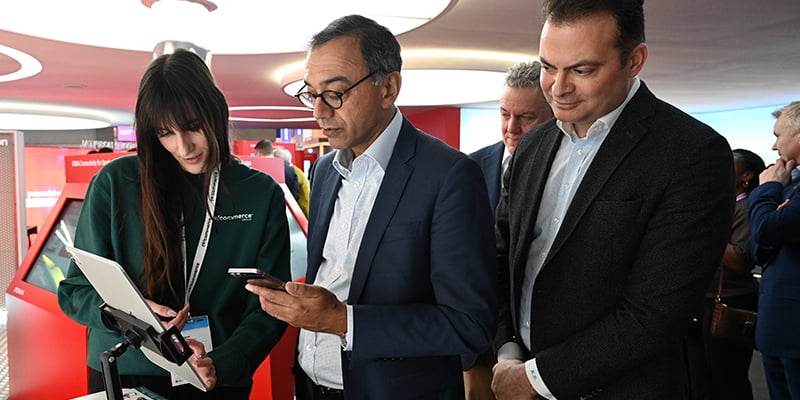
The takeaway is clear: with the right approach, transparency, and user experience, circular models can scale – improving affordability, reducing e-waste, and creating new revenue streams. The circular economy isn’t a niche sustainability play; it is becoming core business strategy.
AI’s Energy Appetite: Opportunity Meets Responsibility
Now let’s talk about the elephant in the data centre: AI’s energy consumption. AI is transforming the telecoms landscape – from network optimisation to customer service – but it comes with a rapidly growing energy footprint.
Balancing AI growth with sustainability
This tension was front and centre in the “AI’s Energy Bill” session at Ministerial Programme, an invite-only space for policymakers and regulators at the heart of MWC. During this session, Thomas Spencer, lead author of the IEA’s landmark Energy and AI report, shared key findings from the agency’s latest research, which highlighted the scale of the challenge.
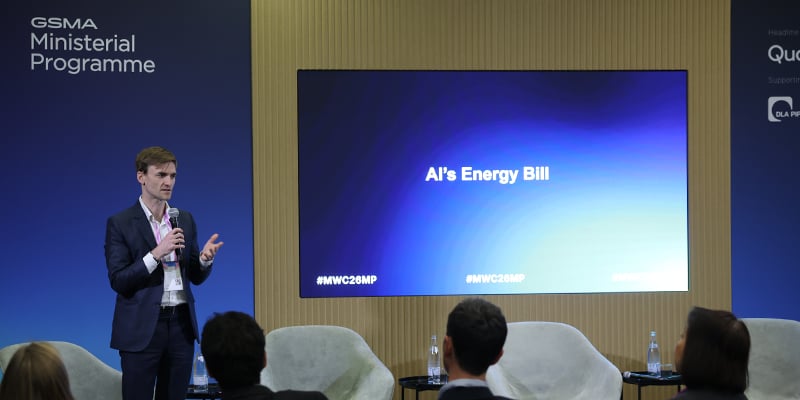
The scale of AI energy consumption
AI promises efficiency and automation, but the infrastructure required to power it is immense – and often located in already energy-constrained urban areas.
Consider the scale:
– Today’s hyperscale data centres can consume as much energy as 100,000 households
– Future AI-focused facilities could exceed the equivalent of one million homes, with some announced projects approaching five million.
Even at a smaller scale, the intensity is striking: a single AI data centre rack – roughly the size of a large fridge – can consume as much energy as 200 household ovens on full blast.
The challenge is clear: how can the industry harness AI while keeping energy consumption under control? The answer lies in balance: combining smarter networks, greener infrastructure, and AI-enabled optimisation.
Can AI help to solve its own energy problem?
Operators are already using AI to dynamically power down parts of mobile networks during low traffic hours, reducing energy use without compromising service quality. In this sense, technology is beginning to solve the very challenges it creates.
From the GSMA side, we have been investigating this issue, looking at the possible impact on telecommunication energy use, both positive and negative. Check out our report when it’s published next month.
Hear about our latest insights and publications by subscribing to the External Affairs newsletter.
Tower Infrastructure: From Cost Centre to Energy Asset
As energy becomes a strategic priority, tower companies are emerging as key players in the transition. Increasingly they are not just hosting equipment, they are managing power through grid resilience, solarisation, and energy-as-a-service. But why do energy efficiency and clean energy investments stall and what would accelerate them?
Real-world examples of sustainable tower innovation
Discussions at the Tower Summit explored how different ownership models from landlord-tenant to energy-as-a-service to full outsourcing lead to different incentives and therefore need different approaches.
Real world examples showed what’s possible:
- – American Tower has deployed solar power and lithium-ion battery systems across thousands of sites in Africa, reducing reliance on diesel generators and improving energy resilience in areas with unreliable grid electricity.
- – Cellnex is piloting the integration of tower batteries with energy-management platforms. These systems can store electricity when renewable generation is high and release it when the grid is under pressure, helping stabilise electricity networks while also earning revenue through grid services.
Solving the energy trilemma
The approaches address the energy “trilemma”: reducing carbon emissions, improving resilience, and maintaining cost efficiency. In some cases, they even unlock new revenue streams through grid-balancing services.
Telecom towers are evolving into distributed energy assets – an important, and often overlooked, component of future energy systems.
If you’re interested in learning more about the future of energy grids and how these ‘virtual power plants’ work, check out our Smart Energy Systems report.
From Climate Commitments to Measurable Business Impact
Climate discussions in telecoms have traditionally focused on commitments and long-term targets. That is changing. The conversation is shifting from ambition to execution – from targets to measurable business impact.
One MWC session posed a simple but powerful question: “How Green Is Your Bottom Line?” It reflects a broader shift: sustainability is no longer solely an environmental concern – telecom sustainability initiatives are delivering strong ROI.
Why sustainability is now a financial metric
Energy costs, supply chains, infrastructure efficiency, and customer expectations are converging. Companies that act decisively are seeing tangible benefits.
For example Telefónica has:
- – saved €2.2 billion from energy-efficiency projects since 2010
- – raised roughly €18.8 billion in sustainable and green financing
- – generated €782 million in eco-service revenues in 2024
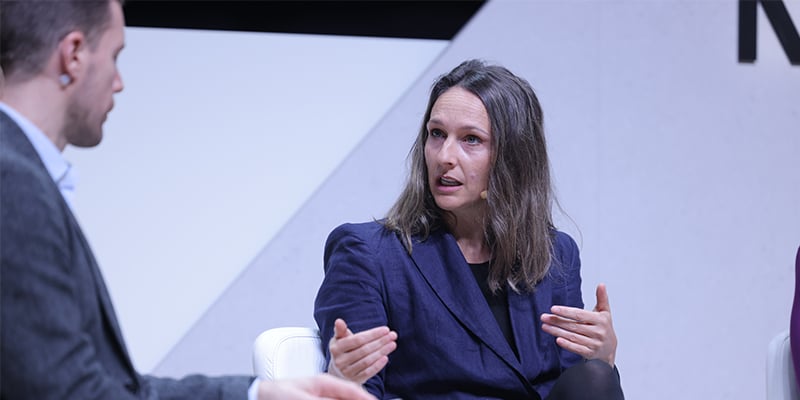
We’re seeing this approach in company Climate Transition Plans as climate action is moving from strategy slides to operational reality – and increasingly, into financial performance.
Building Resilient Networks
Resilience has moved firmly up the agenda. In a world shaped by extreme weather, geopolitical uncertainty, and rising digital dependence, connectivity is critical infrastructure. Networks must not only perform – they must endure.
The MWC discussion “Intelligent Resilience: Building Networks That Endure” explored how operators can strengthen networks to handle everything from climate events to traffic surges.
Operators are investing in smarter automation tools that allow networks to anticipate congestion or outages and respond automatically, maintaining service while minimising disruption.
Real-world resilience in action
Examples from across the industry illustrate this shift:
- – SK Telecom in South Korea is using AI to detect anomalies, predict service degradation, and automatically optimise network resources in response to demand.
- – TMobile in the United States has deployed portable “Cells on Wheels” and satellite-connected emergency coverage units that can be rapidly deployed when hurricanes or wildfires damage fixed infrastructure.
Resilience is no longer just about redundancy. It’s about intelligent networks that anticipate issues, adapt in real time, and recover quickly. Because when connectivity fails, everything else follows.
The Bigger Picture: The Future of Mobile
What struck me most reflecting on MWC Barcelona 2026 is how interconnected all these themes are – circular economy, AI efficiency, climate action, and network resilience.
Individually, these are complex challenges. Together, they form a roadmap for the net zero transition of the mobile industry. It will be built from the cumulative progress I witnessed at this year’s MWC Barcelona: circular markets gaining trust, AI infrastructure being held to account, tower assets earning their place in the energy system, and networks being designed to endure.
And that may be the most important takeaway from MWC Barcelona 2026: the future of the mobile industry will not be defined by a single breakthrough technology, but by how the industry brings together innovation, sustainability, and resilience to deliver long-term value.